


Quick Summary
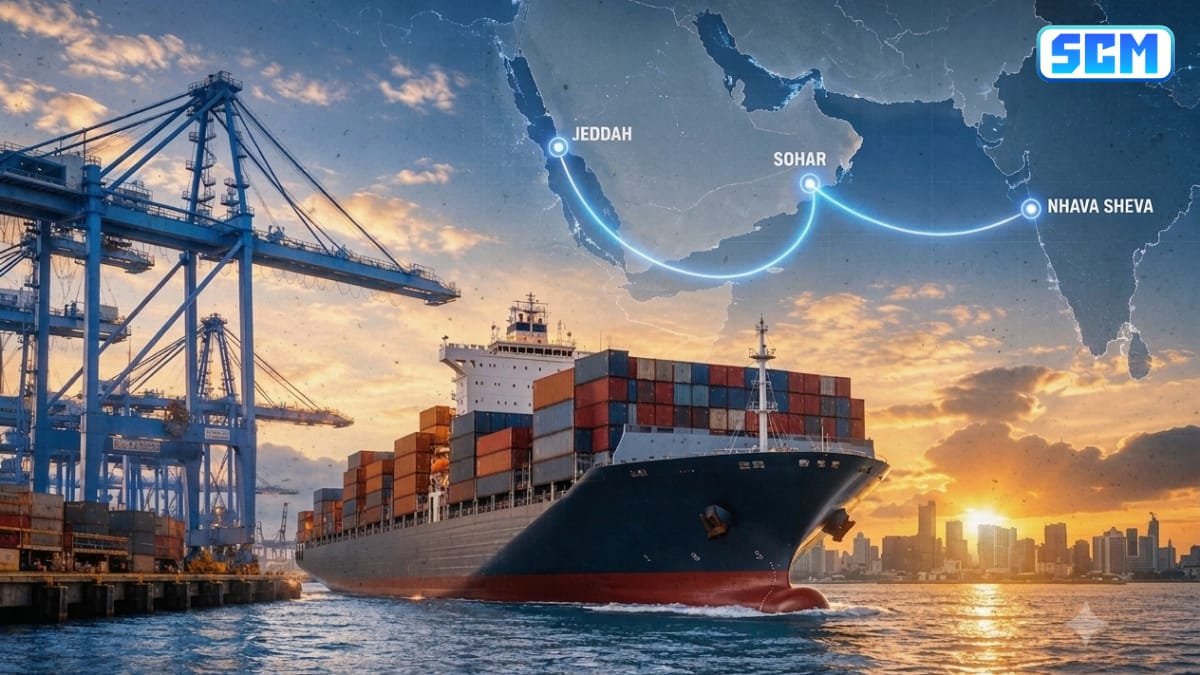
Italian shipping company Ignazio Messina & C. has announced the launch of its Red Sea Express Line — a new dedicated container service linking the Indian Ocean and the Red Sea, set to launch its inaugural sailing from Nhava Sheva (Jawaharlal Nehru Port), India on August 27, 2026. The service will operate on a fixed rotation covering Nhava Sheva (India), Sohar (Oman), and Jeddah (Saudi Arabia) before returning to Nhava Sheva, with a sailing frequency of one departure every 20 days. The dedicated vessel for this service is the m/v Berham Box — a container ship assigned exclusively to the Red Sea Express route. The new line runs alongside Messina’s existing Jolly Line on the Indian Ocean–Red Sea corridor, adding capacity and frequency to one of the most strategically critical maritime trade lanes in the world right now. For Indian importers and exporters — particularly those trading with Saudi Arabia and the Gulf — the timing and routing of this service deserves close attention.
Why Messina Is Expanding Into This Corridor — Right Now
The Indian Ocean–Red Sea corridor has been one of the most disrupted and simultaneously most strategically important shipping lanes in the world since late 2023. Houthi attacks on commercial vessels forced most major carriers to reroute around the Cape of Good Hope from early 2024, adding significant time and cost to Asia-Europe and India-Middle East shipping. While some carriers — including Maersk and CMA CGM — have begun cautious, stepwise returns to Red Sea transits as the security situation has partially stabilised, the corridor remains operationally complex and commercially significant.
Messina’s decision to launch a new dedicated express service specifically on the Indian Ocean–Red Sea sector — rather than waiting for full normalisation — reflects a specific commercial logic: demand for cargo movement between India, Oman, and Saudi Arabia has not disappeared during the disruption. If anything, the rerouting of larger vessels has created gaps in direct India–Red Sea service frequency that specialist operators can fill.
The 20-day frequency of the Red Sea Express Line is not designed to compete with the mainline weekly services that the largest carriers offer in normal conditions. It is designed to provide reliable, dedicated capacity on a specific corridor where reliability has been the scarcest commodity over the past two years — and where shippers with regular cargo between Nhava Sheva, Sohar, and Jeddah need a predictable schedule they can plan around.
The Route in Detail — What the Nhava Sheva–Sohar–Jeddah Rotation Covers
The three-port rotation of the Red Sea Express Line is worth examining specifically because each port represents a distinct trade purpose.
Nhava Sheva (Jawaharlal Nehru Port, India) is India’s largest container port, handling approximately 55-60% of India’s containerised trade. It is the primary gateway for cargo moving from the Mumbai metropolitan region and western India — including significant volumes of engineering goods, chemicals, pharmaceuticals, textiles, and agricultural products destined for the Gulf and Middle East markets. Nhava Sheva as the origin/return port makes the Red Sea Express Line directly accessible to India’s largest export and import base.
Sohar (Oman) is a rapidly growing industrial and logistics hub on the Gulf of Oman — outside the Strait of Hormuz. Sohar Port and Freezone has been actively developing as an alternative routing point for cargo that would previously have transited through Jebel Ali, and its Hormuz-free position makes it particularly valuable in the current geopolitical environment. Messina’s inclusion of Sohar in the rotation connects the Red Sea Express directly to this emerging hub.
Jeddah (Saudi Arabia) is the Red Sea’s dominant container hub and the primary gateway for cargo entering Saudi Arabia’s western region — including the Makkah and Madinah areas, as well as connections northward to Jordan and Egypt through overland links. For Indian exporters selling into Saudi Arabia — the largest Gulf economy and one of India’s top trading partners — a direct Nhava Sheva–Jeddah connection is commercially significant.
The rotation then returns to Nhava Sheva, completing a circular service that serves both import and export flows on the India–Gulf corridor in a single loop.
The m/v Berham Box — Why a Dedicated Vessel Matters
Messina’s decision to assign the m/v Berham Box exclusively to the Red Sea Express Line is operationally significant and worth explaining.
In container shipping, services run with dedicated vessels — where a specific ship is assigned solely to one service rotation — offer more reliable scheduling than services that share vessels across multiple routes. When a vessel is shared across services, delays on one leg can cascade into schedule disruptions on others. A dedicated vessel means the Red Sea Express schedule is insulated from disruptions on Messina’s other services.
For shippers with regular cargo on the Nhava Sheva–Sohar–Jeddah corridor, this is a practical reliability advantage: the Berham Box departure on August 27 establishes a predictable 20-day cycle that shippers can plan their supply chains around.
Messina Line operates a fleet of around 21 ships with over 40,000 TEU of total capacity, and specialises in connecting the Mediterranean, Africa, the Middle East, and India — making the Indian Ocean–Red Sea corridor a natural extension of its core operating geography. MSC holds a 49% minority stake in Messina, which provides additional commercial and operational backing for the new service.
What This Means for Indian Importers and Exporters
For Indian businesses trading with Saudi Arabia, Oman, and the broader Gulf region, the Red Sea Express Line offers a specific new routing option from Nhava Sheva starting August 27.
The practical implications depend on cargo type and trading relationship:
Indian exporters to Saudi Arabia — particularly those in sectors like food products, engineering goods, pharmaceuticals, and textiles — gain a new direct service option to Jeddah that bypasses the Strait of Hormuz entirely on the India–Sohar leg before entering the Red Sea at Jeddah. For exporters currently routing through Jebel Ali and facing Hormuz-related uncertainty, this is a meaningful alternative.
Indian importers from the Gulf — particularly those sourcing petrochemicals, fertilisers, and industrial raw materials from Saudi Arabia and Oman — gain a return leg from Jeddah and Sohar to Nhava Sheva that can be planned on a predictable 20-day cycle.
Freight forwarders handling India–Gulf cargo should note the August 27 inaugural departure from Nhava Sheva as the first booking opportunity on the Red Sea Express schedule. Cargo bookings for the inaugural sailing would need to be in place well ahead of that date — freight forwarders with clients shipping on the Nhava Sheva–Sohar–Jeddah corridor should engage with Messina Line’s India agents now to confirm availability and booking procedures.
The Broader Context — Carriers Are Betting on Red Sea Recovery
Messina’s Red Sea Express launch is part of a broader pattern of shipping lines making new or expanded commitments to Indian Ocean–Red Sea trade lanes in mid-2026, as the security situation in the Red Sea shows signs of gradual stabilisation compared to the peak disruption period of 2024 and early 2025.
This connects directly to the situation we covered in detail regarding DP World’s Fujairah terminal development — where the UAE is simultaneously building Hormuz-bypass capacity as insurance while carriers like Messina are rebuilding Red Sea service capacity as the corridor gradually reopens. These are complementary strategies for managing the same underlying risk: geopolitical uncertainty on the world’s most commercially critical maritime chokepoints.
For Indian exporters and freight forwarders who experienced significant disruption to Gulf and Middle East shipments over the past two years — including the emergency customs procedures that CBIC’s Circular 09/2026 had to address for cargo returning due to Hormuz disruption — the gradual return of direct Indian Ocean–Red Sea services represents a meaningful improvement in routing options, even if full normalisation of the corridor is still some way off.
Bottom Line
Ignazio Messina’s Red Sea Express Line, launching from Nhava Sheva on August 27, is a targeted and commercially well-timed response to a specific gap in India–Gulf service frequency on the Indian Ocean–Red Sea corridor. The Nhava Sheva–Sohar–Jeddah rotation, served by a dedicated vessel on a 20-day cycle, gives Indian importers and exporters trading with Oman and Saudi Arabia a new predictable direct option at a moment when routing reliability on this corridor remains scarce. For freight forwarders and logistics operators handling India–Gulf cargo, the August 27 inaugural sailing is the date to watch — and bookings need to happen now.
Handling cargo on the India–Gulf corridor? Share your current routing experience — we are tracking how direct service options are recovering on the Indian Ocean–Red Sea trade lane.
