


India and New Zealand ratified their Free Trade Agreement on September 21. It comes into force on October 20, Dussehra.
That timing is deliberate. Commerce Minister Piyush Goyal announced the implementation date at a virtual event with New Zealand Trade Minister Todd McClay, and the choice of Dussehra, the festival of victory, was not accidental.
What makes this FTA stand out from most India has signed is one specific commitment: New Zealand is giving India duty-free access on 100% of its exports from day one. No phased reduction. No exclusion lists for politically sensitive products. All tariff lines. Zero duty. October 20.
How Fast Was This Deal Done
Nine months. That is how long negotiations took from start to finish.
That is fast by any standard. India and the EU spent more than a decade on an FTA before concluding it this year. The India-UK deal took years of negotiation. The India-New Zealand agreement went from formal launch in March 2026 to signing in April 2026 to ratification and implementation date announcement in September.
PM Modi’s visit to New Zealand in July 2026, the first by an Indian Prime Minister in four decades, gave the deal political momentum that clearly accelerated the timeline. New Zealand PM Christopher Luxon had committed publicly three years ago to securing an FTA with India within his first term if elected. He followed through.
What Indian Exporters Get
Before this FTA, New Zealand maintained peak tariffs of up to 10% on several Indian product categories including ceramics, carpets, automobiles and auto components.
Those go to zero on October 20.
The sectors that gain the most immediate benefit include textiles and apparel, leather and footwear, engineering goods, pharmaceuticals, automobiles and auto components, processed foods, gems and jewellery, chemicals, and handicrafts.
India’s exports to New Zealand stood at $566.51 million in FY2025-26. That’s a relatively modest number. But it’s also a baseline that was constrained by tariff barriers that no longer exist after October 20.
There is also a specific FDI commitment in this agreement. New Zealand has committed to facilitating $20 billion in investments into India over fifteen years. This is only the second India FTA to include a specific foreign investment commitment, after the EFTA deal which had a $100 billion commitment from Switzerland, Norway, Iceland and Liechtenstein.
What New Zealand Gets
The deal is not one-sided.
New Zealand’s priority exports to India include dairy products, wool, forestry, agrichemicals, and tourism services. India has agreed to eliminate or reduce tariffs on several of these categories, though the specific schedules have not been fully detailed in public announcements.
New Zealand also gains improved market access for services, and the agreement includes a dedicated employment pathway for Indian professionals and expanded post-study work opportunities for Indian students in New Zealand. Given the size of India’s diaspora and student community in New Zealand, that component has real practical value for bilateral people-to-people connections.
New Zealand’s PM Luxon put the economic expectation plainly: “It is exciting to think of how many businesses will grow as a result of this FTA, and then consider what that means for them, for the people who work for them, and for the country as a whole.”
The Numbers Behind the Relationship
Bilateral trade in goods and services between India and New Zealand stood at $2.4 billion in 2024. Merchandise trade actually declined about 11% to $1.15 billion in FY2025-26, from $1.3 billion the previous year.
The two sides have set an aspirational target of doubling bilateral trade to approximately Rs 35,000 crore in the coming years.
That target is ambitious given the starting point. But the removal of all tariff barriers on Indian exports removes the single biggest structural constraint on that growth. Whether Indian exporters can actually convert zero-duty access into meaningful volume expansion depends on their ability to compete in the New Zealand market on quality, pricing, and logistics.
New Zealand is also positioned by both governments as a gateway to wider Oceania and Pacific Island markets. That framing is important for Indian exporters thinking about where New Zealand fits in their export strategy. It’s not just a bilateral market of 5 million people. It’s a potential entry point into a broader Pacific trade ecosystem.
What This Means for Supply Chains and Logistics
For freight forwarders and logistics operators handling India-New Zealand cargo, October 20 is a date worth marking.
Zero tariff barriers typically translate to increased trade volumes over time, though the ramp-up is rarely immediate. Indian exporters who were previously priced out of the New Zealand market by tariff costs will begin evaluating whether they can now compete. That process takes months. But it starts on October 20.
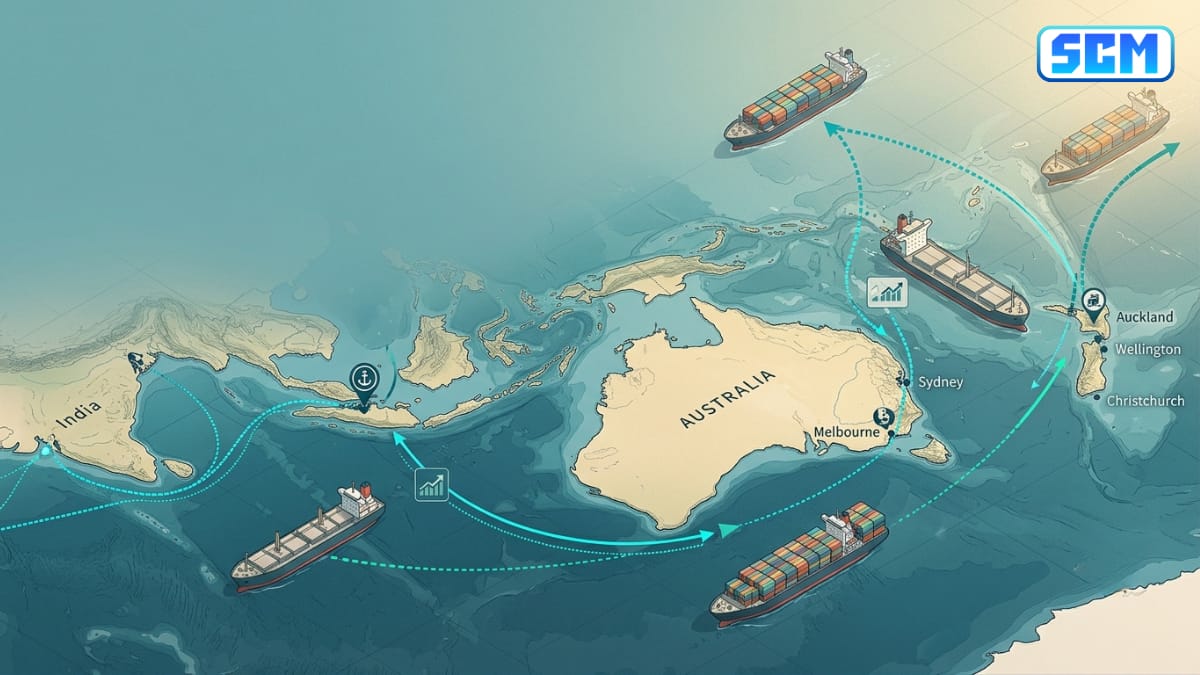
The sea freight corridor between India and New Zealand runs primarily through Australian hub ports. Most cargo moves on container services that call at Indian ports, then transit through Melbourne, Sydney, or Brisbane before reaching Auckland, Wellington, or Christchurch. With increased India-New Zealand trade volumes expected, that routing will come under greater demand.
For MSME exporters in particular, zero-duty access removes a barrier that was previously too costly to overcome. A small textile or gems exporter who calculated that 10% New Zealand tariffs made the market unviable will now recalculate. How many of them do, and how quickly, will determine whether the bilateral trade target is achievable.
Bottom Line
The India-New Zealand FTA is live from October 20. It is one of India’s cleanest trade deals on the export side. 100% duty-free access from day one, across all tariff lines, with no phased schedule. For Indian exporters in textiles, engineering, pharma, food processing and autos, the New Zealand market just became structurally more accessible than it has ever been.
The numbers will take time to reflect the agreement. Trade flows don’t flip overnight. But the framework is now in place, and October 20 is the starting line.
Sources: Ministry of Commerce and Industry, Piyush Goyal statement, New Zealand PM Christopher Luxon statement, New Zealand Trade Minister Todd McClay statement, Tribune India, Upstox, INVC News.
