


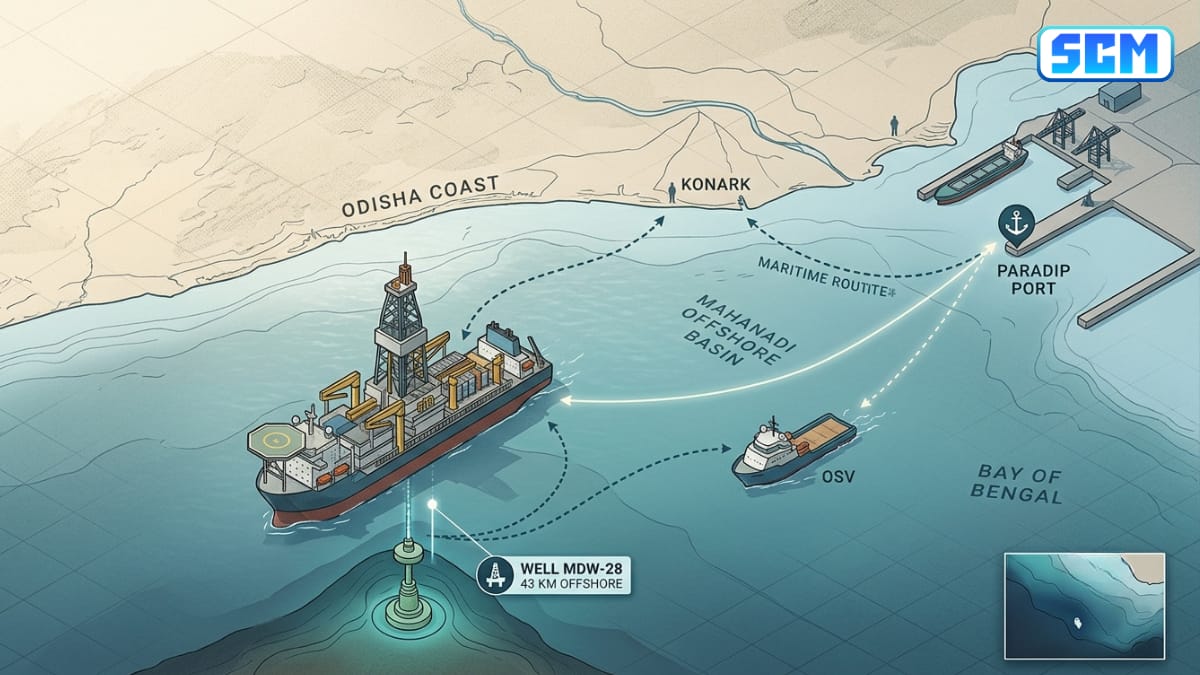
On September 18, ONGC made its first deepwater gas discovery in the Mahanadi Offshore Basin, off the Odisha coast. The well, known as MN-DW18-1-H-D or MDW-28, was drilled to a target depth of 1,623 metres. Gas was encountered between the 1,441 and 1,452 metre intervals.
Three days on from the discovery, the well is still flowing gas at what ONGC describes as an encouraging rate, with healthy reservoir pressure maintained throughout.
This is the first well ONGC has drilled in the Mahanadi Basin under its current exploration campaign. And it worked.
Why the Location Matters
The well is approximately 43 km off the coast of Konark in Odisha. That’s relatively close for a deepwater discovery.
Most deepwater gas fields in India have been in the Krishna-Godavari basin, far off the Andhra Pradesh coast, where development has required complex subsea infrastructure over long distances. The Mahanadi discovery’s proximity to shore changes the development economics if the reservoir proves commercially viable.
ONGC has specifically noted that this coastal proximity could support early monetisation, and has flagged the potential to develop this find alongside other nearby discoveries using shared infrastructure. The Mahanadi Offshore Basin already has two earlier ONGC discoveries, Utkal and Konark, which established that gas-bearing structures exist in the area. MDW-28 adds a new data point confirming that hydrocarbons extend across additional prospects.
For Odisha, a state that we covered recently in the context of Adani’s proposed Rs 1 trillion AI data centre, a domestic gas production hub off its coast would be a significant addition to its energy and industrial infrastructure story.
What Is Samudra Manthan
The discovery comes under ONGC’s flagship deepwater exploration programme called Samudra Manthan, literally meaning “churning of the ocean.”
The programme was spudded on July 25, 2026, when Petroleum Minister Hardeep Singh Puri flagged off the drilling of this first well. The broader Samudra Manthan plan involves drilling 87 deepwater and ultra-deepwater wells by FY2031, at a total investment of Rs 1 lakh crore over five years.
The Mahanadi Basin MDW-28 discovery is therefore milestone number one. ONGC management visited the drillship after the discovery on August 27, and the sequential flow of gas since September 18 gives the programme its first tangible validation.
India currently imports a significant share of its natural gas requirements. The government’s broader push through Samudra Manthan is to raise domestic production from offshore fields and reduce that import dependence. Every successful exploration well, particularly in a basin not previously producing at scale, advances that goal.
What Happens Next
A gas strike is not the same as a commercial discovery. ONGC has been clear that further appraisal and commercial evaluation are required before any production decision is made.
The next steps typically involve appraisal wells to define the extent of the reservoir, reservoir modelling to estimate recoverable volumes, and a commercial evaluation of development costs against expected production rates and gas prices.
Given the proximity to coast, the development planning process may be faster here than at more remote deepwater locations. But even in a best case, it will be years from this discovery to first gas production.
What the MDW-28 discovery does right now is two things. It validates ONGC’s exploration thesis in the Mahanadi Basin. And it strengthens the case for continued investment in Samudra Manthan’s wider 87-well drilling programme.
Supply Chain and Logistics Implications
For the logistics and supply chain sector, a developing deepwater gas field off Odisha has some specific downstream implications worth noting.
Deepwater drilling and development operations require sophisticated supply chain support. Drillships and offshore support vessels need regular resupply of drilling consumables, equipment, and crew. The nearest major port to the discovery location is Paradip, Odisha’s deep-draft port. As Samudra Manthan scales up to more wells, the offshore logistics activity through Paradip and the broader Odisha coast will increase.
If the Mahanadi discovery leads to production infrastructure, the construction phase would involve subsea pipelines, platform or floating production units, and onshore receiving terminals. Each of these requires complex procurement and logistics supply chains.
For now, those are future considerations. But the discovery puts them on the planning horizon.
Bottom Line
ONGC’s MDW-28 gas strike in the Mahanadi Offshore Basin is a genuine exploration success. The first well of the Samudra Manthan campaign found gas. It’s flowing. The reservoir pressure is holding. And the location, 43 km off Konark, is close enough to shore to make development economics more tractable than most deepwater finds.
Whether it becomes a commercial gas field depends on appraisal work still to come. But as exploration milestones go, starting a Rs 1 lakh crore, 87-well programme with a discovery on the very first well is a strong beginning.
Sources: ONGC press release, Business Standard, Indian Masterminds, Indian PSU, Whalesbook Corporate News.
