


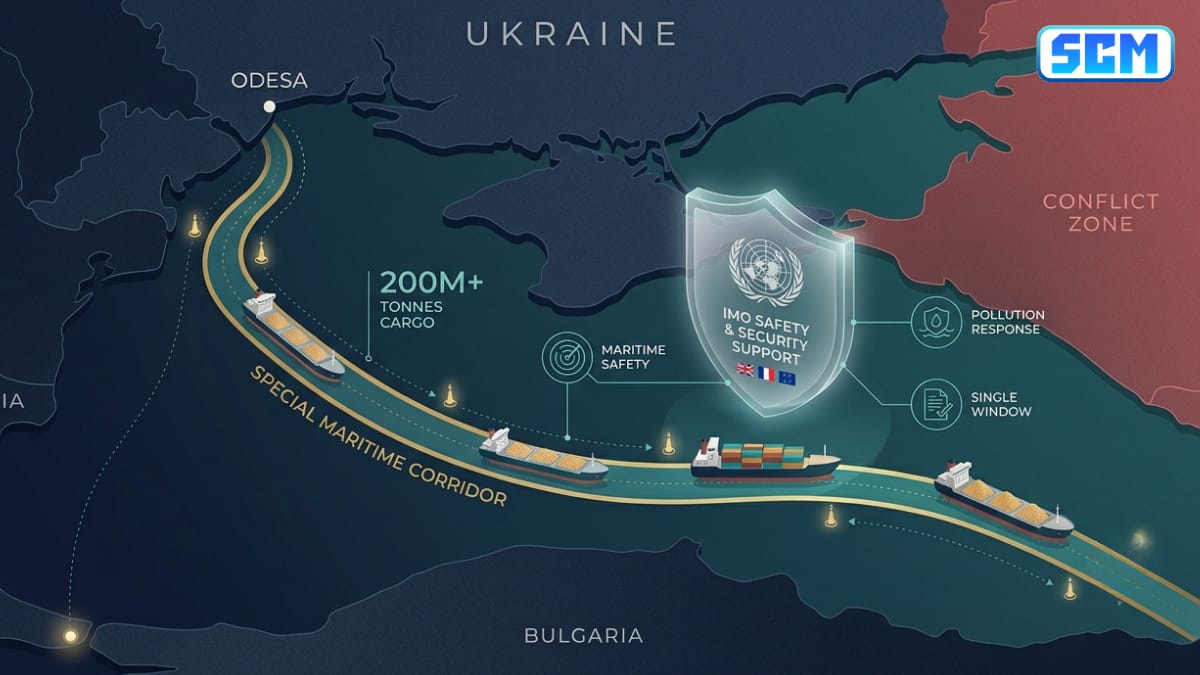
While the world’s attention has been on the Strait of Hormuz and the Bab el-Mandeb, Ukraine has quietly been running one of the more remarkable logistics operations of the past two years.
Since Ukraine established its Special Maritime Corridor in the Black Sea in August 2023, approximately 200 million tonnes of cargo have moved through it. That includes nearly 120 million tonnes of agricultural products. Ukrainian grain, sunflower oil, and food commodities have continued reaching global markets despite an active war on Ukraine’s territory.
Now the International Maritime Organization is stepping in with a formal programme to help Ukraine do this better and more safely.
What Just Happened in Lviv
From September 8 to 10, an inception workshop in Lviv launched a new IMO technical assistance project specifically focused on the Black Sea corridor.
The project is funded by the United Kingdom, France, and the European Union. Its full name is “Enhancing Maritime Safety, Security, Environmental Protection and Trade Facilitation as Ukraine continues to operate the Special Maritime Corridor in the Black Sea.”
The workshop brought together representatives from Ukrainian ministries, public authorities, and state-owned entities across the maritime and inland waterway sectors, alongside IMO experts and consultants.
Dr. José Matejkal, Director of IMO’s Technical Cooperation and Implementation Department, coordinated the event from the IMO side.
The Ukrainian Shipping Administration described the significance clearly: “For Ukraine, this is not just an exchange of experience. It is an opportunity to work directly with international experts on specific solutions that strengthen the capacity of the maritime sector today and create the basis for its recovery.”
What the Project Actually Covers
Three areas of work were discussed during the Lviv workshop.
First, assessing Ukraine’s needs for restoring critical maritime infrastructure and identifying where international support can make the biggest difference. Russia’s systematic attacks on Ukrainian port infrastructure have destroyed grain terminals, oil depots, elevators, ship repair plants, and hydraulic structures. Getting a clear picture of what needs rebuilding is the foundation for any recovery plan.
Second, strengthening Ukraine’s marine pollution response system. A war-damaged maritime environment creates real pollution risks. The project includes training Ukrainian specialists in responding to oil spills and developing a National Action Plan for Marine Environmental Protection.
Third, implementing the Maritime Single Window system. This is a digital platform that consolidates all maritime administrative procedures into one interface, reducing paperwork and speeding up vessel clearance. For a country trying to keep exports moving through a corridor in an active conflict zone, administrative efficiency matters.
The programme also includes IMO experts being physically present in Ukraine, which goes beyond typical technical assistance arrangements. The agreement was reached at Ukraine’s bilateral meeting with IMO Secretary General Arsenio Dominguez during the 34th IMO Assembly session in London.
Why the Black Sea Corridor Matters
The Special Maritime Corridor has been functioning since August 2023, when Ukraine established it unilaterally after Russia withdrew from the UN-facilitated Black Sea Grain Initiative.
That decision was significant. The Grain Initiative had allowed safe passage for vessels carrying Ukrainian agricultural exports through a UN-negotiated corridor. When Russia pulled out in July 2023, many expected Ukrainian maritime exports to stop entirely.
They didn’t.
Ukraine announced its own corridor, and shipping companies began using it. Cargo volumes have built steadily. The 200 million tonne figure cited at the IMO Maritime Safety Committee represents real cargo, real vessels, and real trade flows through a corridor that operates without Russian cooperation.
The shadow fleet angle is also worth noting. At the IMO’s 111th Maritime Safety Committee session, Ukraine presented its position on countering Russian shadow fleet operations in the Black Sea. These are older, poorly maintained vessels used to circumvent sanctions and move Russian cargo. Their presence in the same waters increases collision and pollution risks for vessels using the Ukrainian corridor.
What This Means for Global Food Security
The practical significance of this corridor extends well beyond Ukraine.
Ukraine is one of the world’s largest exporters of wheat, corn, sunflower oil, and barley. During the period when Ukrainian exports were blocked in 2022 and early 2023, global food prices spiked sharply. Countries dependent on Ukrainian grain, particularly in North Africa and the Middle East, faced genuine food security pressure.
The Special Maritime Corridor restored much of that export flow. Keeping it operating safely and efficiently is not just a Ukrainian interest. It is a global food supply chain interest.
The IMO project funded by the UK, France, and EU reflects exactly that understanding. These are not countries making a charitable contribution to a wartime ally. They are protecting a supply corridor that matters to their own food security calculations and to global commodity market stability.
What to Watch
A few things will determine whether this project delivers meaningful results.
The infrastructure assessment will identify the highest-priority repair and recovery needs. Whether funding follows the assessment will be the real test of international commitment.
The Maritime Single Window implementation timeline matters for shipping companies using the corridor. Faster, more predictable vessel clearance reduces dwell time and operational uncertainty for operators already taking a risk by transiting a war zone.
And the shadow fleet issue is unlikely to go away. IMO’s engagement with Ukraine on this front is an indication that the organisation takes the risk seriously. But actually reducing shadow fleet activity in the Black Sea requires political pressure on Russia that goes beyond technical assistance to Ukraine.
Bottom Line
While headlines focus on Hormuz and Bab el-Mandeb, Ukraine has been running a functioning maritime trade corridor through an active war zone for two years. 200 million tonnes of cargo is not a symbolic number. It represents real food reaching real markets.
The IMO project launched in Lviv is about making that corridor more resilient, more transparent, and better equipped to handle the environmental risks that come with operating in a conflict environment. At a moment when two other major chokepoints are under severe pressure, the Black Sea corridor’s continued operation matters more than ever.
Tracking Black Sea shipping and global food supply chain developments? Follow SupplyChain MetaVerse for ongoing coverage.
