


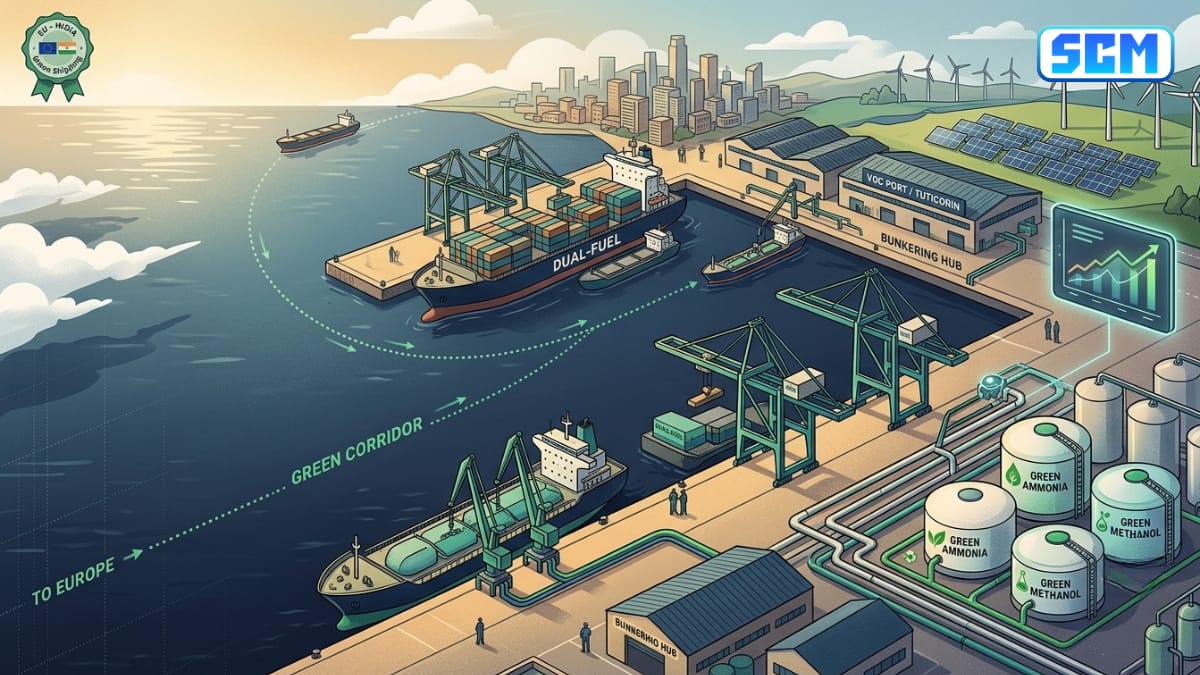
India’s Ministry of Ports, Shipping and Waterways announced the launch of the India-EU Green Shipping Corridor Industry Coalition at Sagar Manthan 2026 in New Delhi on October 7. A Letter of Intent was signed the same evening, with green ammonia and methanol among the fuels being considered.
The coalition brings together ports, renewable energy players, and infrastructure companies from both sides. On the Indian port side, V.O. Chidambaranar Port in Tuticorin has been specifically named as a hub within the corridor framework, alongside other major ports.
Vijay Kumar, Secretary of the Ministry of Ports, Shipping and Waterways, framed the significance directly: “Let Sagar Manthan 2026 be a platform where ideas become partnerships and partnerships become action. We will see in practice this evening with the launch of the industry coalition for the India-EU Green Shipping Corridor.”
This is not the first time India and the EU have discussed green shipping. But it is the first time a formal industry coalition with specific fuel types, named ports, and a commercial pathway assessment process has been created around it.
What the Coalition Actually Does
The India-EU Green Shipping Corridor Coalition is a structured framework rather than an operational corridor. It is designed to answer three specific questions before any physical corridor becomes viable.
First, what are the fuel supply and demand dynamics? India has significant and growing capacity to produce green ammonia and green methanol, both of which are candidate fuels for the next generation of low-emission vessels. Europe has growing demand for exactly these fuels for its shipping fleet, which faces tightening carbon regulations under the EU’s FuelEU Maritime regulation and the IMO’s revised greenhouse gas strategy. The coalition will assess whether India’s production trajectory matches European demand timelines.
Second, what infrastructure is needed? A shipping corridor running on green fuels requires bunkering infrastructure at both ends. Ships need to be able to load green ammonia or methanol at Indian ports and offload or bunker again at European ports. Neither end has that infrastructure fully in place yet. The coalition will assess what needs to be built, where, and at what cost.
Third, what are the commercial pathways? Green fuels currently cost significantly more than conventional bunker fuel. For the corridor to work commercially, either shipping lines absorb the premium, cargo owners pay more, or policy mechanisms — carbon pricing, green fuel subsidies, FTA preferences — close the gap. The coalition will map what commercial structures could make the corridor viable.
Why VOC Port and Tuticorin Matter Here
The specific naming of V.O. Chidambaranar Port in Tuticorin as a hub within the India-EU green corridor framework is not a coincidence.
Earlier this year, VOC Port and Port of Antwerp-Bruges signed a three-year cooperation agreement covering digital port management and green port initiatives, with green methanol bunkering infrastructure at Tuticorin specifically on the agenda. VOC Port already has an operational Green Hydrogen Pilot Plant on site and is developing a Green Methanol Bunkering Facility.
The India-EU Green Shipping Corridor Coalition now gives that bilateral port-level cooperation a strategic policy framework that sits above it. A VOC Port-Antwerp corridor was previously a port-to-port ambition. With this coalition, it is part of a government-backed India-EU initiative with explicit fuel infrastructure goals.
For Indian logistics and shipping professionals watching the green transition, that elevation matters. Port-level MoUs can stay at the level of knowledge exchange and workshops. An industry coalition with an LoI signed at the government level, involving fuel supply assessment and commercial pathway development, has a better chance of generating actual capital deployment.
The Sagar Manthan 2026 Context
The coalition launch came at Sagar Manthan 2026, India’s maritime summit held in New Delhi this week. The event was also the occasion for PM Modi to call for a rules-based maritime order amid rising Hormuz tensions, a reference to the crisis we have been tracking across multiple articles this year.
The maritime summit’s simultaneous focus on geopolitical disruption and green transition reflects the two dominant tensions in Indian shipping policy right now. On one side, the Strait of Hormuz crisis, Houthi forces seizing control of key Red Sea positions, and the Black Sea grain disruption are all creating operational emergencies that demand immediate response. On the other side, the longer-term decarbonisation transition is proceeding on its own timeline regardless of near-term geopolitics, and India needs to be positioned correctly for it.
The India Shipbuilding Investment Conclave, announced for next month in New Delhi, is another indicator of the strategic direction. India’s shipbuilding ambitions under Maritime Amrit Kaal Vision 2047 are explicitly connected to the green transition. Building ships that can run on green ammonia and methanol requires shipyards with the capability to construct dual-fuel vessels, which India is actively trying to develop.
Green Ammonia and Methanol: Why These Two Fuels
The LoI’s specific mention of green ammonia and methanol as candidate fuels for the corridor reflects where the commercial shipping industry’s decarbonisation path currently sits.
Green methanol has the most developed near-term commercial momentum. Maersk, the world’s second-largest container carrier, has been ordering methanol-capable vessels and is actively working to establish methanol bunkering at key ports on its global network. Earlier this year, Maersk and Kuehne+Nagel launched a collaborative sustainable ocean freight initiative using waste-based biofuel as a stepping stone, while Maersk’s longer-term fleet investment is firmly methanol-oriented.
Green ammonia has larger long-term potential, particularly for very large vessels on long-haul routes, because it has higher energy density than methanol. But ammonia also brings more complex handling requirements, safety considerations, and bunkering infrastructure needs. It is a more medium-term commercial proposition than methanol.
For India, both fuels connect to the same industrial base. Green hydrogen, produced from renewable electricity and water electrolysis, is the feedstock for both green ammonia (hydrogen plus nitrogen) and green methanol (hydrogen plus captured CO2). India’s significant renewable energy buildout, particularly solar and wind in states like Rajasthan, Gujarat, and Tamil Nadu, gives it the renewable electricity base to produce green hydrogen at competitive cost.
VOC Port’s location in Tamil Nadu puts it close to Tamil Nadu’s substantial renewable energy capacity. That geographic alignment between renewable production and port bunkering is one reason Tuticorin has been consistently named in India’s green shipping discussions. Tamil Nadu’s port infrastructure story has been developing on multiple fronts — Kamarajar Port recently achieved an 18-metre draft milestone that is already reshaping bulk trade options in the same region.
The India-EU FTA Connection
The coalition launch at Sagar Manthan came explicitly linked to the India-EU FTA. The trade agreement concluded earlier this year and is already reshaping bilateral trade flows between India and Europe. The Ministry of Ports directly referenced the FTA context, and the LoI language positions the green shipping corridor as a component of broader India-EU commercial integration.
This connection matters for two reasons. First, the FTA creates trade volume growth that directly increases the number of vessels moving between India and Europe. More vessels means more fuel consumption on that corridor, which means the economic case for green bunkering infrastructure improves as FTA-driven trade scales up.
Second, the FTA’s sustainability provisions include commitments on carbon emissions and supply chain environmental standards. A green shipping corridor is one of the most direct ways to demonstrate that India-EU trade growth is consistent with both countries’ climate commitments. Having the corridor operational when the FTA’s trade volumes are growing creates a narrative of trade and sustainability moving together rather than in tension.
What Needs to Happen Next
An LoI and a coalition announcement are the beginning of a process, not the end of it.
The coalition’s first task is the fuel supply and demand assessment. India’s green hydrogen and green ammonia production is growing but is not yet at the scale or cost required for commercial shipping adoption. The assessment needs to establish realistic timelines for when Indian production can supply European shipping demand at commercially viable prices.
Port infrastructure investment decisions need to follow. VOC Port’s Green Methanol Bunkering Facility is in development. Scaling that to handle commercial shipping volumes, and replicating it at other ports in the corridor, requires capital that the coalition’s commercial pathway work is designed to unlock.
Shipping line participation is the third requirement. A corridor without shipping lines committed to actually routing vessels through it and using green fuels is infrastructure without customers. Engagement from carriers like Maersk, which already has green fuel commitments, and from the major India-Europe liner services, is what turns the coalition’s framework into an operational corridor.
Bottom Line
The India-EU Green Shipping Corridor Coalition is the most concrete step yet toward operationalising a green fuel bunkering corridor between India and Europe. It gives the VOC Port-Antwerp cooperation a strategic framework, connects India’s renewable energy buildout to European shipping decarbonisation demand, and does so within the context of the India-EU FTA that is already reshaping bilateral trade.
The hard work is ahead. Fuel supply assessment, infrastructure investment, and shipping line buy-in all need to follow the LoI. But the coalition’s formation at government level, with named ports, specific fuels, and a commercial pathway mandate, is a more serious commitment than the policy discussions that preceded it.
For India’s green shipping and port infrastructure sector, October 7 is a date worth marking.
Sources: Ministry of Ports Shipping and Waterways, Ship & Bunker, Business Standard, Whalesbook Corporate News.
