


Quick Summary
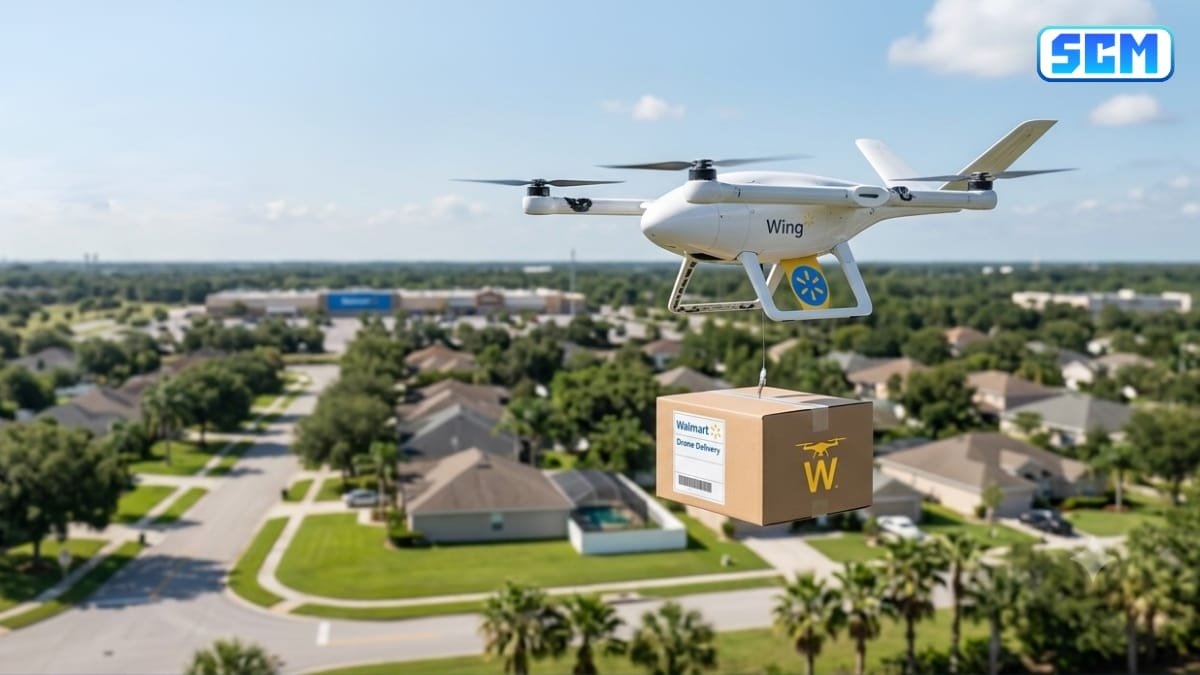
Walmart and Wing, the drone delivery subsidiary of Alphabet (Google’s parent company), launched drone delivery operations in Greater Orlando, Florida on July 29, 2026 — Wing’s first market in Florida and an extension of the two companies’ growing national partnership. The service currently covers more than 50,000 homes, businesses, and apartment buildings across Central Florida from two Walmart Supercenters in Apopka and Clermont, with three additional locations in Ocoee, Clermont, and Haines City planned for expansion in the coming weeks. Customers can order thousands of everyday essentials — groceries, household products, electronics, school supplies, health items — with deliveries arriving in as fast as 30 minutes. Wing drones currently carry up to 2.5 pounds per flight, with plans to increase that limit to 5 pounds. The launch is significant. But so is the context: Florida is the same state where Walmart’s previous drone delivery programme, run with a different operator, shut down entirely in 2024.
What the Service Actually Looks Like — The Operational Details
The mechanics of the Wing-Walmart Florida service are worth understanding specifically, because drone delivery in practice looks quite different from how it is typically described in press releases.
Customers order through the Walmart app, Walmart.com, or the Wing app, selecting drone delivery as their fulfilment option. Orders are prepared at the participating Walmart Supercenter, loaded into a Wing drone, and flown to the delivery address. On arrival, the drone descends to approximately 20 feet above ground level and uses a secure tether to lower the package gently to the ground — the drone itself does not land. The entire process, from order to delivery, is designed to complete in under 30 minutes.
The current 2.5-pound weight limit is a meaningful constraint. It covers a substantial range of everyday items — a bag of groceries, a phone charger, a bottle of shampoo, school supplies — but rules out heavier purchases that are common Walmart categories. The planned increase to 5 pounds will expand the range of eligible orders considerably, though still well short of a full grocery shop.
The two launch locations — Walmart Supercenter at 1700 South Orange Blossom Trail in Apopka, and the Johns Lake Road location in Clermont — are both in northwest Greater Orlando, covering a mix of residential suburbs and, notably, vacation rental properties. Wing has specifically highlighted the tourism angle: Central Florida hosts tens of millions of visitors annually, and drone delivery to vacation rentals and hotels represents a demand segment that does not exist in most other US markets.
The Context Nobody Is Mentioning — Florida Has Been Here Before
The launch has been covered widely as a straightforward positive story. But there is a material piece of context that makes this launch more complicated than the press releases suggest: Florida is not a new frontier for Walmart drone delivery. It is a market where Walmart’s previous drone delivery programme already failed.
Walmart’s prior Florida drone operations — run with DroneUp rather than Wing — launched in Orlando and Tampa in December 2022 with comparable fanfare. Twenty months later, DroneUp closed 18 hubs nationally, including Florida, and laid off 70 people. The reason was straightforward: it cost approximately $30 to fly a package that customers expected to receive for free or at minimal cost. The unit economics did not work.
Wing is a fundamentally different operator from DroneUp — it is backed by Alphabet, has been operating commercially since 2019, and has developed more mature autonomous flight technology over a longer runway of investment. Wing’s existing Walmart partnership already covers more than 270 Walmart locations under contract by 2027, suggesting a more systematic national rollout rather than a pilot experiment. These are real differences.
But the underlying economic question — what does it cost Wing to complete a delivery, and what will customers pay for it — has not been answered publicly. Until it is, the DroneUp precedent is the only data point available for what happens when drone delivery economics are tested in the real world at scale.
The Regulatory Situation — Still Unresolved
There is a second complication that has received almost no coverage in the mainstream reporting on this launch: the regulatory framework that would govern large-scale commercial drone delivery in the US is still not finalised.
President Trump’s June 2025 executive order set a February 1, 2026 deadline for the FAA to publish final rules on commercial drone operations — including the presumptive right-of-way and electronic conspicuity standards that are essential for scaling beyond small pilots. That deadline passed without a final rule. The rule reached the Office of Information and Regulatory Affairs on July 10, 2026 for final review — a process that can take up to 90 days.
Wing is operating the Florida service under existing waivers and exemptions, which is legally sound for the current scale. But scaling to hundreds of markets nationally — which Wing’s 270-location Walmart contract implies — requires the final rule to be in place. The regulatory uncertainty is not a crisis for the Florida launch, but it is a real constraint on how fast the broader programme can expand.
What This Means for Last-Mile Logistics
The Walmart-Wing Florida launch matters for the broader logistics industry because it is the most commercially serious attempt yet to prove that drone delivery can work as a mainstream last-mile option rather than a technology demonstration.
Several structural factors make the current attempt more credible than previous ones. Wing’s technology is more mature — the company has logged millions of commercial deliveries globally, primarily in Australia and the US. Walmart’s scale means the programme has a genuine demand base from day one, not a bootstrapped customer acquisition problem. The 270-location national contract creates enough volume to potentially achieve the unit economics that eluded smaller operators.
For Indian logistics operators and last-mile providers, the Florida launch is worth tracking carefully. India’s drone delivery regulatory framework — under DGCA’s drone corridors programme and the Production Linked Incentive scheme for drone manufacturing — is advancing along a similar path to the US, with comparable questions about unit economics and regulatory maturity. What Wing and Walmart prove or disprove in Orlando over the next 12 months will be one of the most relevant data points available for how drone last-mile delivery performs at commercial scale in a real market.
What to Watch
Unit economics disclosure — if Wing or Walmart release any data on per-delivery costs or pricing structures, it will be the most important indicator of whether this programme has legs.
Expansion pace — the three additional Florida locations planned for coming weeks will test whether the operational model scales cleanly beyond the initial two stores. If expansion slows or stalls, that is a signal.
FAA final rule timeline — OIRA review completing and the final rule publishing would remove the regulatory uncertainty that currently caps how fast the national programme can grow.
Customer adoption rates — Wing’s 50,000-home coverage area is meaningful, but coverage does not equal usage. Early data on how many eligible customers are actually using the service will matter more than the headline coverage number.
Bottom Line
Walmart and Wing’s Florida launch is the most credible commercial-scale drone delivery operation in the US to date — backed by Alphabet’s resources, Walmart’s demand base, and Wing’s operational track record. It is also launching into a market where the previous attempt failed on economics, under a regulatory framework that is not yet finalised, at a weight limit that excludes the majority of Walmart’s product range. Whether this time is genuinely different from DroneUp’s Florida experience is the question the next 12 months will answer. The technology works. The economics and the regulatory environment are still being figured out.
Tracking drone delivery and last-mile logistics developments? Follow SupplyChain MetaVerse for ongoing coverage of how technology is reshaping delivery operations globally.
