


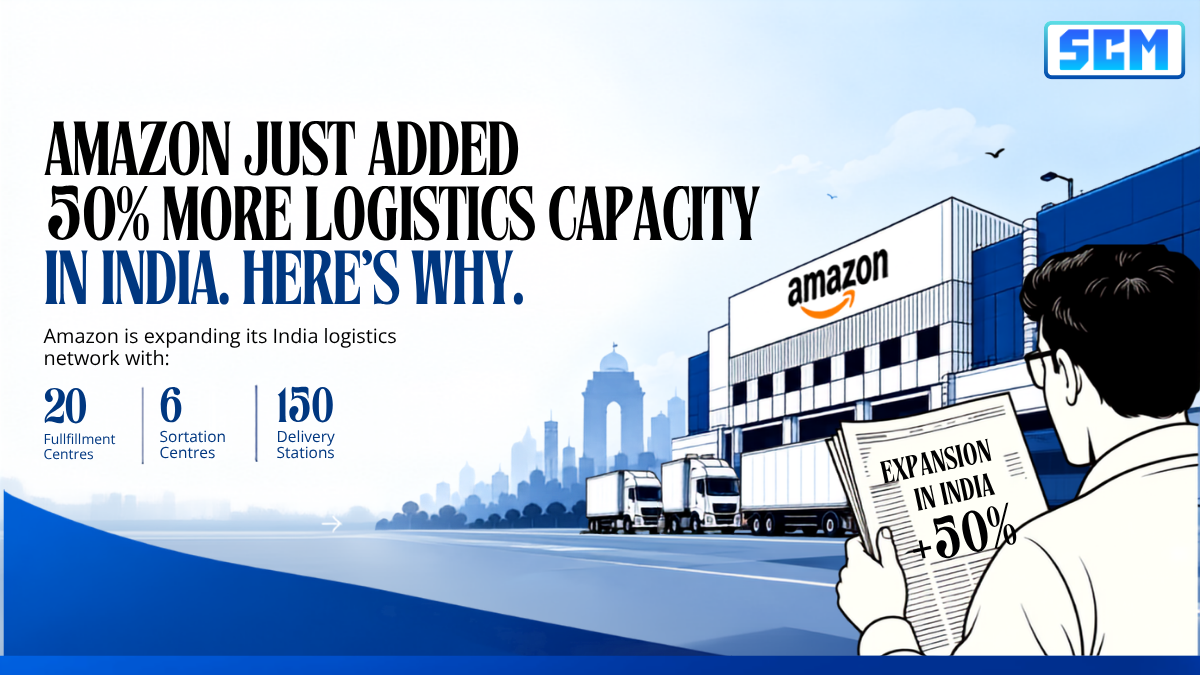
Amazon is expanding its logistics footprint in India at a time when the country’s e-commerce market is becoming faster, more distributed and more demanding.
The company has added 20 fulfilment centres and 150 delivery stations, while increasing its storage capacity by 50% to 64 million cubic feet across 118 cities.
On the surface, this looks like a straightforward infrastructure expansion.
But the real question is: what does Amazon know about future demand that the rest of the supply chain should be paying attention to?
This Is Not Just About More Warehouses
Adding capacity is easy to celebrate.
The harder part is understanding why that capacity is being added now.
Amazon is moving deeper into non-metro markets, placing inventory and delivery infrastructure closer to customers.
That suggests a bigger shift:
India’s next growth wave may not come only from the largest cities.
Demand is spreading.
And logistics networks have to spread with it.
The result is a supply chain that is becoming increasingly fragmented geographically, even as customers expect faster and more predictable deliveries.
That creates a difficult operational equation:
More locations + more shipments + faster delivery expectations = more complexity.
The Hidden Challenge: Capacity Alone Doesn’t Solve the Problem
There is a tendency to treat logistics infrastructure as the answer.
It isn’t.
A new fulfilment centre gives you capacity.
It doesn’t automatically give you:
- Better inventory positioning
- Better demand forecasting
- Better vehicle utilisation
- Better last-mile planning
- Better coordination
- Better visibility
In fact, scaling physical infrastructure without scaling the systems behind it can create an entirely different problem.
More nodes can mean more points of failure.
The Supply Chain Ripple Effect
Amazon’s expansion doesn’t stop at Amazon.
Every additional fulfilment centre and delivery station creates downstream implications for the wider logistics ecosystem.
More inventory movement means more transportation.
More deliveries mean more last-mile activity.
More regional distribution means more coordination between warehouses, carriers and delivery networks.
And peak periods make all of this harder.
A network that works reasonably well at normal volumes can behave very differently when demand suddenly spikes.
That is where supply chain resilience gets tested.
The Bigger Question for Logistics Leaders
Amazon can invest billions in infrastructure.
Most logistics companies cannot.
So the strategic question for the wider industry isn’t:
Can we build a network as large as Amazon’s?
It is:
Can we make our existing network significantly more productive?
That means looking beyond physical assets and asking harder questions about data, processes, technology and decision-making.
Where is inventory sitting?
How quickly is it moving?
Where are bottlenecks forming?
Which routes are inefficient?
Where is capacity being wasted?
And perhaps most importantly:
How quickly can the business respond when demand changes?
India Is Entering a Different Logistics Game
The old logistics advantage was largely about scale.
The emerging advantage is about scale + speed + intelligence.
Amazon’s expansion is therefore more than an infrastructure story.
It is a warning.
The supply chain is becoming more distributed while customer expectations are becoming less tolerant of delays.
Companies that continue adding people and physical capacity without improving the way their networks operate may eventually hit a ceiling.
The winners will not necessarily be the companies with the biggest footprint.
They will be the companies that can extract the most value from every part of that footprint.
The Critical Takeaway
Amazon adding 50% more logistics capacity tells us one thing clearly:
Amazon expects India to need it.
The more important question is whether the rest of the logistics ecosystem is preparing for the same future.
Because when demand accelerates, operational weaknesses don’t stay hidden. They get amplified.
India’s logistics network is getting bigger.
Now it needs to get smarter.
