


Quick Summary
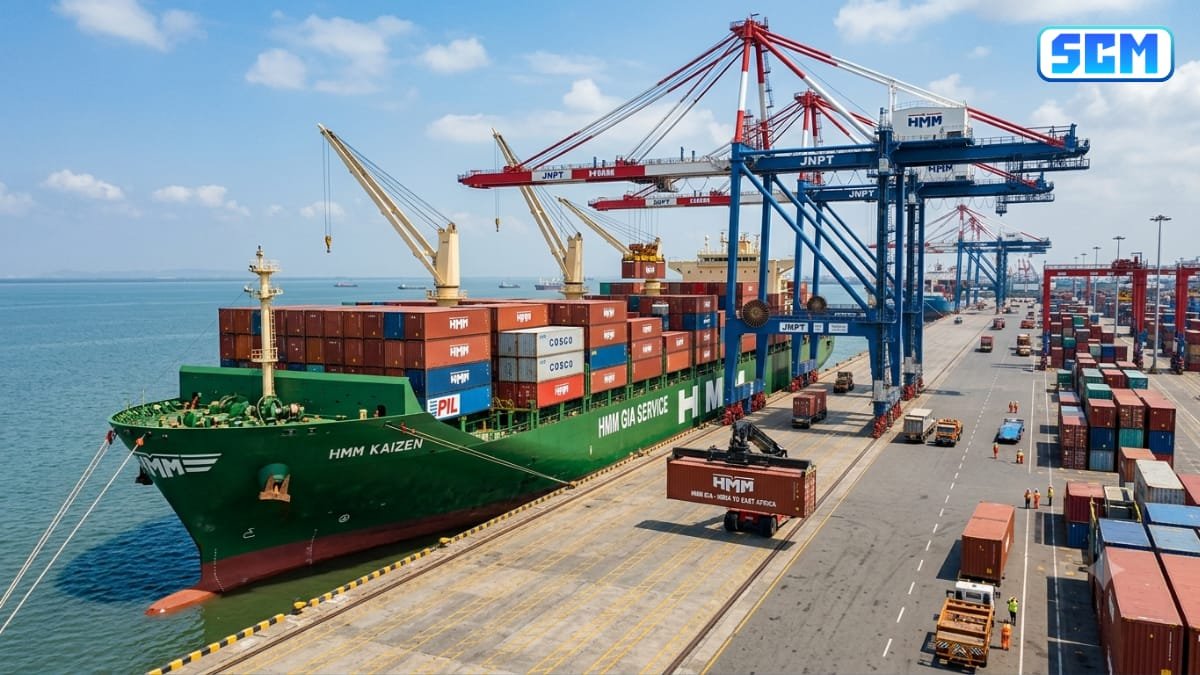
HMM (Hyundai Merchant Marine), South Korea’s national container carrier, will launch its Gulf-India-East Africa (GIA) service in September 2026 — a new weekly container loop connecting Nhava Sheva and Mundra in India with Dar es Salaam (Tanzania) and Mombasa (Kenya). The first sailing departs Nhava Sheva in the fourth week of September. The service deploys six vessels of approximately 2,800 TEU class — three from HMM, two from COSCO, and one from Pacific International Lines (PIL) — on a 35-day port rotation: Nhava Sheva → Mundra → Dar es Salaam → Mombasa → Nhava Sheva. The GIA is HMM President Choi Won-hyuk’s second Africa feeder service under the carrier’s hub-and-spoke strategy, following the North and West Africa MA2 service launched in July from Algeciras. For Indian exporters and freight forwarders, this is a meaningful addition to India-East Africa direct shipping capacity — arriving at a moment when demand on the corridor is growing faster than existing capacity can handle.
Why India as the Hub — The Strategic Logic of the Rotation
The GIA service rotation is built around a specific commercial insight: India — and specifically Nhava Sheva and Mundra — is where cargo from India and Central Asia converges before moving onward to East Africa. HMM has explicitly described the two Indian ports as the “hub” of the GIA service, not just stops on a loop.
This positioning matters. It means HMM is not simply adding a port call in India on its way between Northeast Asia and East Africa — it is designing the service around India as the origin and return point for the East Africa trade. The 35-day rotation closes at Nhava Sheva, meaning both outbound Indian exports to Tanzania and Kenya, and inbound East African goods returning to India, are primary cargo flows the service is designed to carry.
The inclusion of Mundra alongside Nhava Sheva is particularly relevant for Indian exporters in Gujarat and western India — Mundra has been growing rapidly as a cargo hub and its inclusion gives GIA coverage of both India’s largest container port (Nhava Sheva) and its fastest-growing major port (Mundra) in a single service loop.
The “Central Asia” reference in HMM’s announcement is also worth noting. Cargo from Central Asian countries — Kazakhstan, Uzbekistan, Turkmenistan — increasingly transits through Indian ports after moving south through Afghanistan or via the International North-South Transport Corridor (INSTC). Positioning Nhava Sheva as a Central Asia transit hub for East Africa-bound cargo adds a dimension to the GIA service that goes beyond simple India-East Africa bilateral trade.
The Consortium Structure — HMM, COSCO, and PIL Together
The GIA service is not a solo HMM operation — it is a consortium of three carriers: HMM (three vessels), COSCO (two vessels), and Pacific International Lines or PIL (one vessel), jointly deploying six ships to maintain the weekly frequency.
This consortium structure is worth understanding because it affects how the service operates commercially.
COSCO’s participation brings China’s largest carrier into the India-East Africa service. COSCO has extensive cargo relationships with Chinese manufacturers exporting to Africa — by joining the GIA consortium, COSCO gains a direct India-hub routing option for China-East Africa cargo that can transship through Nhava Sheva or Mundra rather than requiring a separate direct China-Africa service.
PIL’s participation is significant because PIL is one of the most established carriers on emerging market trade lanes, with deep existing relationships in Southeast Asia and Africa. Its single-vessel contribution to the GIA brings operational experience on the East Africa calling ports — Dar es Salaam and Mombasa — that HMM, which is newer to African trades, may have less of.
Together, the three-carrier consortium creates a commercially more robust service than any single carrier could justify on its own at this stage of India-East Africa demand development — sharing vessel costs while each carrier fills its allocated slots through its own commercial networks.
Dar es Salaam and Mombasa — Why These Two Ports
The GIA’s East Africa port pair — Dar es Salaam in Tanzania and Mombasa in Kenya — covers the two dominant container gateways on East Africa’s Indian Ocean coast. Understanding why each matters helps clarify which Indian export and import flows the service is most directly relevant for.
Dar es Salaam is Tanzania’s primary port and the main gateway for landlocked countries to its west and north — including Zambia, Democratic Republic of Congo (eastern regions), Rwanda, Burundi, and Uganda. Cargo for these landlocked markets moves overland from Dar es Salaam through the Northern and Central Corridors. For Indian exporters selling into these markets — pharmaceuticals, FMCG goods, engineering equipment, textiles — Dar es Salaam is the first East African landing point.
Mombasa is Kenya’s main port and East Africa’s largest container terminal — handling cargo for Kenya itself as well as landlocked Uganda, Rwanda, South Sudan, and parts of eastern DRC through the Northern Corridor highway and the Standard Gauge Railway to Nairobi and Kampala. Kenya is one of Africa’s fastest-growing economies and a significant market for Indian goods across multiple categories.
Together, the two ports give the GIA service coverage of the majority of East Africa’s import-consuming markets — from Tanzania through Kenya and the landlocked countries both ports serve as transit gateways.
This directly connects to the India-Rwanda bilateral trade developments we covered recently — the India-Rwanda Joint Trade Committee’s first session, held in New Delhi on July 30-31, specifically addressed logistics bottlenecks in India-East Africa trade. Mombasa and Dar es Salaam are the two ports through which Rwanda’s trade with India primarily moves. The GIA service’s launch — arriving weeks after the JTC meeting — provides exactly the kind of direct shipping capacity improvement that the JTC’s logistics agenda is trying to accelerate.
What This Means for Indian Exporters and Freight Forwarders
For Indian businesses exporting to East Africa — and freight forwarders handling those cargo flows — the GIA service offers a specific operational improvement over current routing options.
Weekly frequency from Nhava Sheva — a weekly departure gives exporters planning flexibility that fortnightly or less frequent services cannot match. For exporters managing inventory replenishment cycles with East African distributors, weekly shipping frequency is a meaningful operational benefit.
Direct Mombasa and Dar es Salaam calls — routing options that require transshipment via Colombo, Singapore, or other hubs add transit time and handling complexity. A direct India-East Africa service that calls at both major East African gateway ports eliminates one transshipment step for the majority of India-East Africa cargo flows.
Competitive freight rates — the entry of a new weekly service with six vessels adds meaningful capacity to the India-East Africa corridor. The Loadstar has noted that India-Africa trades are experiencing higher freight yields due to stronger demand — the addition of GIA capacity should provide some competitive discipline on rates without eliminating the demand-driven strength of the corridor.
Categories particularly relevant: Indian pharmaceuticals (already dominant in Rwanda and Kenya), FMCG consumer goods, engineering equipment, two- and three-wheelers, textiles, and agricultural products are the primary export categories that will benefit from improved India-East Africa direct shipping capacity.
HMM’s Africa Strategy — Why This Is the Second Step, Not the First
The GIA launch is HMM’s second Africa service move in rapid succession. In July 2026, HMM launched the MA2 service connecting North and West Africa via Algeciras, Spain. With the GIA adding East Africa in September, HMM now has coverage across Africa’s major Indian Ocean and Atlantic coast shipping markets — a deliberate geographic completion of an Africa network that President Choi Won-hyuk has been building since taking office in March 2025.
This matters because it signals that HMM’s Africa engagement is a strategic commitment rather than an opportunistic one-off. The hub-and-spoke model — using Nhava Sheva and Mundra as India hubs that feed into feeder networks for Africa — is a structured approach to building Africa market presence in a capital-efficient way, rather than trying to compete on mainline Asia-Africa direct services against carriers with larger fleets.
For Indian freight forwarders evaluating carrier relationships for East Africa cargo, HMM’s strategic commitment to the corridor — backed by COSCO and PIL as consortium partners — suggests the GIA service is likely to operate with greater longevity than a purely opportunistic service would.
Bottom Line
HMM’s GIA service — launching from Nhava Sheva in late September 2026 — gives Indian exporters and freight forwarders a new weekly direct option to Dar es Salaam and Mombasa at a moment when India-East Africa trade demand is growing and direct capacity has been constrained. The consortium structure with COSCO and PIL, the India-hub design of the rotation, and the strategic backing of HMM’s broader Africa network commitment make this a service worth taking seriously for businesses moving cargo between India and East Africa. The fourth week of September is the date to plan around for inaugural bookings.
Moving cargo between India and East Africa? Share your current routing experience — we are tracking how new direct services are changing the logistics options on this corridor.
