


Quick Summary
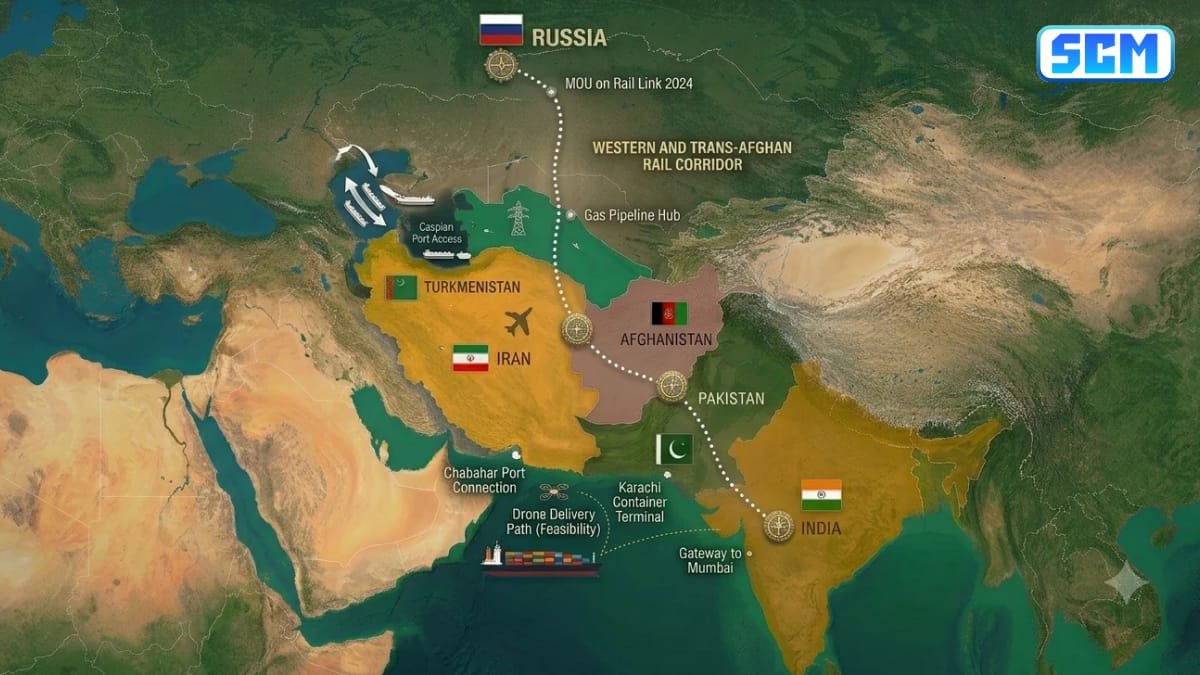
Russian Deputy Prime Minister Marat Khusnullin, in an interview with state news agency TASS, has called for the exploration of a direct railway corridor from Russia to the Indian Ocean — proposing a route that would run through Turkmenistan, Iran, Afghanistan, and Pakistan before connecting to India. The statement comes as the Strait of Hormuz disruption has forced a fundamental rethink of Russia’s trade route dependencies, and fits into Moscow’s broader push to build alternative overland corridors connecting Russia with South Asian markets. There is currently no confirmed construction plan, cost estimate, timeline, or intergovernmental agreement behind the proposal — Khusnullin explicitly described it as something that “should be explored.” For India’s supply chain and logistics community, this proposal raises an important question: is this a genuine infrastructure vision that could reshape Eurasian freight flows, or is it another ambitious corridor concept that will remain on paper for years? The honest answer, based on a realistic assessment of what the route requires, is that the obstacles are as significant as the ambition.
What Khusnullin Actually Said — And What He Didn’t
The framing of Russia’s statement matters because it has been widely reported in ways that overstate its current status.
Khusnullin said Russia “should examine alternative transport routes to reduce dependence on key maritime chokepoints,” specifically mentioning the Bosphorus and the Strait of Hormuz. He identified a corridor through Turkmenistan, Iran, Afghanistan, and Pakistan as one possible option, and added that Russia would consider “any route capable of providing access to India.”
What he did not say: that Russia has decided to build this railway, that a feasibility study has been commissioned, that intergovernmental agreements are in place, or that construction funding has been identified. The statement is a strategic signal — a public articulation of the direction Russia wants to explore — not an infrastructure announcement.
This distinction is important for logistics professionals evaluating whether this corridor is relevant to their near or medium-term supply chain planning. It is not. What it is relevant to is understanding the direction of Russia’s long-term trade route strategy and how that interacts with India’s own connectivity ambitions.
Why Russia Wants This Route — The Hormuz and Bosphorus Problem
Russia’s motivation for exploring a new overland corridor to India is directly connected to the maritime chokepoint disruptions of 2025-26.
The Strait of Hormuz has been largely disrupted since February 2026 following the resumption of the US-Iran conflict — a situation we have covered in detail through its impact on India’s Gulf trade and DP World’s Fujairah terminal response. For Russia, whose energy exports pass through both the Bosphorus (for Black Sea oil terminals) and indirectly through Gulf routes for LNG, this disruption has reinforced a strategic vulnerability that existed before 2026 but has become operationally urgent.
Russia’s traditional trade routes to global markets have also been severely disrupted by Western sanctions following the 2022 Ukraine invasion. European rail and road networks are largely closed to Russian freight. The Suez Canal route, while technically available, involves passage through maritime zones where Russia’s commercial standing is compromised. An overland corridor to India — bypassing all of these constraints — would give Russia a sanctions-resilient, chokepoint-independent route to one of the world’s fastest-growing large economies.
For India, the route’s attraction is symmetric: a direct overland connection to Russia would reduce India’s dependence on maritime routes for Russian energy and commodity imports — particularly coal, fertilisers, and potentially oil — and open a corridor to Central Asian markets (Kazakhstan, Uzbekistan, Turkmenistan) without requiring sea transit.
The Route — What It Would Actually Require
The proposed corridor — Russia through Turkmenistan, Iran, Afghanistan, and Pakistan to India — is approximately 7,000-8,000 kilometres of overland distance. To understand why this is genuinely complex, it helps to look at each segment.
Russia to Turkmenistan: This segment is the most infrastructure-ready part of the route. Rail connectivity between Russia and Central Asian republics through Kazakhstan exists and has been operational for decades. The extension into Turkmenistan is feasible and has existing partial connectivity.
Turkmenistan to Iran: The Turkmenistan-Iran railway connection at Sarakhs-Tedzhen exists and has been operational since 1996. This segment works.
Iran southward: Iran’s rail network connects to its southern ports, including Bandar Abbas. The Chabahar-Zahedan railway — partially financed by India — is under construction and approaching completion, which would give the Iranian corridor a direct Indian Ocean port connection. This segment is advancing, though not yet complete.
Afghanistan: This is where the route faces its most significant infrastructure gap. Afghanistan currently has very limited railway infrastructure — a short line in the north connecting to Uzbekistan, and a line at Herat connecting to Iran. There is no continuous railway running through Afghanistan from north to south or west to east. Building the necessary Afghan rail segment — through difficult terrain, under Taliban governance, across a country that has seen minimal infrastructure investment for decades — would be one of the most complex railway construction projects in the world.
Pakistan: Pakistan has an existing broad-gauge railway network, but it operates on a different gauge from the metre-gauge networks common in parts of Central Asia, requiring either gauge conversion or transshipment. Pakistan’s railway infrastructure has also been chronically underfunded and underdeveloped, with significant sections in poor operational condition.
Pakistan to India: The India-Pakistan border is currently closed to land freight. There is no operational rail freight crossing between the two countries under current political conditions. Reopening it would require a fundamental shift in India-Pakistan relations — a geopolitical precondition that has no clear timeline.
How This Compares to the INSTC — The Route That’s Already Being Built
The Russia proposal is not the only overland Russia-India corridor concept. The International North-South Transport Corridor (INSTC) — a multimodal network linking India, Iran, Russia and Central Asia — has been under development for years and is significantly more advanced.
The INSTC routes cargo by sea from Indian ports to Iran’s Bandar Abbas or Chabahar, then by rail through Iran and onwards through the Caspian Sea or overland to Russia. The Chabahar-Zahedan railway under construction in Iran is a critical INSTC infrastructure piece — one that India has directly financed. As we covered earlier, Russia’s engagement with Chabahar through the INSTC has been an ongoing strategic priority.
The INSTC route avoids the Pakistan and Afghanistan problem entirely by routing through Iran and the Caspian. It is genuinely under construction, has functioning intergovernmental agreements, and has already seen test cargo runs. The proposed Turkmenistan-Iran-Afghanistan-Pakistan corridor, by contrast, requires resolving the most intractable geopolitical and infrastructure challenges in Eurasia before a single container can move.
This does not make the new proposal irrelevant — but it does put it in context. The INSTC is the near-term operational corridor. The Afghanistan-Pakistan route is a long-term strategic aspiration that may take decades to become commercially functional, if it ever does.
What to Watch — The PAKAFUZ Railway
The most concrete related development is the Pakistan-Afghanistan-Uzbekistan (PAKAFUZ) railway project, also known as the Trans-Afghan Railway. Russia and Uzbekistan’s Transport Ministries agreed earlier in 2026 to begin feasibility studies on this project. The goal is to create a Central Eurasian freight corridor connecting Russia and Central Asia through Afghanistan to Pakistan’s warm-water ports.
PAKAFUZ is essentially the southern segment of the route Khusnullin described — and it is marginally more advanced than the full Russia-India concept because it focuses on the Afghanistan-Pakistan connectivity problem specifically. But feasibility studies on projects of this complexity typically precede construction by many years, and the five core challenges — terrain, funding, Afghan governance, gauge compatibility, and Pakistan-India border relations — have not changed.
What This Means for India’s Trade and Supply Chain
For Indian logistics operators and trade policymakers, Russia’s rail corridor proposal has two practical implications.
First, it reinforces the strategic importance of the INSTC and Chabahar — the corridor that India has actually been investing in. If Russia is explicitly identifying India connectivity as a strategic priority, India’s existing investments in Chabahar and the Iranian rail network become more valuable as leverage and as infrastructure.
Second, it signals that the long-term direction of Eurasian freight flows is toward overland connectivity that bypasses both the Suez Canal and the Strait of Hormuz. That direction is aligned with India’s own interest in reducing maritime chokepoint dependency — even if the specific route Khusnullin described is decades away from operational reality.
Bottom Line
Russia’s proposed rail route to India through Turkmenistan, Iran, Afghanistan, and Pakistan is a genuine strategic vision — but it is a vision, not a plan. The infrastructure gaps in Afghanistan, the gauge incompatibilities in Pakistan, and the closed India-Pakistan border are not short-term problems. They are structural challenges that no amount of political will can resolve quickly. The corridor that India should be watching — and investing in — is the INSTC through Iran, which is already being built and has already moved test cargo. Russia’s new proposal is the long-term destination on the map. The INSTC is the road that actually exists.
Tracking Eurasian trade corridor developments and their impact on India’s supply chains? Follow SupplyChain MetaVerse for ongoing coverage of how overland freight routes are evolving.
