


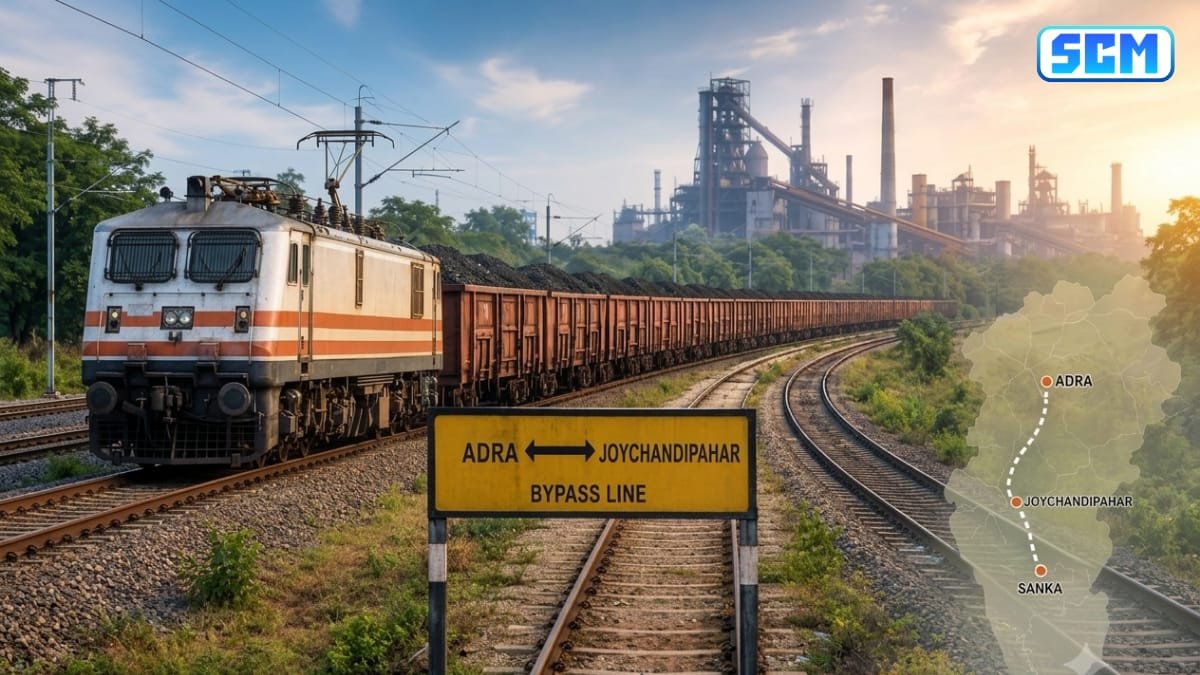
Indian Railways just approved a project that’s been long overdue for eastern India’s industrial freight network.
On September 1, the Ministry of Railways greenlit the construction of an 11-kilometre bypass line between Adra and Joychandipahar in the South Eastern Railway zone — at a total cost of ₹272 crore. The project is officially called the Adra-Joychandipahar-Sanka bypass.
It’s not the flashiest rail announcement you’ll read this year. But for freight operators, steel producers, and logistics companies working in Jharkhand and West Bengal’s industrial belt, it solves a real, everyday problem.
What’s the Actual Problem Here?
The Adra-Joychandipahar section is a congestion hotspot. The existing network is running at 71% utilisation — that’s high for a corridor handling heavy industrial freight. And surface-crossing conflicts are slowing things down further.
Surface crossings are exactly what they sound like — points where freight trains cross other rail lines at grade level. Every crossing is a potential delay. When you’re running 45 rakes a day for coking coal alone, those delays add up fast.
The bypass line creates dedicated path segregation. In plain terms — freight trains get their own lane. No more competing for track space, no more surface-crossing hold-ups.
Who Benefits Most
Two names stand out in the project approval.
SAIL — the Steel Authority of India Limited — has an iron ore demand of 23.40 million tonnes per annum running through this corridor. That’s a massive, consistent freight flow that any bottleneck directly affects.
BCCL — Bharat Coking Coal Limited — is projecting 45 rakes per day on this section. Coal for coke, coke for steel. It’s one of the most critical supply chains in eastern India’s industrial economy.
When two organisations of this scale are depending on a single rail corridor, building relief capacity isn’t optional. It’s overdue.
What Changes After This Is Built
The numbers from the Ministry of Railways tell a clear story.
The bypass will support 6.065 freight rakes per day of additional movement. Line capacity utilisation on the Joychandipahar-Adra section — currently at 47.50% — is projected to rise to 56.45% by 2028-29 after the project is complete.
And total additional traffic facilitated? 8.88 million tonnes per annum.
That’s not a marginal improvement. For a region that’s one of India’s most important industrial freight corridors, 8.88 MTPA of additional throughput capacity is significant headroom.
The bypass also provides a bi-directional connection to the upcoming third line — meaning it’s built with future expansion in mind, not just today’s traffic.
The Bigger Picture
This project is part of the Energy, Mineral and Cement Corridor identified under Indian Railways’ freight network planning. That corridor covers some of India’s most freight-intensive industrial zones — coal mines, steel plants, cement factories, power stations.
Getting this corridor right matters because it’s not just about moving raw materials. It’s about making India’s steel and energy supply chains less fragile. Every time a surface-crossing conflict stalls a coal rake heading to a steel plant, there’s a downstream effect — production schedules slip, costs go up, delivery timelines stretch.
A dedicated bypass line sounds like a technical fix. But for the industries depending on it, it’s supply chain resilience being built in concrete and steel.
Bottom Line
₹272 crore for 11 kilometres of bypass line won’t make headlines the way a new passenger express does. But the Adra-Joychandipahar corridor moves some of India’s most critical industrial cargo — iron ore and coking coal that keeps steel plants running.
Getting 8.88 MTPA of additional freight capacity on this corridor by 2028-29 is exactly the kind of infrastructure investment that India’s eastern industrial belt has needed for a while.
Tracking Indian Railways freight infrastructure investments? Follow SupplyChain MetaVerse for ongoing coverage of how India’s rail freight network is developing.
