

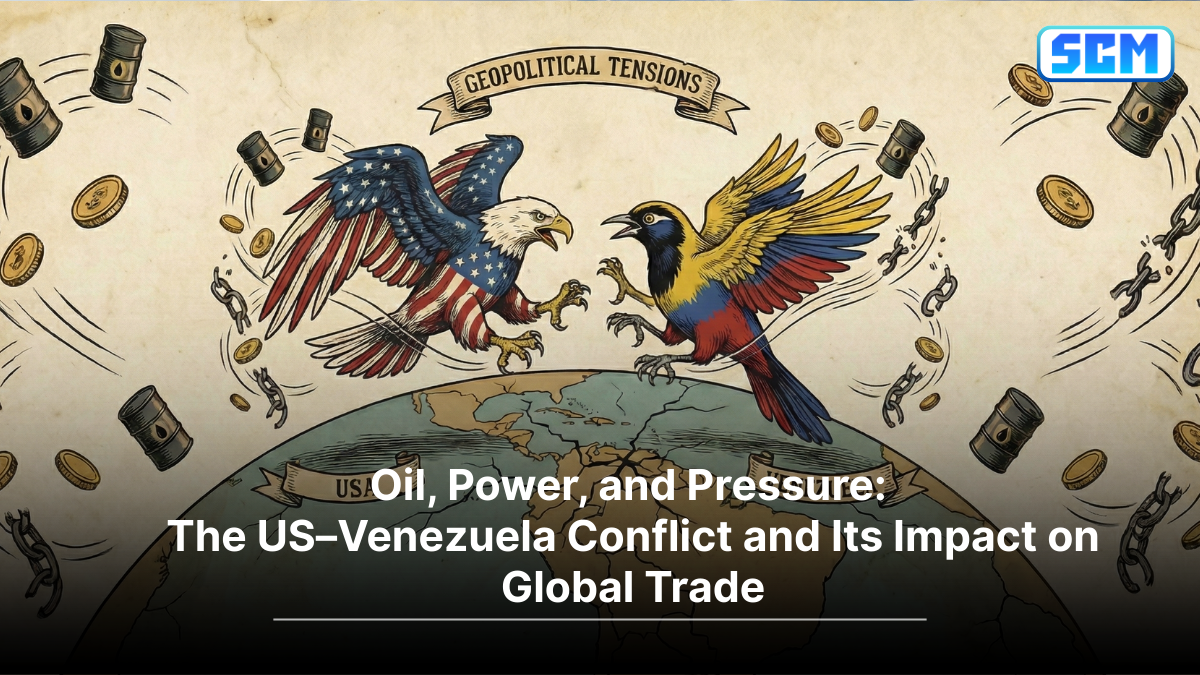
The relationship between the United States and Venezuela has long been shaped by oil, ideology, and influence. What often appears as a political standoff carries consequences far beyond diplomacy. In a global economy where energy, shipping, and finance are tightly linked, even rising tensions without open conflict can disrupt trade flows worldwide.
This is a story of how power struggles around oil translate into pressure across global markets.
Oil at the center of the conflict
Venezuela holds some of the world’s largest proven oil reserves. Despite years of sanctions, underinvestment, and declining output, its oil still matters. Not because of volume alone, but because of where it sits in the global energy puzzle.
Any escalation in tensions immediately raises questions:
- Will supply tighten further?
- Will sanctions expand or ease?
- Will alternative trade channels emerge?
Energy markets respond to risk faster than reality. Even the perception of disruption pushes prices up, increasing fuel costs for shipping, aviation, manufacturing, and agriculture. What begins as a political signal quickly becomes an economic one.
Trade routes and shipping feel the strain
The Caribbean region plays a critical role in global trade. It connects the US Gulf, Latin America, and transatlantic shipping lanes. When geopolitical pressure rises in this corridor, shipping reacts defensively.
Common outcomes include:
- Higher war-risk and insurance premiums
- Rerouting of vessels to avoid sensitive zones
- Longer transit times and increased freight costs
These changes affect far more than oil. Containers carrying food, consumer goods, machinery, and raw materials all absorb higher logistics costs. For importers and exporters, margins shrink while uncertainty grows.
Sanctions reshape how trade moves
Sanctions are one of the most powerful tools in the US–Venezuela conflict. Their impact extends well beyond the two countries involved.
Sanctions influence:
- Access to trade finance and dollar transactions
- Who can insure, ship, or charter vessels
- Which banks and intermediaries can participate
When formal channels close, trade adapts. New routes, currencies, and intermediaries appear. While trade continues, it becomes slower, less transparent, and riskier. Compliance costs rise, and even companies with no direct exposure are forced to reassess counterparties and contracts.
Regional spillover effects
Latin America feels the impact first. Heightened risk perception affects:
- Regional currencies and capital flows
- Foreign investment decisions
- Intra-regional trade confidence
But the ripple doesn’t stop there. Higher energy and freight costs reach Europe, Asia, and Africa through global supply chains. What starts as a regional issue quickly becomes a global one.
Confidence is the real casualty
More than oil barrels or shipping delays, the biggest loss is confidence.
Global trade depends on predictability. When energy supply, policy enforcement, and trade access become uncertain, businesses pause, diversify, or delay decisions. This slows investment, complicates planning, and raises costs across the board.
Companies respond by:
- Diversifying suppliers and energy sources
- Reducing exposure to high-risk regions
- Prioritizing resilience over pure cost efficiency
These shifts reshape trade patterns long after headlines fade.
The bigger picture
The US–Venezuela conflict is not just about bilateral relations or oil politics. It is a reminder of how closely global trade is tied to geopolitics. In an interconnected world, pressure applied in one region rarely stays contained.
Oil may be the trigger, but the impact is felt in freight rates, insurance costs, sourcing strategies, and boardroom decisions worldwide.
And that is why conflicts driven by power and pressure never remain local. They travel through markets, supply chains, and economies, leaving a global footprint long before any resolution appears.


