

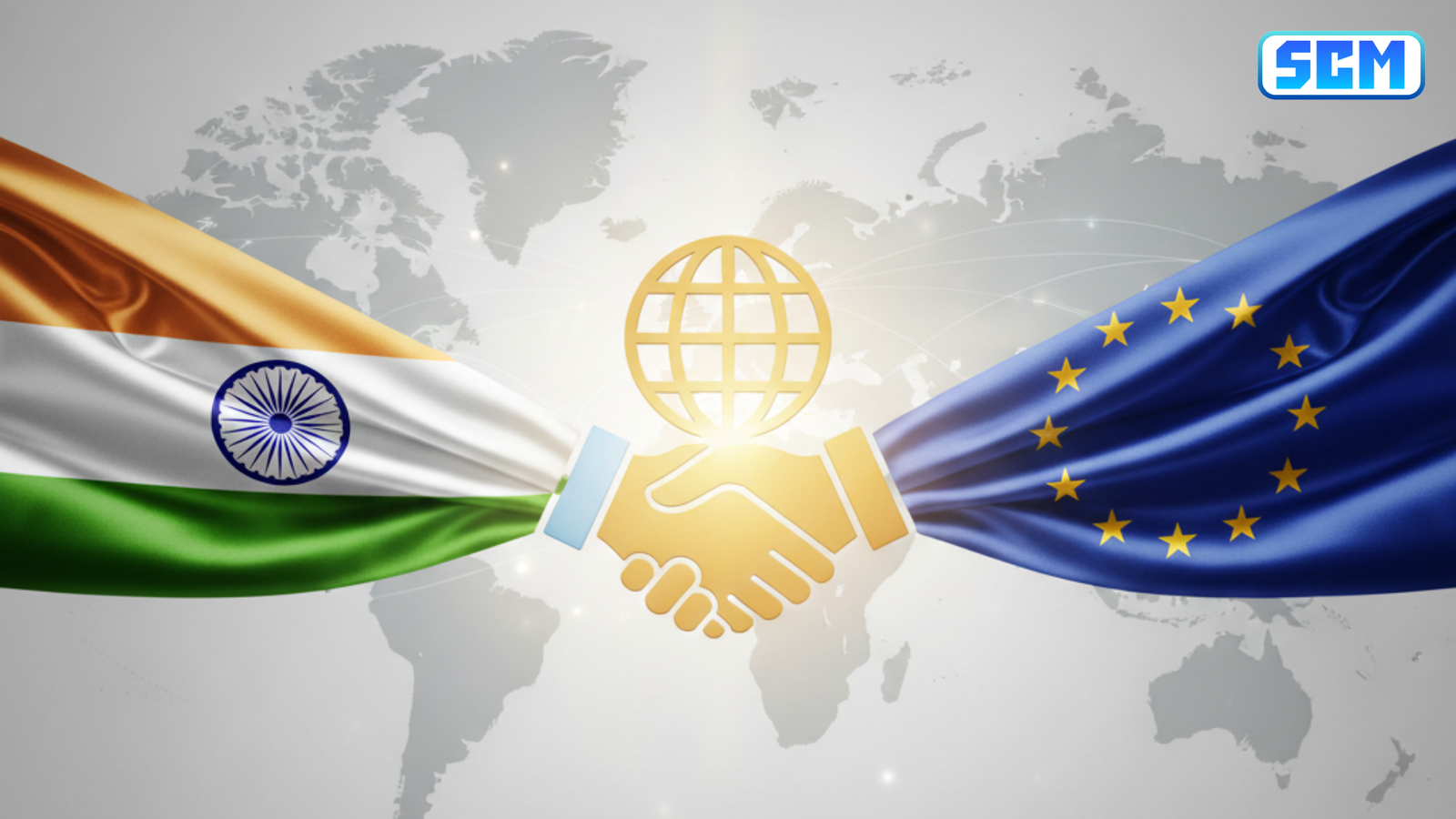
After nearly two decades of on-and-off negotiations, India and the European Union have finally concluded a historic Free Trade Agreement (FTA), widely described by leaders and trade experts as the “mother of all trade deals.” The agreement marks a major turning point in India–EU economic relations and is expected to reshape global trade flows in an era of rising protectionism and geopolitical uncertainty.
A Deal 20 Years in the Making
Talks for the India–EU FTA first began in 2007 but were stalled for years due to disagreements over market access, tariffs, data protection, and regulatory standards. Negotiations were revived in 2022 amid changing global dynamics, including supply-chain disruptions, the China-plus-one strategy, and growing trade tensions involving the US and Europe.
In January 2026, both sides officially announced the successful conclusion of negotiations, calling it one of the most ambitious trade agreements ever signed by either party.
Scope and Scale of the Agreement
The India–EU FTA brings together two massive markets:
- India, the world’s fastest-growing major economy
- The European Union, a 27-nation bloc with a combined GDP exceeding €16 trillion
Together, they represent nearly 2 billion consumers.
Under the agreement:
- 90–97% of goods traded between India and the EU will see tariffs reduced or eliminated over phased timelines.
- Trade in services, investment flows, and regulatory cooperation will be significantly expanded.
- Non-tariff barriers, including customs procedures and technical standards, will be streamlined to reduce friction in cross-border trade.
Key Tariff Reductions and Market Access
One of the most closely watched elements of the deal is tariff liberalization:
1. Automobiles and Industrial Goods (EU exports to India)
- India will gradually cut import duties on European cars, which currently go as high as 100–110%.
- Duties are expected to fall to around 10% over time, with quotas and phased schedules.
- Machinery, medical equipment, electrical goods, and chemicals will also see major tariff cuts.
2. Textiles, Gems & Jewellery, and Chemicals (Indian exports to EU)
- The EU will reduce or eliminate tariffs on Indian textiles, apparel, leather products, and footwear.
- Indian gems, jewellery, pharmaceuticals, and specialty chemicals will gain easier access to EU markets.
3. Agriculture and Sensitive Sectors
- India has protected certain sensitive sectors such as dairy, cereals, and small cars.
- The EU has also maintained safeguards for specific agri-products and wines under quota-based access.
Services, Investment, and Digital Trade
Beyond goods, the FTA places strong emphasis on:
- IT and professional services, allowing easier movement of skilled professionals.
- Financial services, fintech, and digital trade facilitation.
- Investment protection, giving European companies greater confidence to invest in India and vice versa.
- Data governance and cybersecurity standards, though these remain areas of continued dialogue.
This is particularly significant for India’s booming tech sector and the EU’s advanced manufacturing and services industries.
Strategic Importance in a Shifting Global Order
The timing of the deal is no coincidence. With:
- Rising US tariffs and protectionist policies
- Ongoing geopolitical tensions involving China
- Supply-chain realignments post-COVID
Both India and the EU see the FTA as a strategic hedge and a way to strengthen economic sovereignty.
European leaders have emphasized that the pact will reduce dependence on a narrow set of trading partners, while Indian officials have highlighted how it aligns with initiatives such as Make in India, Digital India, and Atmanirbhar Bharat.
Economic Impact and Trade Projections
Early estimates suggest:
- EU exporters could save around €4 billion annually in tariffs once the deal is fully implemented.
- Bilateral trade could double by 2032, significantly boosting exports on both sides.
- The agreement could generate hundreds of thousands of jobs, particularly in manufacturing, logistics, and services.
India’s labour-intensive sectors such as textiles, leather, and gems are expected to benefit the most in the near term, while Europe’s automotive, engineering, and green technology firms stand to gain in the long run.
Environmental, Labour, and Sustainability Commitments
The FTA also includes chapters on:
- Sustainable development
- Climate commitments
- Labour rights and ethical sourcing
Both sides have agreed to align parts of the deal with the Paris Climate Agreement and international labour standards, though implementation details will be closely watched by civil society groups.
Ratification and Timeline for Implementation
Although negotiations are complete, the agreement is not yet in force. It must be:
- Approved by the European Parliament
- Ratified by all 27 EU member states
- Cleared by India’s Union Cabinet and Parliament
This process is expected to take 12–24 months, meaning the FTA could realistically come into effect in 2027 or later.
Challenges and Criticism
Despite the optimism, the deal has not been without controversy:
- Indian MSMEs fear increased competition from European imports.
- European farmers are concerned about cheaper agricultural imports from India.
- Data privacy and regulatory alignment remain sensitive topics.
- Environmental groups worry about the climate impact of expanded trade.
Governments on both sides have promised safeguard clauses, adjustment funds, and phased liberalization to address these concerns.
Conclusion: A New Chapter in India–EU Relations
The India–EU Free Trade Agreement is more than just a trade pact—it is a strategic partnership for the next generation of global commerce. By unlocking market access, modernizing regulations, and strengthening geopolitical ties, the deal has the potential to become a cornerstone of 21st-century trade architecture.
If implemented effectively, the “mother of all deals” could redefine India’s role in global supply chains and give Europe a powerful economic partner in Asia—ushering in a new era of cooperation, growth, and shared prosperity.


