

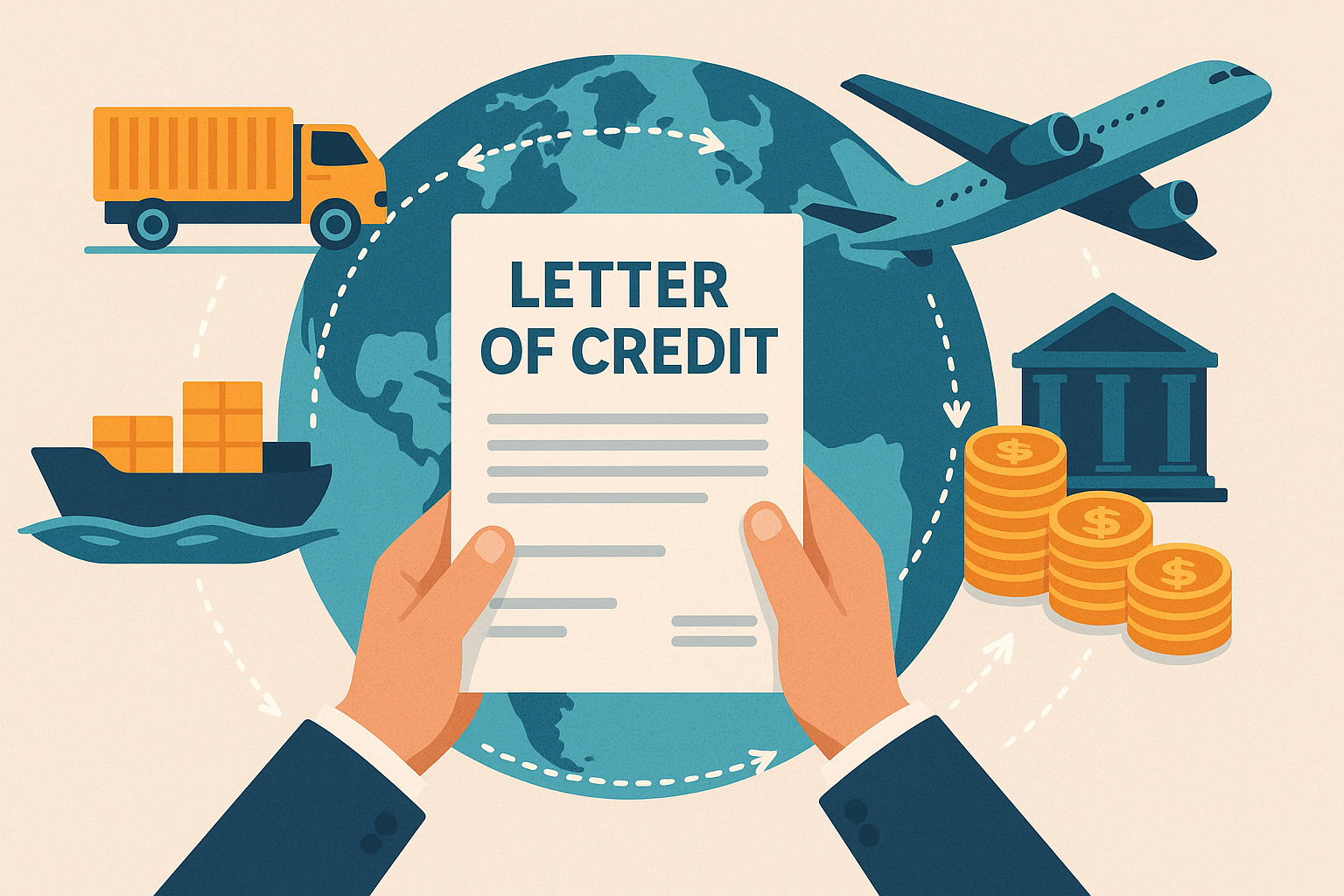
In international trade, trust is everything. Buyers want to be sure they’ll receive what they paid for, while sellers need assurance that they’ll be paid once they ship their goods. But when transactions cross borders — involving different legal systems, currencies, and regulations — that trust can become uncertain.
This is where the Letter of Credit (LC) plays a crucial role. It’s not just a financial document; it’s the backbone of confidence in global commerce. Let’s dive deep into what a Letter of Credit is, how it works, its types, and how it helps businesses, exporters, importers, and logistics professionals operate securely in international trade.
What Is a Letter of Credit?
A Letter of Credit (LC) is a guarantee issued by a bank on behalf of a buyer (importer) to pay a seller (exporter) for goods or services, provided that the seller meets all the terms and conditions mentioned in the LC.
It acts as a safety net for both parties:
- The seller is assured of receiving payment once they present the required documents proving that shipment has been made.
- The buyer is assured that payment will only be released if the seller meets all specified terms — such as delivering goods within deadlines and providing accurate documentation.
In simple terms, an LC reduces the risk of non-payment for the seller and non-performance for the buyer.
Why Letters of Credit Are Vital in International Trade
Trading across borders comes with many uncertainties:
- Distance and lack of direct contact
- Political instability or regulatory differences
- Currency exchange risks
- Possibility of non-delivery or non-payment
A Letter of Credit acts as a trusted bridge that connects the buyer and seller through the banking system, ensuring that:
- The buyer’s bank guarantees payment once the conditions are met.
- The seller can confidently ship goods knowing payment is secured.
This system has made the LC one of the most reliable instruments in international trade finance.
Key Participants in a Letter of Credit Transaction
Each LC involves multiple parties, each performing a specific function:
| Party | Role |
| Applicant (Buyer/Importer) | Requests the LC from their bank and commits to pay for the goods. |
| Issuing Bank | The buyer’s bank that issues the LC and guarantees payment to the seller. |
| Beneficiary (Seller/Exporter) | The party entitled to payment under the LC. |
| Advising Bank | The bank in the exporter’s country that verifies the authenticity of the LC and informs the exporter. |
| Confirming Bank (optional) | Adds its own guarantee to the LC, providing extra security to the exporter. |
| Negotiating Bank (optional) | Examines the documents and facilitates payment or negotiation with the issuing bank |
Each entity ensures the process remains transparent and trustworthy.
The Process: How a Letter of Credit Works
Here’s a step-by-step look at how a typical LC transaction unfolds:
- Agreement Between Buyer and Seller: Both parties sign a sales contract specifying that payment will be made via a Letter of Credit.
- LC Application and Issuance: The buyer applies for an LC from their bank. Once approved, the issuing bank sends the LC to the advising bank in the exporter’s country.
- Verification by Seller: The exporter checks the LC terms to ensure they align with the sales agreement.
- Shipment of Goods: After confirming the LC, the exporter ships the goods and collects all necessary shipping documents.
- Submission of Documents: The exporter presents documents such as the invoice, bill of lading, and packing list to the advising or negotiating bank.
- Document Review and Payment: The bank reviews the documents for compliance with LC terms. If everything is correct, payment is made to the exporter.
- Reimbursement and Delivery: The issuing bank reimburses the advising bank and releases the documents to the buyer, who then takes delivery of the goods.
Different Types of Letters of Credit
There isn’t just one type of LC — several variations exist to meet different trade scenarios.
a. Revocable and Irrevocable LC
- Revocable LC: Can be modified or canceled by the issuing bank without notice to the exporter. (Rarely used today)
- Irrevocable LC: Cannot be changed or canceled without the agreement of all parties involved. (Most common type in modern trade)
b. Confirmed LC
An additional guarantee from another bank (the confirming bank) to ensure payment, even if the issuing bank fails to do so. Commonly used when trading with countries having political or economic risks.
c. Sight LC
Payment is made immediately upon presentation of compliant documents.
d. Usance (Deferred Payment) LC
Payment is made after a specific time period — such as 30, 60, or 90 days from shipment or document acceptance.
e. Back-to-Back LC
Used when a middle trader uses one LC received from a buyer to issue another LC to their supplier.
f. Transferable LC
Allows the beneficiary (exporter) to transfer all or part of the LC value to another party — often used when subcontractors are involved.
g. Standby LC
Functions like a guarantee — the bank pays only if the buyer defaults on payment.
Each LC type serves a different business purpose, depending on trade relationships and financial security needs.
Essential Documents Required in an LC Transaction
In LC operations, documentation is everything. Banks deal with documents, not goods — meaning payment depends solely on whether documents meet the LC terms.
The common documents include:
- Commercial Invoice
- Bill of Lading / Airway Bill
- Packing List
- Certificate of Origin
- Insurance Certificate
- Inspection Certificate (if required)
- Bill of Exchange (Draft)
Even a small mismatch in details — such as spelling errors or incorrect shipment dates — can lead to rejection or delayed payment.
Letters of Credit and the Logistics Sector
For logistics and freight forwarding professionals, the LC process is more than financial paperwork — it directly impacts shipment timelines and documentation accuracy.
Here’s how logistics teams play a key role:
- Freight forwarders ensure all shipping documents comply with LC terms.
- Customs brokers help prepare documents like certificates of origin and invoices according to international standards.
- Warehousing and shipping partners coordinate schedules to align with LC deadlines.
Since a single discrepancy in a Bill of Lading or shipping schedule can cause financial losses, coordination among logistics, banking, and trade teams is essential.
Common Challenges in LC Operations
Despite their reliability, LCs involve certain challenges:
- Complex Documentation: Each LC has strict requirements that must be followed word-for-word.
- High Processing Time: Manual checking and document transfers can delay payment.
- Bank Charges and Fees: Multiple banks may be involved, increasing administrative costs.
- Discrepancy Risk: Even minor clerical errors can lead to payment rejection.
- Limited Transparency: Traditional LC systems rely heavily on paper-based processes, leading to inefficiencies.
Because of these issues, many traders are now shifting toward digital LC processes to save time and avoid costly errors.
The Rise of Digital and Electronic Letters of Credit
The last decade has seen a major shift toward digital trade finance. Banks and corporates are adopting electronic Letters of Credit (e-LC) to make global trade faster and more efficient.
Key Advancements:
- eUCP (Electronic Uniform Customs and Practice): A digital extension of traditional LC rules that allows documents to be submitted electronically.
- Blockchain Technology: Enables secure, transparent, and tamper-proof LC transactions between banks, exporters, and importers.
- Integrated Trade Platforms: Connect logistics, documentation, and banking data — eliminating manual re-entry and paperwork.
Digital LCs not only reduce turnaround time from weeks to days but also improve accuracy and traceability across the supply chain.
Best Practices for Managing Letters of Credit
Whether you’re an exporter, importer, or logistics service provider, following best practices can prevent costly mistakes.
- Review LC Terms Carefully: Ensure the LC exactly matches your sales agreement. Even small wording differences can create disputes later.
- Use Standardized Documentation: Follow international formats like UCP 600 (Uniform Customs & Practice for Documentary Credits) to maintain compliance.
- Communicate with Your Bank Regularly: Stay updated on LC amendments, document requirements, and timelines.
- Coordinate Across Departments: Logistics, finance, and operations teams must stay aligned to meet LC deadlines and shipment schedules.
- Double-Check Every Document: Before submission, review all documents for consistency — dates, values, product details, and signatures.
- Move Toward Digitization: Use digital document management systems or trade platforms to reduce errors and speed up LC processing.
Following these practices builds a smoother, faster, and more reliable trade process.
The Economic and Strategic Importance of LCs
Letters of Credit are not just operational tools — they are strategic enablers of international commerce.
- They enable SMEs to compete globally without fearing non-payment.
- They provide financial discipline — ensuring documentation and compliance are properly maintained.
- They strengthen trade relationships between countries by building financial trust.
- They help in securing finance — as exporters can discount LCs with banks to get immediate working capital.
In a world of fluctuating markets and geopolitical tensions, the LC remains one of the few instruments that guarantee certainty.
The Future of Letters of Credit
As international trade becomes more digital, LCs are evolving from paper-based instruments to smart, automated, and data-driven processes.
The future will focus on:
- Fully digital documentation with real-time validation
- Interconnected trade ecosystems linking banks, customs, and shipping systems
- AI-driven document checks to reduce human error
- Blockchain-secured LC contracts for transparency and fraud prevention
These innovations will make LCs faster, safer, and more accessible — even to small traders in developing economies.
Conclusion
A Letter of Credit is the cornerstone of trust in international trade. It balances the interests of buyers and sellers, minimizes financial risk, and ensures smooth cross-border transactions.
For exporters and importers, understanding the LC process — from documentation to payment — is not just a banking necessity but a strategic business skill.
As technology continues to reshape trade finance, embracing digital tools and best practices around Letters of Credit will help businesses operate with greater efficiency, security, and global reach.
The Letter of Credit may be a century-old concept, but in today’s fast-paced global supply chain, it remains the timeless key to secure and successful trade.


