

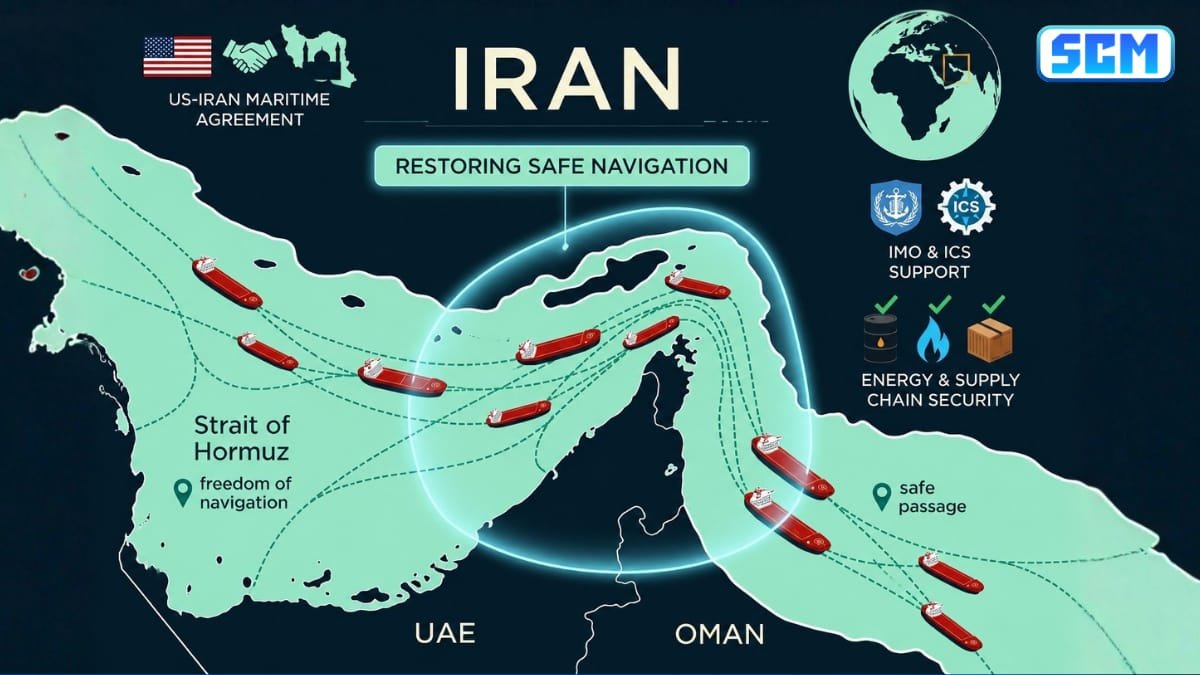
Quick Summary
The International Maritime Organization (IMO) and the International Chamber of Shipping (ICS) have welcomed the latest US-Iran agreement aimed at restoring safe maritime movement through the Strait of Hormuz. The development is expected to reduce pressure on global shipping, stabilize energy transportation, and improve supply chain reliability after months of geopolitical uncertainty in the Gulf region.
Key Highlights
- IMO and ICS support the new US-Iran maritime agreement
- Focus placed on restoring freedom of navigation in the Strait of Hormuz
- Hundreds of vessels and thousands of seafarers were impacted during the crisis
- Shipping insurers and tanker operators expect gradual market stabilization
- Oil, LNG, and container shipping sectors could benefit significantly
- India and Asia may see improved energy supply security
IMO and ICS Welcome Diplomatic Breakthrough in Hormuz Region
Global maritime organizations have responded positively after the United States and Iran reportedly reached an agreement to reduce tensions around the Strait of Hormuz, one of the world’s most critical shipping routes.
The International Maritime Organization (IMO) and the International Chamber of Shipping (ICS) stated that the agreement could help restore stability, protect seafarers, and normalize vessel movement through the Gulf region after months of disruption.
The Strait of Hormuz is considered one of the most important maritime chokepoints globally, handling a massive share of international oil and LNG exports. Any disruption in this region immediately affects freight markets, energy prices, and global supply chains.
Why the Strait of Hormuz Is So Important
The Strait of Hormuz connects the Persian Gulf to the Gulf of Oman and the Arabian Sea. It serves as a key transit route for:
- Crude oil exports from Gulf countries
- LNG shipments from Qatar
- Container cargo moving between Asia, Europe, and the Middle East
- Petroleum and chemical tanker operations
Industry estimates suggest that nearly one-fifth of global oil trade passes through this narrow waterway.
During the recent conflict escalation, vessel operators faced:
- Security threats
- Higher war-risk insurance costs
- Crew safety concerns
- Delayed transits
- Freight market volatility
The crisis also created uncertainty for global energy markets and manufacturing supply chains dependent on Gulf exports.
IMO Calls for Safe and Uninterrupted Navigation
IMO Secretary-General Arsenio Dominguez welcomed the agreement and emphasized the importance of restoring safe navigation and protecting seafarers operating in the Gulf.
According to maritime reports, nearly 500 vessels were waiting for safe transit clearance during the peak of the disruption.
The IMO highlighted several priorities:
- Restoring freedom of navigation
- Ensuring crew safety
- Preventing future maritime escalation
- Supporting global trade continuity
The organization also stressed the need for international cooperation to maintain long-term stability in the region.
ICS Highlights Pressure on Global Shipping Industry
The International Chamber of Shipping stated that the agreement could provide immediate relief to shipping companies and seafarers stranded during the crisis.
ICS noted that shipping crews faced:
- Severe operational uncertainty
- Extended voyage delays
- Mental stress
- Increased security risks
The organization urged governments to continue diplomatic engagement and maintain secure transit corridors for commercial shipping.
Shipping companies are still closely monitoring the region despite the positive diplomatic development.
Impact on Global Shipping and Supply Chains
Oil and LNG Trade Could Stabilize
The Strait of Hormuz plays a central role in transporting:
- Middle Eastern crude oil
- LNG cargoes
- Refined petroleum products
As tensions ease, the shipping industry expects:
- More stable tanker operations
- Reduced freight volatility
- Improved energy supply confidence
- Lower charter rate pressure
Energy-importing countries across Asia, including India, China, Japan, and South Korea, are expected to benefit significantly.
Freight Rates May Gradually Normalize
The conflict had triggered:
- War-risk surcharges
- Higher marine insurance premiums
- Increased tanker operating costs
A sustained peace agreement could help lower operational expenses for vessel operators over the coming months.
However, analysts warn that freight markets may remain cautious until the region achieves long-term geopolitical stability.
Container Shipping Could Improve
Container lines operating through Gulf trade corridors experienced:
- Delayed schedules
- Route adjustments
- Congestion risks
- Increased transit uncertainty
Improved maritime security could help restore schedule reliability and reduce supply chain disruptions for importers and exporters.
India’s Strategic Interest in Hormuz Stability
India closely monitors developments in the Strait of Hormuz because a large portion of its:
- Crude oil imports
- LPG imports
- Energy trade
- Gulf-region commerce
depends on uninterrupted maritime access through the region.
Any prolonged disruption directly impacts:
- Fuel prices
- Import costs
- Industrial supply chains
- Inflation levels
Indian logistics, shipping, and manufacturing sectors may see operational relief if the agreement leads to sustained maritime stability.
Why Shipping Companies Are Still Cautious
Despite optimism, shipping operators remain careful due to:
- Ongoing naval security operations
- Possible regional political tensions
- Maritime inspection concerns
- Mine-clearing activities in certain zones
Many operators are expected to continue using enhanced security protocols until the situation fully stabilizes.
Some insurers may also maintain elevated premiums temporarily until risk assessments improve.
What This Means for the Logistics Industry
The agreement could become a major turning point for global logistics and supply chains if stability continues.
Expected Industry Impact
| Sector | Expected Outcome |
| Tanker Shipping | Improved operational stability |
| LNG Transportation | Better cargo movement reliability |
| Container Shipping | Reduced transit disruptions |
| Marine Insurance | Possible premium reductions |
| Energy Markets | Lower volatility |
| Global Trade | Improved supply chain confidence |
The logistics industry will now closely monitor whether diplomatic progress translates into long-term operational stability in one of the world’s busiest maritime trade corridors.
Conclusion
The positive response from the IMO and ICS signals how critical the Strait of Hormuz remains to global trade and energy transportation.
While the US-Iran agreement has improved market sentiment and reduced immediate fears of maritime escalation, shipping companies and supply chain stakeholders remain cautious about long-term regional stability.
If the agreement holds, the global shipping industry could see:
- Lower operational risks
- Improved vessel movement
- Better freight predictability
- Stronger supply chain resilience
For global logistics, energy markets, and international trade, the coming weeks will be closely watched as the maritime industry assesses whether stability has truly returned to the Gulf region.


