


The world’s shipping industry just lost another chokepoint.
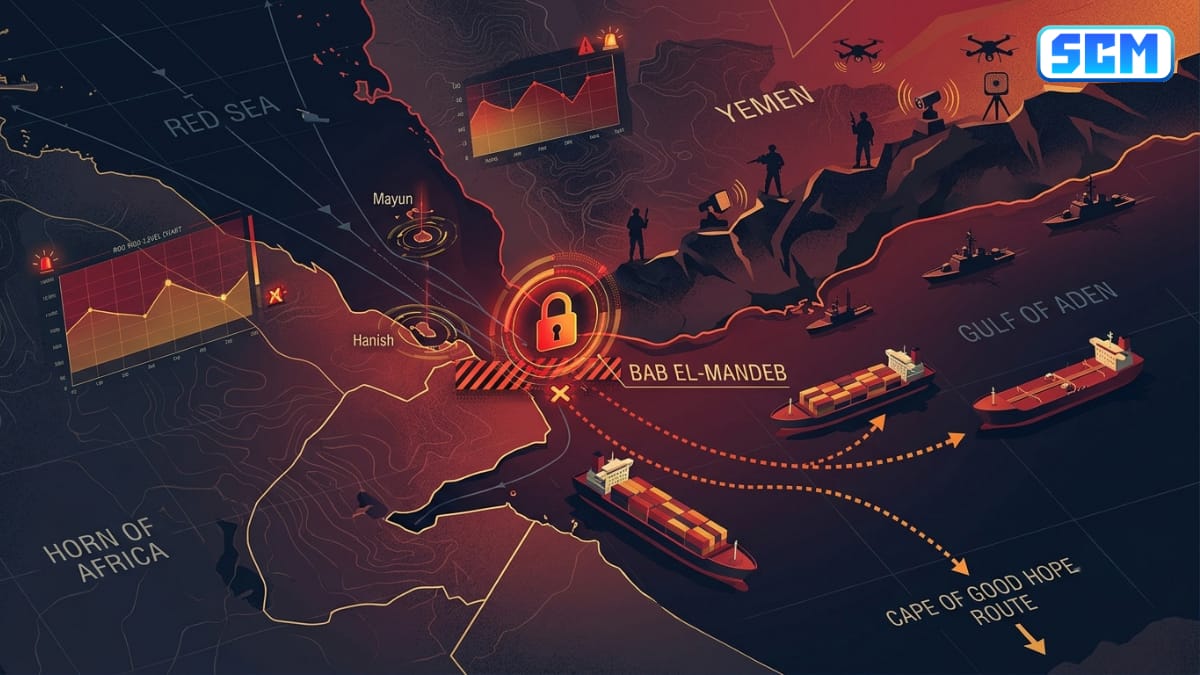
Yemen’s Houthi rebels have seized control of Mayun island, located inside the Bab el-Mandeb Strait itself, and then followed that up by capturing the Greater and Lesser Hanish islands, 160 kilometres north of the strait. They also took the port city of Mokha on Yemen’s mainland.
Three strategic positions. Captured in less than a week. With little resistance.
This is not a minor development. The Bab el-Mandeb is the gateway between the Red Sea and the open ocean. About 12% of the world’s traded goods pass through it. For Saudi Arabia, it was supposed to be the Hormuz bypass, the alternative route for its oil exports now that Iran has made the Persian Gulf increasingly impassable. That alternative route is now under Houthi control.
What Was Taken and Why It Matters
Start with Mayun. It sits directly inside the Bab el-Mandeb Strait. Whoever controls Mayun controls what passes through the strait. The Houthis’ military spokesperson Yahya Saree said after the seizure that maritime navigation is safe for all companies except Saudi vessels. That statement alone should be enough to understand what the Houthis intend to do with this position.
Then came Mokha. The port city on Yemen’s mainland fell to Houthi forces, allowing them to seize a UN compound. All UN staff evacuated safely before the city was taken.
Then came Greater and Lesser Hanish. These islands lie north of the strait and had been held by Saudi-backed Yemeni government forces, hundreds of whom withdrew from the archipelago before the Houthis arrived. The withdrawal happened with little fighting. That is a sign of how quickly the balance of power in this part of Yemen has shifted.
Saudi Arabia’s response was to shut down its East-West Pipeline as a precautionary measure following attacks on its oil infrastructure. That pipeline runs across the width of Saudi Arabia, moving crude from Gulf ports to Red Sea ports, specifically to avoid the Hormuz route. Two regional officials told the Associated Press on Monday that the pipeline will be out of service for weeks while damage is repaired.
The Hormuz Bypass Is Gone
This is the part that matters most for global trade.
Since the US-Iran conflict escalated in February 2026 and the Strait of Hormuz became unreliable for commercial shipping, Saudi Arabia had been routing its oil exports through the East-West Pipeline to Red Sea ports, then south through the Bab el-Mandeb. That route was the workaround.
The Houthis have now taken control of the entrance to that route, damaged the pipeline feeding it, and are launching attacks on Saudi military sites in southern Saudi Arabia. All three legs of the bypass are now under pressure simultaneously.
Saudi Arabia faces a situation where both of its main oil export corridors, Hormuz in the east and Bab el-Mandeb in the west, are compromised at the same time. There is no clean alternative.
Meanwhile, the Gulf states called off a meeting that Oman had arranged for Monday, where Iran and Gulf countries were supposed to discuss negotiations around reopening the Strait of Hormuz. Iran blamed Saudi Arabia for pulling out. Riyadh’s decision to cancel may be connected to the Houthi attacks, but regardless of cause, the diplomatic path toward Hormuz reopening has stalled at exactly the moment Bab el-Mandeb has become contested.
What the Houthis Said
Yahya Saree has been specific: navigation is safe for non-Saudi vessels through Bab el-Mandeb. The Houthis are presenting this as a targeted operation against Saudi Arabia, not a general shipping blockade.
But markets are not reassured by that statement. Experts have consistently described the Houthis as unpredictable. Their track record since 2023 has included attacks on vessels that had no obvious connection to their stated targets. A group that attacked commercial ships for months claiming solidarity with Gaza is not one whose assurances about safe passage carry much weight with insurers and shipping lines.
The Joint War Committee, the London-based body that designates maritime high-risk zones for insurance purposes, is expected to update its Red Sea listings in response to these developments. When war risk zones expand, insurance premiums rise, and some operators pull vessels from affected routes entirely.
The Supply Chain Impact: Layers of Disruption
For the global logistics and supply chain community, the Houthi seizure of Bab el-Mandeb positions adds a second major chokepoint disruption on top of the already compromised Hormuz.
The practical effects are layered.
Saudi oil exports face the most immediate pressure. With Hormuz restricted and Bab el-Mandeb now contested, Saudi Arabia’s options for moving crude to Asian and European markets are significantly reduced. Oil prices responded. Brent was already above $97 a barrel before this week’s Houthi advances.
European importers of Gulf energy will feel this next. The Red Sea route was the primary path for Gulf LNG and crude headed to European terminals. With Bab el-Mandeb under Houthi control and the Red Sea increasingly hostile, the Cape of Good Hope diversion, already in extensive use since late 2023, becomes the default route for a larger share of Gulf-origin cargo. That adds weeks to transit times and significant cost.
Indian importers are also directly exposed. India sources roughly 60% of its crude from the Gulf. The Bab el-Mandeb was the western exit route for that crude heading to Indian Ocean refineries. Tighter Bab el-Mandeb access puts pressure on India’s crude import logistics at a time when Hormuz is already unreliable.
For container shipping, the Red Sea had been slowly and cautiously returning to use after the 2024 Houthi campaign pushed most carriers onto Cape of Good Hope routes. That cautious return is now likely to pause or reverse. Carriers including Maersk, who had been routing some services back through the Red Sea, will need to reassess.
Yemen’s Civil War Returns
There is a broader context here that matters for how long this disruption might last.
The Houthi advances have pushed Yemen back toward full-scale civil war. A truce that had largely held for three years has now collapsed. Saudi-backed Yemeni government forces are trying to regroup. Fighting has been reported near Dhubab, the strategic town north of the Bab el-Mandeb Strait.
But the Houthis’ momentum and the limited resistance they’ve encountered suggest this isn’t a situation that reverses quickly. Taking back Mayun, Mokha, and the Hanish islands from a well-armed force that has captured them and dug in would require a significant military operation, one that Saudi Arabia, already under pressure from multiple fronts, would need to lead or heavily support.
That suggests the Bab el-Mandeb disruption is not a one-week problem. It’s a structural shift in Red Sea shipping risk that could persist for months.
Bottom Line
Two weeks ago, the world’s attention was on Iran’s new restricted zone in the Gulf. Now the Bab el-Mandeb, the other bookend of Middle East shipping, is under Houthi control. Saudi Arabia’s oil pipeline is damaged. The Hormuz diplomatic talks have stalled.
Both ends of the Arabian Peninsula’s shipping geography are disrupted simultaneously. For anyone moving cargo through or around the Middle East, this is the most serious chokepoint situation since the Suez Crisis of the 1950s.
The Cape of Good Hope route is going to get very busy.
Tracking the Red Sea situation and its global supply chain impact? Follow SupplyChain MetaVerse for ongoing coverage as this develops.
