

For almost three decades, the world worked under a simple idea: if countries follow the same trade rules, everyone plays fair and everyone grows.
That idea held the global economy together. Markets expanded, supply chains stretched across continents, and businesses built strategies on the belief that the system was predictable and stable.
But that stability is now slipping.
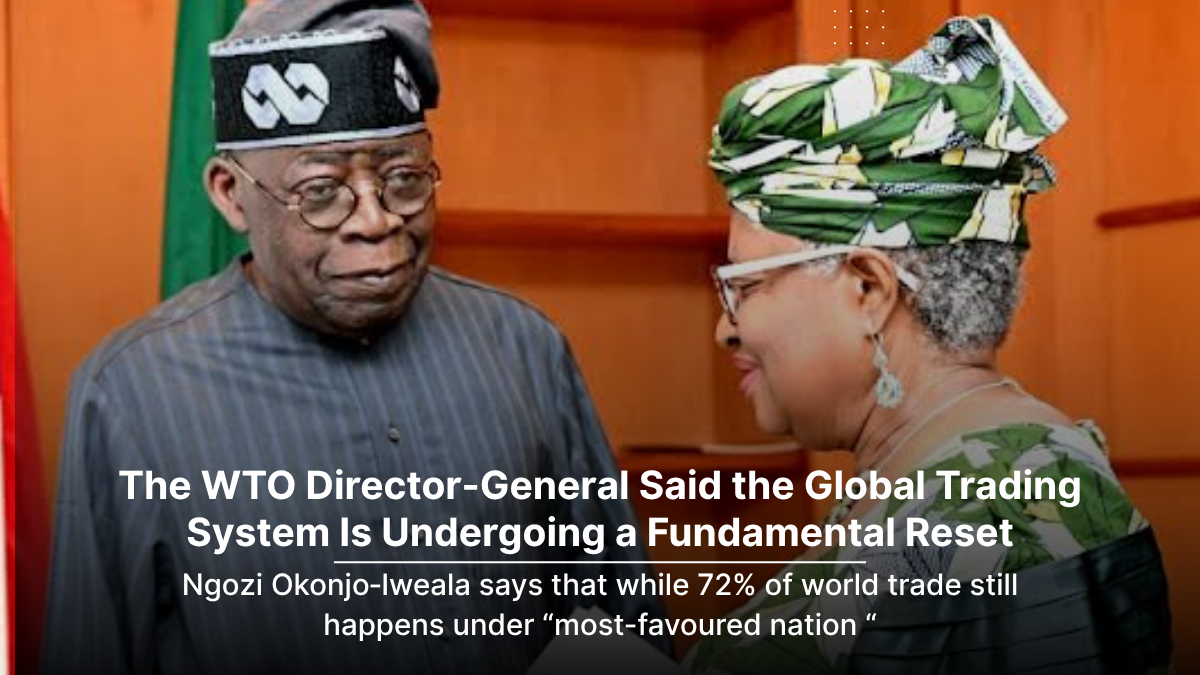
WTO Director-General Ngozi Okonjo-Iweala recently made a point that cuts through the noise: only 72% of global trade is still happening under the traditional “most-favoured nation” (MFN) system.
What this means is that nearly one-third of global trade is now influenced by exceptions, special deals, tariffs, controls, and political conditions that sit outside the old rulebook.
This is not a small crack. This is structural.
And it’s triggering what she calls a reset of the global trade system.
Let’s unpack what that really means.
The World Isn’t Trading Less — It’s Trading Differently
For decades, MFN principles kept things clear: if a country lowers a tariff for one member, it must extend the same treatment to all 164 WTO members.
It created a level field. It held together a complex global web of trade flows.
But the rise of unilateral trade moves is breaking that symmetry.
We’re now seeing:
- tariffs used as political tools
- export controls on chips, rare earths, key minerals
- cross-border taxes linked to climate policies
- targeted sanctions shaping supply-chain decisions
- exclusive regional trade partnerships
- countries selectively choosing who gets favourable access
It’s not that globalisation is reversing. It’s reorganising itself around trust, security, and geopolitics.
Trade isn’t just about economics anymore. It’s about strategy.
The Age of Smaller, More Aligned Trade Networks
Think of the old global trade model as one big marketplace where everyone mingled. Today, that marketplace is splitting into clusters.
We’re seeing:
- the US and EU tightening trade with democratic allies
- China expanding its ties through RCEP and Belt & Road routes
- Middle Eastern economies diversifying into Asia and Africa
- Southeast Asia becoming a neutral trade hub
- Latin America building stronger south-south pathways
- emerging economies forming new digital-trade alliances
Countries are gravitating toward those they trust — economically and politically.
The result? Supply chains are being rewired. Critical materials are being reshored or nearshored. Companies are maintaining multiple supplier bases instead of one.
Trade is becoming less about efficiency and more about resilience.
The Ripple Effect on Businesses and Supply Chains
This reset hits real-world operations in ways that can’t be ignored.
- Costs are becoming unpredictable
- Supply chains must become multi-path
- Trade compliance is now a strategic function
- Technology becomes the backbone of resilience
- Logistic networks are shifting
Where Does India Fit Into This Reset?
India stands out for a few reasons:
- Digital trade strength
- Value chain diversification
- Strategic geography
- South–South trade momentum
In a world of shifting alliances, India has the chance to become a central node in the new trade grid.
What Comes Next?
WTO reform focus areas:
- digital trade modernisation
- faster dispute resolution
- consensus rule reform
- climate–trade alignment
- subsidy frameworks
- developing-country support
The Bottom Line: Prepare for the New Trade Era
Global trade isn’t collapsing. It’s being redesigned.
The winners will be the ones who read the shifts early, diversify fast, and stay agile with technology.
The world map of trade is being redrawn. Understanding it will be the real advantage.


