


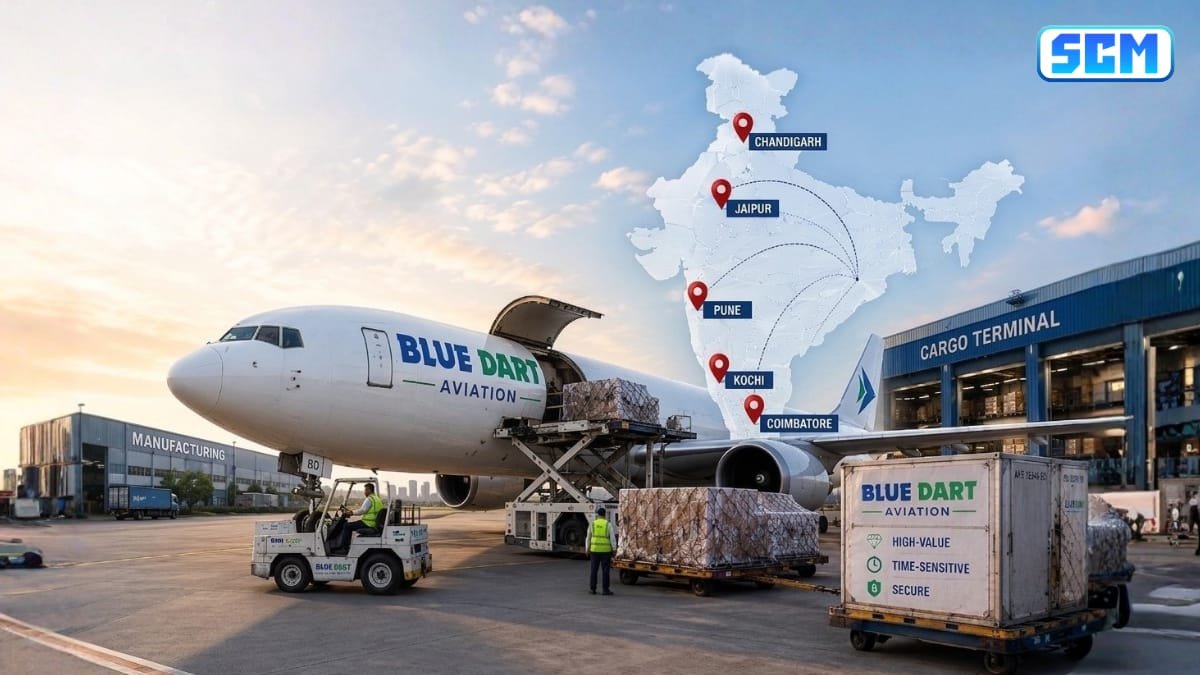
India’s air cargo sector is witnessing a strategic shift as Blue Dart Aviation announces plans to expand operations across five emerging non-metro logistics hubs—Pune, Jaipur, Chandigarh, Kochi, and Coimbatore. The initiative is aimed at capturing growing demand for high-value, time-sensitive cargo generated by manufacturing, pharmaceuticals, electronics, engineering, and e-commerce industries.
The expansion reflects a broader transformation in India’s supply chain landscape, where industrial growth is increasingly occurring outside traditional metropolitan centers such as Mumbai, Delhi, Bengaluru, and Chennai.
With plans to handle approximately 100 tonnes of cargo daily from these emerging hubs over the next five years, Blue Dart is positioning itself to capitalize on India’s rapidly evolving logistics ecosystem.
Quick Summary
Blue Dart Aviation has announced plans to expand its air cargo operations across Pune, Jaipur, Chandigarh, Kochi, and Coimbatore over the next five years. The company aims to handle approximately 100 tonnes of high-value cargo daily from these emerging logistics hubs. The move reflects India’s growing manufacturing base beyond metro cities and is expected to strengthen regional supply chain connectivity.
Key Highlights
- Five emerging cargo hubs identified for expansion.
- Focus on electronics, pharmaceuticals, engineering goods, and e-commerce shipments.
- Target throughput of 100 tonnes per day.
- Supports India’s manufacturing and export growth strategy.
- Encourages logistics decentralization beyond major metros.
- Expected to improve air freight accessibility for Tier-1 and Tier-2 industrial clusters.
- Creates opportunities for freight forwarders and regional exporters.
Why Blue Dart Is Expanding Beyond Major Metro Airports
For decades, India’s air cargo industry has been heavily concentrated around major metropolitan airports. However, recent industrial development patterns have created strong demand for logistics infrastructure closer to manufacturing centers.
Government initiatives such as:
- Production Linked Incentive (PLI) schemes
- Make in India
- National Logistics Policy
- Industrial corridor projects
- Export promotion programs
have encouraged companies to establish manufacturing facilities in Tier-1 and Tier-2 cities.
As a result, regional industrial clusters now require faster access to domestic and international markets, creating new opportunities for dedicated air cargo services.
Blue Dart’s expansion strategy is designed to serve these emerging cargo corridors before they become saturated.
The Strategic Importance of the Five Selected Cities
Pune: Automotive and Engineering Powerhouse
Pune has emerged as one of India’s largest manufacturing ecosystems.
Major industries include:
- Automotive manufacturing
- Auto components
- Engineering equipment
- Electronics manufacturing
- Industrial machinery
Many manufacturers require urgent movement of spare parts, components, and production-critical shipments, making air cargo an essential transportation mode.
Jaipur: Growing Export and SME Hub
Jaipur has strengthened its position as an export-focused city.
Key industries include:
- Gems and jewellery
- Textiles
- Handicrafts
- Fashion products
- Small and medium enterprises
Many of these products carry high value and require secure, rapid transportation, creating strong demand for premium cargo services.
Chandigarh: Pharmaceutical and Healthcare Logistics Center
The Chandigarh region has become an important hub for:
- Pharmaceuticals
- Medical devices
- Healthcare products
- Industrial manufacturing
Temperature-sensitive and time-critical healthcare shipments often depend on reliable air freight connectivity.
Kochi: Gateway for International Trade
Kochi plays a vital role in southern India’s logistics network.
The city supports:
- Seafood exports
- Electronics imports
- Healthcare logistics
- International trade activities
Its strategic coastal location makes it an important multimodal logistics hub connecting air, sea, and road transportation.
Coimbatore: Manufacturing and Industrial Excellence
Coimbatore is one of India’s leading industrial centers.
Key sectors include:
- Engineering goods
- Pumps and motors
- Textile machinery
- Industrial equipment
- Precision manufacturing
Businesses in the region increasingly require faster transportation solutions to support domestic distribution and export commitments.
Focus on High-Value Cargo Rather Than Bulk Freight
Unlike traditional freight carriers that compete in bulk transportation markets, Blue Dart is targeting premium cargo categories where speed, reliability, and security are critical.
The company is expected to focus on:
- Electronics
- Semiconductors
- Pharmaceuticals
- Healthcare products
- Automotive spare parts
- Industrial components
- Engineering goods
- E-commerce shipments
- High-value manufacturing products
These sectors typically prioritize transit time and shipment integrity over transportation cost, making air cargo the preferred logistics solution.
What This Means for India’s Supply Chain Industry
Stronger Regional Connectivity
Manufacturers located outside major metropolitan regions will gain access to faster transportation networks.
Faster Delivery Cycles
Improved air cargo connectivity can significantly reduce delivery lead times for high-priority shipments.
Support for Export Growth
Regional exporters will benefit from easier access to domestic air cargo gateways and international supply chains.
Improved Supply Chain Resilience
Diversifying cargo operations across multiple cities reduces dependency on a limited number of major airports.
Growth of Tier-2 Logistics Infrastructure
The investment could encourage additional logistics providers, warehousing operators, and freight forwarders to expand operations in these emerging hubs.
Fleet Expansion Remains Demand-Driven
Blue Dart has indicated that immediate aircraft fleet expansion is not a priority.
Instead, the company plans to:
- Optimize existing freighter capacity
- Monitor cargo demand from new hubs
- Expand fleet resources as volumes increase
This phased approach allows the company to manage costs while ensuring sufficient capacity to support future growth.
Industry Analysis: A Sign of India’s Logistics Decentralization
Blue Dart’s announcement highlights a larger trend reshaping India’s logistics industry.
Historically, most cargo activity flowed through a handful of metropolitan airports. However, manufacturing growth is now becoming more geographically distributed.
As industrial production expands into emerging cities, logistics providers must build infrastructure closer to production centers.
This decentralization is expected to:
- Reduce transportation bottlenecks
- Lower transit times
- Improve service levels
- Support regional economic development
- Enhance India’s export competitiveness
For freight forwarders, exporters, manufacturers, and supply chain professionals, Blue Dart’s move signals growing confidence in India’s regional industrial economy.
