


Quick Summary
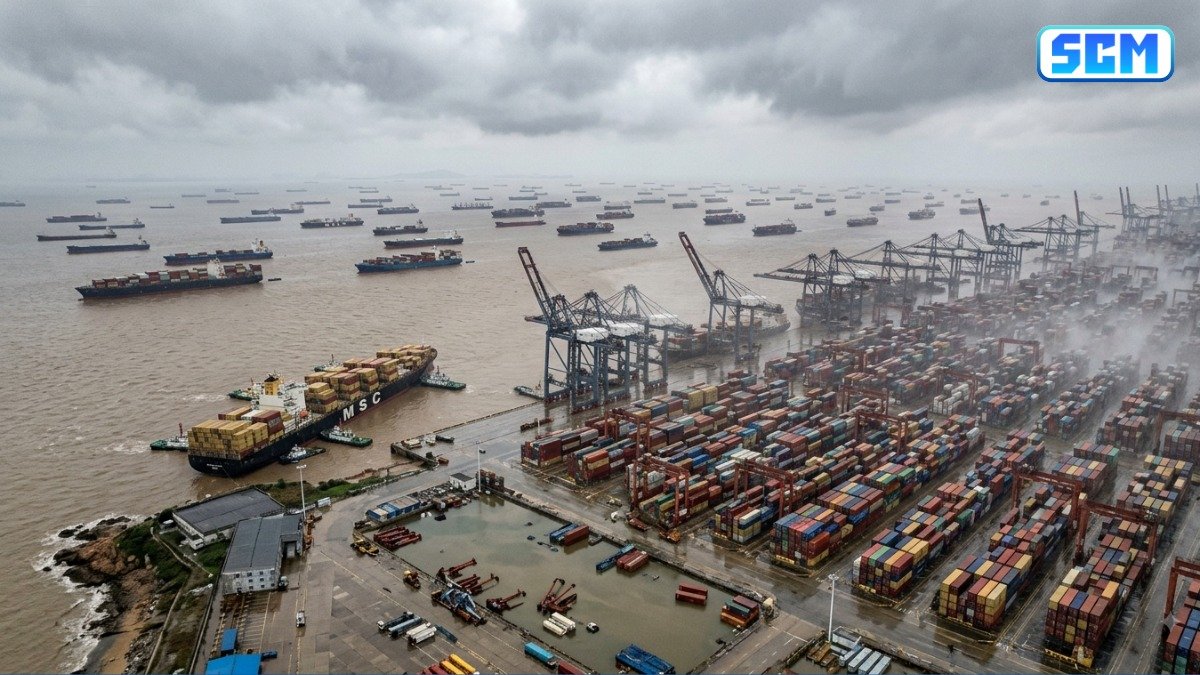
Typhoon Dolphin — the strongest cyclone to hit China’s east coast in 2026 — struck Ningbo on August 9, forcing three-day closures across multiple container terminals at Shanghai and Ningbo and leaving more than 2.4 million TEUs of containership capacity stranded across North Asia as of August 12. The storm is the third tropical storm to hit China’s east coast in five weeks, following Typhoons Bavi and Noul in July, compounding congestion that was already building before Dolphin made landfall. Shanghai berth waiting times now stand at 5-8 days; Ningbo vessel waits are running 3-5 days with a 7-day average waiting time of 2.26 days — up nearly 15 hours from last week. The queue-to-berth ratio at Shanghai and Ningbo has reached 3.5 — the highest of any major port globally with more than 20 ships at anchorage. One MSC vessel — the 8,401 TEU MSC Silvana VIII — ran aground near Zhoushan and is at risk of sinking after unsuccessful refloating attempts. Clearing the backlog is expected to take several weeks. For Indian importers, exporters, and freight forwarders with cargo moving through Chinese ports, the disruption is immediate, significant, and not yet resolved.
What Typhoon Dolphin Did to Shanghai and Ningbo — The Data
The scale of the Typhoon Dolphin disruption is best understood through the vessel and port data rather than the storm meteorology.
Before the storm struck, vessels destined for Shanghai and Ningbo had already moved out of anchorage areas to shelter — standard practice when a significant typhoon is forecast. Kuehne+Nagel’s seaexplorer data shows that only one vessel remained in Shanghai’s official anchorage area on August 9 at the storm’s peak. By August 12, 117 vessels had returned to the Shanghai port anchorage area and 60 to Ningbo — a combined return of 177 vessels across the two ports in roughly three days, all competing for berth slots simultaneously.
The queue-to-berth ratio of 3.5 at Shanghai and Ningbo is a precise indicator of how severe the backlog is: for every vessel currently berthed, 3.5 vessels are waiting at anchorage. At a major port running normally, this ratio typically sits well below 1. A ratio of 3.5 means the ports are processing cargo at less than a third of the rate needed to keep up with vessel arrivals — and that gap will persist until enough vessels have been processed to draw down the queue.
Seven ultra-large container vessels with capacities exceeding 20,000 TEU were awaiting berthing at Ningbo alone as of the latest data — including the 24,188-TEU OOCL Felixstowe and the 24,116-TEU MSC Raya. When vessels of this size are sitting at anchorage rather than working cargo, the impact on schedule reliability cascades across every port these vessels are scheduled to call next.
Congestion has also spread southward — ports in Southern China, which were already recovering from Typhoon Noul in July, are experiencing further delays as vessels reroute or adjust rotations in response to the Dolphin backlog at Shanghai and Ningbo.
This Is the Third Storm in Five Weeks — Why the Cumulative Effect Matters
Typhoon Dolphin is not arriving into a clean slate. It is the third significant tropical storm to hit China’s east coast in five weeks — after Typhoon Bavi and Typhoon Noul both struck in July 2026.
The cumulative effect of three consecutive storms is operationally more damaging than any single storm of equivalent intensity, for a specific reason: port recovery from a typhoon disruption requires vessels and cargo to flow normally in the weeks after the storm to work down the backlog. When a second storm arrives before the first backlog has cleared, the queue gets longer rather than shorter. When a third storm arrives while the second storm’s backlog is still being processed, the congestion compounds again.
This is exactly the situation at Shanghai and Ningbo in August 2026. The vessel backlog from Typhoons Bavi and Noul in July had not fully cleared when Typhoon Dolphin struck. The result is a congestion layer cake — multiple weeks of delayed vessel calls stacked on top of each other — that industry analysts at Linerlytica say will take several weeks to fully clear.
Freight forwarder CH Robinson has advised customers that ports across East China are implementing contingency measures, and that schedule volatility should be expected through the recovery period. Inland supply chains have been separately affected by the storm — torrential rain caused widespread flooding stretching north toward Beijing and west to Wuhan in Hubei province, disrupting road and rail freight connections to and from the affected port zones.
The MSC Silvana VIII — A Casualty That Adds Complexity
Beyond the port congestion, Typhoon Dolphin has claimed a direct maritime casualty: the MSC Silvana VIII, an 8,401-TEU container vessel built in 2006, ran aground near Zhoushan after the storm and is half-submerged following unsuccessful refloating attempts.
A vessel of this size running aground near a major Chinese port creates several complications beyond the immediate loss of the ship and its cargo. Salvage operations in or near port approaches can affect navigation and berthing operations at nearby terminals. Cargo on board — which may include containers of goods destined for multiple ports globally — enters a complex salvage and insurance process. And any fuel or container cargo spillage creates environmental risk management requirements that add further operational complexity to an already congested port zone.
For cargo owners with shipments on the MSC Silvana VIII, engagement with their freight forwarder and cargo insurance provider is immediately necessary to understand the status of their specific containers and the claims process.
What This Means for India — The Supply Chain Implications
For Indian importers, exporters, and freight forwarders, Typhoon Dolphin’s impact on China’s ports is not a distant maritime story — it is an active supply chain disruption with direct commercial consequences.
Indian importers sourcing from China: India imports significant volumes from Chinese manufacturers across electronics, machinery, chemicals, textiles, and consumer goods. Cargo that was scheduled to depart Shanghai or Ningbo in the August 7-12 window is delayed. Vessels that were scheduled to call at Shanghai or Ningbo and then proceed to Indian ports — Nhava Sheva, Mundra, Chennai — are running behind schedule, meaning arrivals at Indian ports will be delayed by the berth waiting time accumulating in China. Importers managing just-in-time inventory should engage their freight forwarders immediately to get the latest estimated departure dates for their specific cargo.
Indian exporters with transshipment through Chinese hubs: Some Indian export cargo moves through Chinese hub ports as part of its routing to destinations in East Asia, the US West Coast, or other markets. This cargo is affected by the same congestion — vessels collecting Indian export cargo at transshipment hubs connected to Chinese ports will be running delayed schedules.
Freight rate implications: Drewry has noted that the constrained container capacity caused by Typhoon Dolphin’s disruption is providing further support to freight rates on the trans-Pacific trade lane — a signal that the supply-side tightening from vessel delays is already feeding into rate movements. Indian exporters pricing shipments for the coming weeks should factor in potential freight rate volatility as the China congestion works through the system.
Air freight as a contingency: For time-sensitive cargo where the sea freight delay is commercially unacceptable, air freight from China to India or air freight of Indian-manufactured substitutes is worth evaluating — though capacity may be tighter than usual given that Typhoon Dolphin also disrupted air operations in East China, which are normalising but remain congested mid-week.
Practical Guidance for Freight Forwarders Managing China-Origin Cargo
Based on the current operational data, here is a realistic picture of what freight forwarders and their clients should be planning around:
Shanghai: Berth waiting times of 5-8 days. Yard density high. Trucking congestion at port gates. Operations resumed Tuesday morning but working through a significant backlog.
Ningbo: Vessel waits of 3-5 days. Container handling gradually resuming after Monday afternoon restart. 7-day average wait time 2.26 days and rising.
South China ports: Largely normal with minor delays — for cargo that can be rerouted through Guangzhou, Shenzhen, or Yantian, this may be worth exploring depending on the specific trade lane.
Rail and feeder services: 2-4 days delayed on inland transport connections to affected port zones due to flooding-related road and bridge impacts.
Recovery timeline: Industry consensus is several weeks for the backlog to clear — the Loadstar’s Linerlytica-sourced analysis and Omnitrans both point to mid-to-late August as the likely recovery period, with schedule normalisation extending into September for some services.
Bottom Line
Typhoon Dolphin has created the most significant China port congestion event of 2026 so far — compounding two months of sequential storm disruptions into a backlog that will take several weeks to clear. The 2.4 million TEU stranded figure, the 3.5 queue-to-berth ratio at Shanghai and Ningbo, and the MSC Silvana VIII grounding near Zhoushan together paint a picture of a port system under serious near-term stress. For Indian supply chain operators, the immediate priority is visibility — understanding exactly which vessels and terminals your cargo is moving through, and what the realistic revised ETAs look like. The situation is recovering, but it is not recovered yet.
Managing cargo through Chinese ports during the Typhoon Dolphin disruption? Share your current experience — we are tracking the China congestion situation as it develops.
