


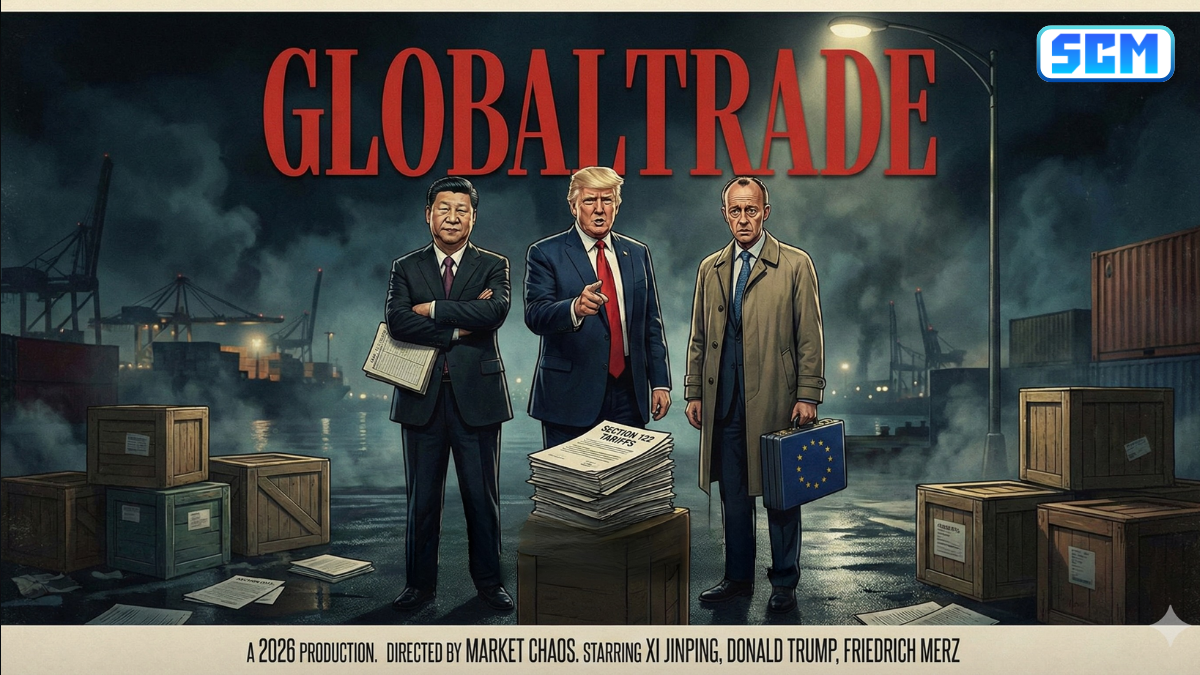
If the global trade landscape of early 2026 feels like a high-stakes crime drama, it’s because the rules are being rewritten in real-time. We’ve moved past simple market fluctuations into a territory of “organized commerce”—where every tariff, court ruling, and diplomatic pivot is a calculated move in a larger game of power.
The events of February 15–22, 2026, have officially pushed us over the edge. Between the U.S. Supreme Court’s (SCOTUS) blockbuster decision and the immediate retaliation from the White House, the “Global Supply Chain” isn’t just taking a hit; it’s lying on the asphalt like a victim in a Scorsese flick.
Here is the breakdown of the “Three Kings” and the chaos currently defining our industry.
1. The SCOTUS “Hit” and the Section 122 Retaliation
On February 20, the U.S. Supreme Court delivered a 6:3 ruling that sent shockwaves through the maritime and logistics sectors. The Court struck down billions in tariffs previously imposed under the International Emergency Economic Powers Act (IEEPA), stating the President exceeded his authority.
For a fleeting moment, markets expected a “tariff holiday.” That lasted exactly four hours.
By the next morning, the administration “whacked” the market with a brand-new 15% global import surcharge under Section 122 of the Trade Act of 1974.
The 2026 Reality: “In this business, you don’t sue your partners. You just tax them until they can’t stand up.” Unlike previous country-specific rates, this is a blanket surcharge. While it offers a slight reduction for countries like India (which was previously facing 18%), it removes the “comparative advantage” many regional hubs spent 2025 building.
2. The “Three Kings” of the 2026 Standoff
The current trade war is being directed by three central figures, each navigating a different version of the same storm:
The Enforcer: Xi Jinping (China)
With U.S. relations in a “paper-thin” truce, Xi has spent early 2026 executing a massive pivot to Southeast Asia. Through the CAFTA 3.0 upgrade, China is integrating digital and green trade across ASEAN nations. They aren’t waiting for Western markets to settle; they are building a “Digital Silk Road” that bypasses the traditional tariff walls entirely.
The Don: Donald Trump (USA)
Defiant following the SCOTUS ruling, the U.S. administration is doubling down on “Protectionism as a Service.” By invoking Section 122, they’ve set a 150-day timer on global trade. It’s a move designed to pressure partners into bilateral concessions before the July expiration date. For logistics managers, this means “normalization” is dead; the only constant is the next Saturday morning social media announcement.
The Diplomat: Friedrich Merz (Germany/EU)
The newly minted German Chancellor is caught in a classic “squeeze.” With €251bn in trade with China and a rocky relationship with Washington, Merz is heading to D.C. next week to present a “Coordinated European Position.” Europe is already eyeing a €93 billion “trade bazooka” of retaliatory tariffs if the U.S. surcharge isn’t moderated for EU exporters.
3. The Logistics Impact: The “Tariff Roller Coaster”
For the freight forwarders and logistics professionals on the ground, this isn’t just policy it’s operational warfare.
Inventory Shocks: Importers are rushing to restock before the new surcharge fully integrates, leading to artificial spikes in container demand.
Rate Volatility: While the Drewry Index showed a minor 1% decline last week, the uncertainty around Section 122 is expected to trigger “blank sailings” as carriers try to protect spot rates against shifting volumes.
Strategic Re-Sourcing: The shift toward nearshoring in Mexico and Vietnam is being re-evaluated every 48 hours. If a blanket 15% surcharge applies everywhere, does moving production still make sense?
Conclusion: Chaos is the New Strategy
The “Global Trade GoodFellas” poster isn’t just a meme; it’s a blueprint. In 2026, the global supply chain is being treated as loot to be divided, taxed, and rerouted.
Whether you’re managing a single lane from Navi Mumbai or a global network across 50 countries, the message is clear: Agility is no longer a perk; it’s a survival requirement.
How is your cargo moving through this “Tariff Roller Coaster”? Are you holding inventory, or are you pushing for “speed to market” before the next 150-day window closes?
