


Quick Summary
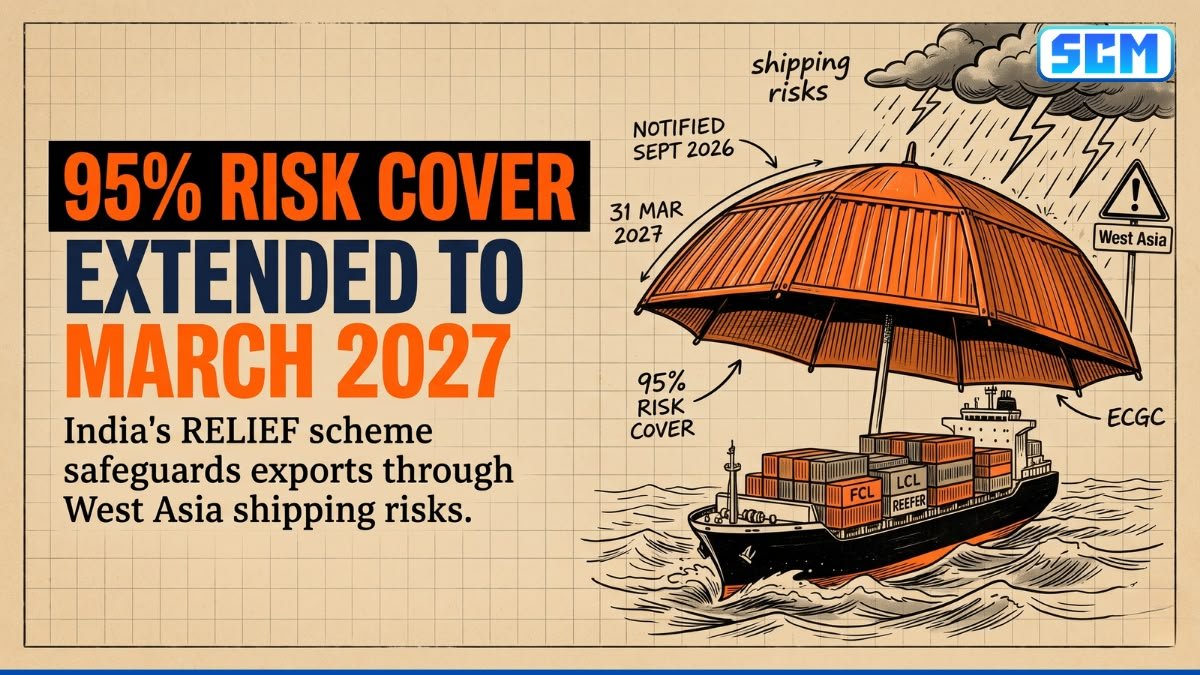
The Government of India has extended Component II of the RELIEF scheme until 31 March 2027. The initiative offers eligible exporters 95% risk coverage through ECGC-backed insurance arrangements and protection against increases in insurance premiums beyond pre-disruption levels. The extension comes amid continuing geopolitical disruptions affecting maritime logistics across West Asia.
Key Highlights
- RELIEF Component II has been extended until 31 March 2027.
- The extension was notified under Notification No. 37/2026-27 dated 30 September 2026.
- Eligible exporters can access 95% risk coverage through qualifying ECGC insurance arrangements.
- Standalone and Whole Turnover Policies obtained on or after 16 March 2026 may qualify, subject to scheme conditions.
- Eligible cargo categories include full container load (FCL), less than container load (LCL) and refrigerated container shipments, excluding energy shipments.
- Exporters must follow the prescribed ECGC registration and claim-submission process.
Government Extends RELIEF Scheme for Exporters Until March 2027
The Government of India has extended Component II of the Resilience & Logistics Intervention for Export Facilitation (RELIEF) initiative until 31 March 2027, providing continued insurance-related support to eligible Indian exporters affected by disruptions in West Asian maritime trade.
The Department of Commerce announced the extension on 26 October 2026. The measure was notified through Notification No. 37/2026-27 dated 30 September 2026 under the government’s Export Promotion Mission (EPM).
The decision comes amid continuing geopolitical uncertainty in West Asia and its impact on shipping operations across the Gulf and adjoining regions. These disruptions can increase freight expenses, raise insurance premiums and create additional risks for businesses exporting goods to affected destinations.
The extended timeline gives eligible exporters more time to obtain qualifying insurance coverage for upcoming shipments. However, the extension applies specifically to Component II of RELIEF, and benefits remain subject to the scheme’s eligibility requirements and applicable policy conditions.
What Is the RELIEF Scheme?
RELIEF stands for Resilience & Logistics Intervention for Export Facilitation. Launched on 19 March 2026, the initiative was designed to support Indian exporters facing extraordinary freight cost increases, higher insurance premiums and war-related export risks associated with disruptions across the Gulf and wider West Asian maritime corridor.
The scheme operates under the Export Promotion Mission, with the Export Credit Guarantee Corporation of India (ECGC) playing a central role in providing insurance-related support.
International shipping disruptions can affect exporters in several ways. Vessels may face route changes, insurance providers may reassess war-related risks, and shipping costs can become more difficult to predict. These factors can reduce profit margins and make it harder for businesses to fulfil export orders at previously agreed prices.
RELIEF seeks to address some of these challenges through targeted support for eligible shipments and qualifying insurance arrangements.
What Does the Extension Mean for Indian Exporters?
The extension keeps Component II available until 31 March 2027, giving eligible businesses additional time to arrange insurance protection for qualifying shipments.
The support is particularly relevant for exporters whose cargo movements or insurance arrangements are exposed to geopolitical risks associated with designated West Asian destinations.
The principal benefits include:
- Enhanced risk coverage: Component II provides 95% risk coverage to encourage eligible exporters to obtain ECGC insurance for upcoming shipments.
- Protection against premium increases: Eligible exporters receive protection against insurance premium increases beyond pre-disruption levels during the applicable period.
- Additional time for eligible shipments: The extended deadline allows qualifying shipments to be considered under the programme for a longer period.
- Greater risk-management support: Appropriate insurance arrangements can help exporters assess potential exposure when planning international shipments.
The scheme does not automatically reimburse every freight increase, shipment delay or commercial loss. Exporters must confirm that their policies, cargo and transactions satisfy the applicable conditions.
How Does the 95% Risk Coverage Work?
Under Component II, the government provides 95% risk coverage to encourage eligible exporters to obtain insurance cover through ECGC for upcoming shipments to specified regions.
This is an insurance-related risk-support arrangement, not a blanket payment of 95% of an export invoice or shipping bill. The actual protection available for a shipment depends on the scheme’s provisions, the qualifying policy and the circumstances of a claim.
The component also protects eligible exporters against increases in insurance premiums beyond pre-disruption levels during the applicable period.
For example, an exporter planning a shipment to an eligible destination may face higher insurance costs because of changing geopolitical conditions. A qualifying insurance arrangement under RELIEF may provide the prescribed risk protection and premium-related benefit, subject to the scheme’s requirements.
Exporters should review the policy wording and official scheme notification before assuming that a particular loss or premium increase is covered.
Which Insurance Policies and Cargo Shipments Are Eligible?
The government has specified that Component II benefits are available for qualifying Standalone Policies and Whole Turnover Policies obtained on or after 16 March 2026.
The notified cargo categories include:
- Full Container Load (FCL): Shipments in which a container is allocated to one shipper’s cargo.
- Less than Container Load (LCL): Shipments in which cargo from multiple shippers is consolidated into a container.
- Refrigerated container shipments: Cargo transported in temperature-controlled reefer containers.
Energy shipments are excluded from the covered cargo categories under Component II.
Meeting the policy-date and cargo-category requirements alone does not guarantee eligibility. Exporters must also verify the destination, shipment timing, insurance terms and other applicable conditions under the official notification.
How Can Exporters Apply for RELIEF Benefits?
Exporters seeking coverage under the RELIEF initiative must use the prescribed ECGC process and submit the necessary claims and supporting documents through the ECGC customer portal.
Businesses should take the following steps:
- Review the official notification: Read Notification No. 37/2026-27 and the underlying RELIEF scheme provisions to understand the applicable eligibility requirements.
- Check insurance eligibility: Confirm whether the Standalone or Whole Turnover Policy meets the policy-date and other prescribed conditions.
- Verify shipment details: Check the destination, cargo category, shipment timeline and applicable policy terms.
- Complete exporter registration: Follow the registration and account-access procedure specified by ECGC.
- Prepare supporting documents: Keep the relevant policy, shipment records and claim documentation ready as required by the scheme.
- Submit through ECGC: File claims and supporting documents using the official ECGC customer portal.
The government has also pointed exporters to ECGC’s official YouTube channel, @ecgcltd7016, for guidance on generating login credentials, completing registration and submitting claims.
Official portal: https://www.ecgcltd.in/
Exporters should verify the latest procedural instructions and document requirements directly with ECGC before submitting a claim.
Why the RELIEF Extension Matters for Supply Chains
The extension comes at a time when geopolitical uncertainty can affect shipping schedules, freight pricing and insurance availability across international trade routes.
For exporters, these issues can create operational and financial pressure. A shipment that was commercially viable when an order was accepted may become less profitable if freight or insurance costs rise before dispatch. Smaller businesses may have less financial flexibility to absorb these unexpected expenses.
Continued access to qualifying insurance protection can help exporters evaluate risks before committing cargo to affected trade routes. It can also support better coordination between exporters, freight forwarders, customs brokers, shipping lines and insurance providers.
Businesses should nevertheless treat RELIEF as one part of a broader risk-management strategy. They should continue monitoring shipping advisories, reviewing contractual responsibilities, checking cargo insurance and assessing alternative routing options where commercially and operationally feasible.
The extension does not guarantee stable freight rates or uninterrupted maritime services. Its practical value depends on the shipment’s eligibility and the terms of the applicable insurance arrangement.
What Should Exporters Do Before 31 March 2027?
Exporters trading with eligible destinations should avoid waiting until the final weeks of the extended period to review their coverage.
Businesses can begin by identifying upcoming shipments, checking whether their policies qualify and confirming the documents required by ECGC. They should also maintain clear records of shipment dates, cargo details, insurance premiums and any relevant correspondence concerning changes in risk or coverage.
Where an export contract involves tight margins, companies should reassess their freight and insurance assumptions before confirming prices or dispatch schedules. Coordination between the commercial, finance, logistics and documentation teams can help prevent avoidable delays in insurance and claim processing.
The deadline is important, but eligibility and compliance remain central to accessing the scheme’s benefits.
Conclusion
The extension of RELIEF Component II until 31 March 2027 gives eligible Indian exporters additional time to access prescribed insurance-related support amid continuing disruptions in West Asian maritime logistics.
The 95% risk-coverage provision and protection against increases in insurance premiums beyond pre-disruption levels may help eligible businesses manage certain risks associated with qualifying shipments. However, the scheme is not an automatic reimbursement mechanism for all export losses or logistics expenses.
Exporters should review the official notification, confirm their policy and shipment eligibility, and follow ECGC’s prescribed registration and claims procedures. Timely verification will be essential to making use of the extended support period.
