

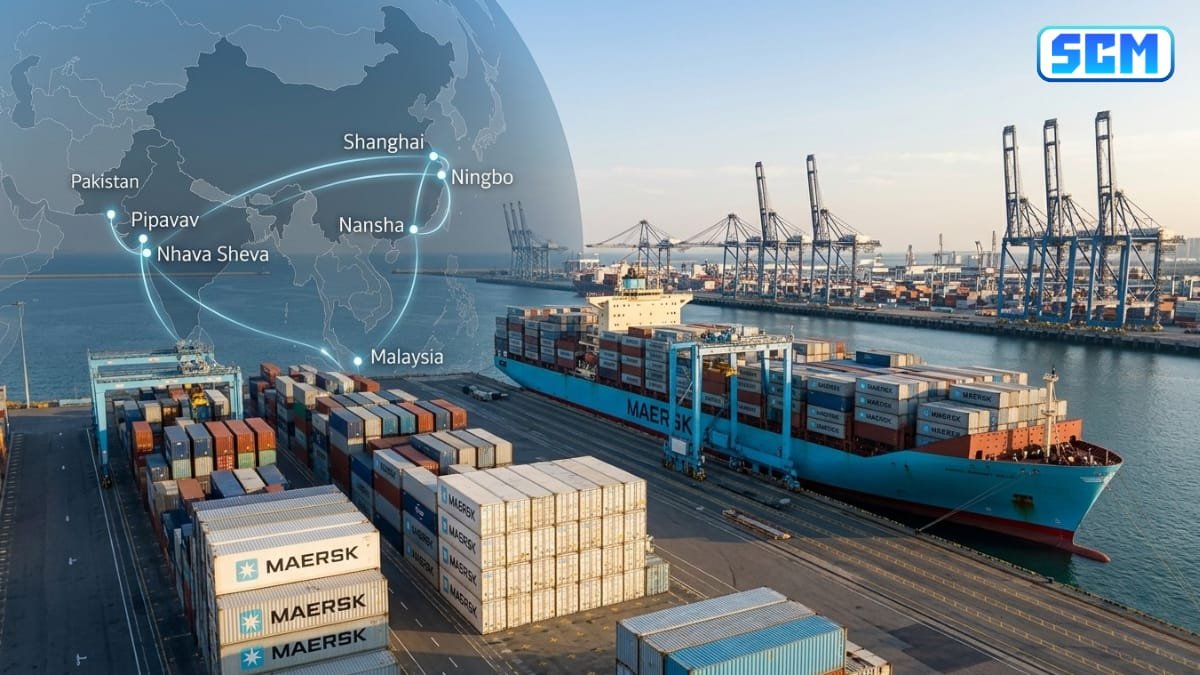
A.P. Moller – Maersk has announced the launch of its new Far East India 2 (FI2) ocean service to strengthen cargo connectivity between China, India, and other major Asian trade hubs.
The new service aims to improve shipping reliability, increase vessel capacity, and support growing trade demand across the India–China corridor.
As intra-Asia trade volumes continue to rise, shipping lines are expanding direct service networks to help businesses reduce delays, improve supply chain planning, and move cargo more efficiently.
What Is the Maersk FI2 Service?
The FI2 service is Maersk’s new intra-Asia ocean freight route connecting key ports in China, Malaysia, India, and Pakistan.
FI2 Port Rotation Includes:
- Shanghai
- Ningbo
- Nansha
- Tanjung Pelepas
- Nhava Sheva (JNPT)
- Pipavav
- Port Qasim
The first sailing is scheduled to begin from Shanghai in June 2026.
The service will operate alongside Maersk’s existing FI3 network to provide customers with additional weekly shipping options and improved transit reliability.
Why Maersk Introduced the FI2 Service
The launch of the FI2 service comes as demand for India–China trade connectivity continues to grow across multiple industries.
Businesses importing goods from China often face operational challenges such as:
- Vessel space shortages
- Shipment delays
- Port congestion
- Unstable sailing schedules
- Transshipment dependency
By introducing a direct service loop, Maersk aims to improve cargo movement efficiency and offer more stable shipping schedules for importers and exporters.
The FI2 service is expected to support businesses handling:
- Electronics
- Machinery
- Chemicals
- Auto components
- Industrial raw materials
- Consumer goods
How the FI2 Service Benefits Indian Importers and Exporters
The new service is expected to create several operational advantages for businesses involved in international trade.
Faster Cargo Movement
Direct connectivity between major Asian ports can reduce transit disruptions and improve shipment turnaround times.
Better Schedule Reliability
Additional sailing frequency helps businesses plan imports and exports with greater accuracy.
Improved Container Availability
The new service adds shipping capacity to the market, helping reduce pressure during peak trade periods.
Reduced Supply Chain Delays
More predictable vessel schedules can help companies improve inventory planning and customer delivery timelines.
Strategic Importance of Indian Ports
The inclusion of Nhava Sheva and Pipavav highlights India’s growing role in regional supply chains and global trade operations.
Pipavav port offers strong rail connectivity through India’s Dedicated Freight Corridor (DFC), enabling faster inland cargo movement toward manufacturing and industrial zones across North and Western India.
This infrastructure support is expected to improve overall logistics efficiency for businesses handling high cargo volumes.
Growing Focus on Intra-Asia Trade Connectivity
The FI2 launch reflects a broader trend within the global shipping industry.
As companies adopt “China + 1” sourcing strategies and diversify supply chains across Asia, demand for reliable regional shipping services continues to increase.
Shipping lines are now focusing on:
- Expanding direct port connectivity
- Increasing intra-Asia vessel deployment
- Reducing transshipment risks
- Improving cargo visibility
- Strengthening regional supply chain resilience
The FI2 service supports this shift by creating stronger trade connectivity between major Asian manufacturing and consumption markets.
What This Means for Freight Forwarders and Logistics Companies
For freight forwarders, customs brokers, and logistics providers, the FI2 service may help improve operational planning and customer service efficiency.
Potential benefits include:
- Better shipment predictability
- Faster cargo handling
- Lower dependency on feeder services
- Improved schedule management
- Reduced cargo rollover risks
As shipping reliability improves, businesses can strengthen overall supply chain performance and reduce operational disruptions.
Key Takeaways
- Maersk has launched the new FI2 ocean service for the India–China trade lane.
- The service connects major ports across China, Malaysia, India, and Pakistan.
- FI2 aims to improve shipping reliability, cargo capacity, and supply chain efficiency.
- Indian importers, exporters, freight forwarders, and logistics providers are expected to benefit from improved connectivity and faster cargo movement.
FAQ
What is Maersk FI2 service?
The FI2 service is Maersk’s new intra-Asia ocean freight route connecting China, India, Malaysia, and Pakistan to improve cargo movement and shipping reliability.
Which Indian ports are included in the FI2 service?
The FI2 service includes Nhava Sheva (JNPT) and Pipavav ports in India.
Why did Maersk launch the FI2 service?
Maersk introduced the FI2 service to meet growing trade demand and improve shipping connectivity between China and India.
How will the FI2 service help freight forwarders?
The service may help freight forwarders with better schedule reliability, improved shipment planning, and reduced cargo delays.
Why is India–China shipping demand increasing?
Trade demand continues to grow due to strong manufacturing activity, industrial sourcing, electronics imports, and expanding intra-Asia supply chains.
Conclusion
The launch of Maersk’s FI2 service marks another important step in strengthening Asia’s regional shipping network.
With improved connectivity between China and India, the service is expected to support faster cargo movement, better schedule reliability, and more efficient trade operations for businesses across the logistics and supply chain ecosystem.
As intra-Asia trade continues to expand, direct ocean services like FI2 will play a critical role in improving supply chain resilience and supporting international trade growth.


