

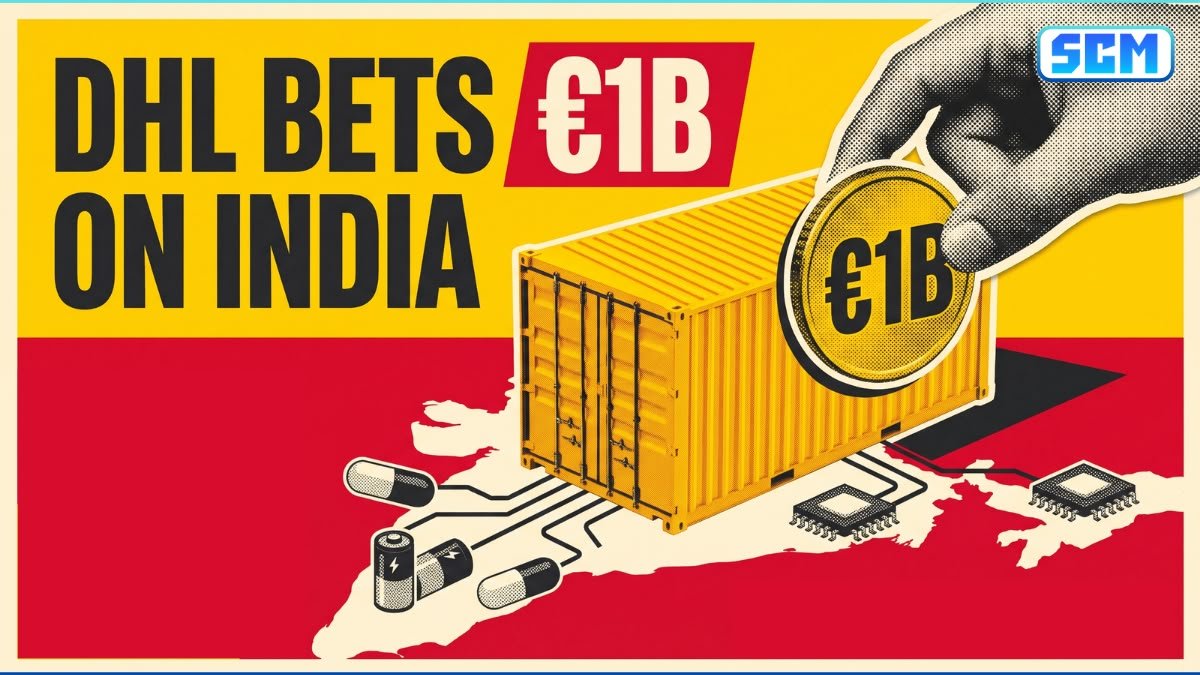
DHL is strengthening its long-term presence in India through infrastructure development, specialised logistics and digitalisation, with organic expansion taking priority over acquisitions.
India is becoming an increasingly important market for global logistics companies as manufacturing expands, international trade evolves and businesses seek more reliable supply chain solutions. Against this backdrop, DHL Group is stepping up its commitment to India, focusing on developing its own capabilities rather than relying primarily on acquisitions.
The German logistics group has committed approximately €1 billion in investments across its Indian businesses by 2030. Its strategy targets healthcare logistics, electric vehicle (EV) batteries, semiconductor supply chains, e-commerce and technology-enabled operations.
According to a report published by Business Standard on 23 October 2026, DHL Global Forwarding CEO Oscar de Bok highlighted India’s growth potential and the company’s preference for organic expansion, while leaving room for selective acquisitions that provide specific expertise or geographic reach.
Why DHL Is Prioritising India for Growth
India’s expanding economy, manufacturing investments and changing international trade relationships are creating new opportunities for logistics providers. Exporters are reaching new markets, manufacturers are diversifying sourcing strategies, and businesses are demanding better shipment visibility and more specialised transportation services.
DHL sees India as a long-term growth market because of several factors:
- Growing international trade: Indian businesses are expanding commercial relationships across Asia, Europe, the Middle East and other markets.
- Manufacturing expansion: Investment in electronics, pharmaceuticals, automotive components and new-energy industries is creating demand for specialised logistics.
- Increasing supply chain complexity: Companies need better inventory management, transportation planning and real-time shipment visibility.
- Demand for specialised services: Temperature-controlled transportation, secure warehousing and high-value cargo handling are becoming more important.
DHL’s Trade Atlas 2025 projects that India will account for 6% of incremental global trade between 2024 and 2029. This outlook reinforces the country’s importance in global supply chain planning.
Organic Expansion Over Acquisitions
DHL’s strategy centres on building infrastructure, developing employees, strengthening technology capabilities and expanding services to meet customer needs.
Acquisitions can help logistics companies enter new markets quickly, gain customers or obtain specialist expertise. However, integrating different technology platforms, operating procedures and service networks can be complex.
Organic expansion gives DHL greater control over infrastructure development, service standards, technology deployment and operational efficiency.
The company is not ruling out acquisitions entirely. Instead, it may consider targeted deals when they provide capabilities or regional coverage that complement its existing network.
This approach allows DHL to focus on sustainable expansion while maintaining flexibility to pursue strategic opportunities.
Where DHL Plans to Invest in India
DHL announced its approximately €1 billion investment commitment in November 2025, covering its Indian businesses through 2030. The programme spans several areas of logistics and technology.
| Investment area | Planned development | Expected operational benefit |
| Healthcare logistics | Healthcare logistics hub in Bhiwandi, Maharashtra | Better handling of temperature-sensitive pharmaceutical products |
| EV and battery logistics | Centres of Excellence in Chennai and Mumbai | Specialised handling of batteries and automotive components |
| Express logistics | Automated sorting infrastructure in Delhi | Improved parcel processing and efficiency |
| Ground transportation | Lower-emission operating facilities | Support for more sustainable logistics operations |
| Digital capabilities | IT services and training infrastructure in Indore | Stronger automation, technology and AI capabilities |
These investments are intended to strengthen DHL’s presence across multiple supply chain segments rather than concentrate its growth in one business area.
Healthcare Logistics Emerges as a Key Investment Area
Pharmaceutical and healthcare logistics require specialised infrastructure because many medicines, vaccines and medical products must remain within defined temperature ranges throughout transportation and storage.
DHL’s healthcare logistics development in Bhiwandi is intended to support the handling and distribution of healthcare products.
Specialised healthcare logistics can include temperature-controlled storage, monitoring systems, validated packaging, shipment traceability and coordinated distribution.
These capabilities help reduce the risk of temperature excursions, product damage and delivery disruptions.
For pharmaceutical manufacturers and distributors, reliable logistics operations are particularly important when products move through multiple warehouses, airports and transportation networks before reaching hospitals, pharmacies or other destinations.
As India’s pharmaceutical industry continues to develop its domestic and export markets, specialised cold-chain logistics could become an increasingly important part of the supply chain.
EV Batteries and Automotive Logistics Gain Importance
India’s expanding electric vehicle industry is creating new requirements for transporting and storing batteries, automotive components and finished vehicles.
DHL has identified EV and battery logistics as a priority area, with Centres of Excellence planned in Chennai and Mumbai.
These capabilities can support several parts of the automotive supply chain, including:
- Transportation of batteries and components between suppliers and manufacturing facilities.
- Warehousing of automotive parts and production materials.
- Coordination of inbound international shipments and domestic distribution.
- Specialised handling procedures for battery-related cargo.
- Support for automotive manufacturers serving international markets.
Battery logistics requires appropriate packaging, risk assessment, trained personnel and compliance with applicable transport and safety regulations.
For logistics providers, investment in specialised capabilities can help meet the requirements of automotive manufacturers while supporting the wider development of India’s EV ecosystem.
Semiconductor Logistics Creates New Opportunities
India’s semiconductor ambitions are also creating demand for specialised logistics services.
Semiconductor manufacturing depends on sensitive equipment, high-value components and carefully managed transportation. Delays or damage to critical equipment can affect production schedules and project costs.
A separate report published by Mint on 13 October 2026 described plans for a dedicated semiconductor warehouse in Dholera, Gujarat, to support the developing semiconductor manufacturing ecosystem.
Specialised semiconductor logistics may require:
- Protection against dust, humidity and electrostatic discharge.
- Secure transportation of high-value equipment.
- Careful handling of sensitive components.
- Shipment tracking and coordinated delivery schedules.
- Integration between suppliers, manufacturers and industrial facilities.
The pace of opportunity will depend on the development of manufacturing projects, supplier networks and supporting infrastructure.
Digitalisation and AI to Support Logistics Operations
Alongside physical infrastructure, DHL is investing in technology and digital capabilities to support its long-term growth.
Automation and artificial intelligence can improve logistics operations by helping companies process shipments, monitor inventory, identify potential delays and optimise the use of warehouse space and transportation capacity.
Key applications include:
- Shipment visibility: Giving customers better information about shipment status and exceptions.
- Warehouse automation: Improving sorting, inventory handling and order processing.
- Predictive planning: Helping teams anticipate demand changes and potential disruptions.
- Transport optimisation: Supporting better vehicle utilisation and route planning.
- Supply chain resilience: Improving coordination when trade routes or transport capacity are disrupted.
DHL’s planned technology and training development in Indore is part of its wider effort to strengthen digital capabilities and employee skills.
However, technology alone cannot eliminate supply chain disruptions. Its effectiveness depends on reliable data, integration between systems and the ability of operations teams to act on the information available.
Geopolitical Risks Continue to Affect Global Logistics
Despite India’s growth potential, logistics companies continue to face uncertainty from geopolitical conflicts, changing tariffs, trade restrictions and disruptions to international transport corridors.
These developments can affect freight rates, transit times, insurance costs and delivery commitments.
When established shipping or air-freight routes become difficult to use, exporters and freight forwarders may need to evaluate alternative routes, transportation modes and service providers.
DHL’s international network can help customers assess alternatives, although rerouting cargo may still increase costs or extend transit times.
For Indian businesses, the situation highlights the importance of diversified sourcing, flexible logistics planning and better shipment visibility.
What DHL’s Expansion Means for India’s Logistics Industry
DHL’s strategy reflects a broader shift in logistics, where specialised capabilities and technology are becoming increasingly important alongside network size.
Indian logistics providers may find opportunities to support expanding supply chains through:
- Pharmaceutical and temperature-controlled warehousing.
- EV battery and automotive component transportation.
- Industrial logistics for semiconductor and electronics manufacturing.
- Digital shipment tracking and warehouse management.
- Domestic distribution supporting international trade.
At the same time, competition may increase as global logistics companies invest in infrastructure, technology and specialised services.
Providers looking to serve these sectors will need to strengthen safety procedures, employee training, technology integration and service reliability.
For exporters and manufacturers, additional specialised logistics capacity could expand service options. The actual benefits will depend on how quickly facilities are developed, where capacity becomes available and whether pricing meets customer requirements.
Conclusion
DHL’s India strategy demonstrates its confidence in the country’s long-term manufacturing, trade and logistics potential. Its approximately €1 billion investment commitment through 2030 is focused on specialised infrastructure, healthcare logistics, EV batteries, digitalisation and other growth areas.
By prioritising organic expansion while remaining open to selective acquisitions, DHL aims to build capabilities around India’s evolving supply chain requirements.
For the wider industry, the message is clear: future logistics growth will depend not only on transportation networks and warehouse capacity, but also on specialised expertise, digital capabilities and the ability to manage increasingly complex supply chains.
As India strengthens its position in global manufacturing and trade, investments of this kind could help shape the next phase of the country’s logistics sector.


