

Quick Summary
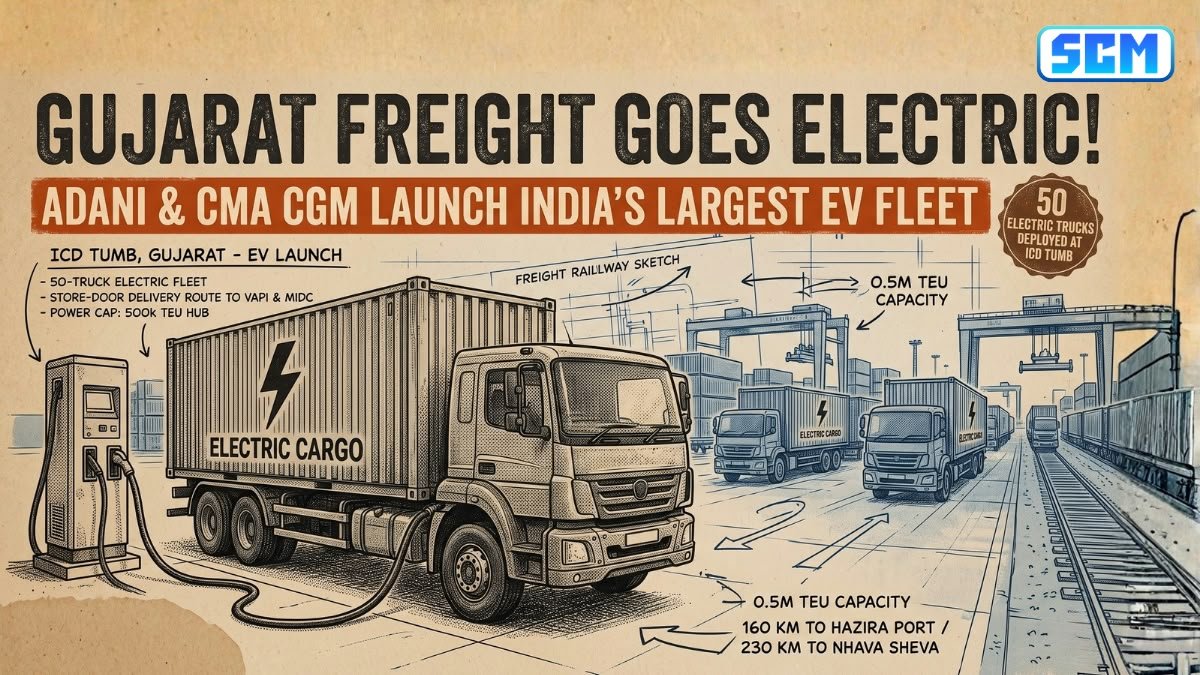
Adani Logistics and CMA CGM have introduced an electric truck fleet for container transportation at Inland Container Depot (ICD) Tumb near Vapi, Gujarat. The deployment brings electric mobility into inland freight operations, supporting the movement of containers between ports, logistics facilities and industrial customers. The initiative reflects the logistics industry’s growing focus on reducing transport emissions while strengthening multimodal supply chain connectivity.
Key Highlights
- Adani Logistics and CMA CGM have launched electric container transportation at ICD Tumb.
- The depot connects industrial customers in Gujarat and Maharashtra with western Indian ports.
- Electric trucks can reduce tailpipe emissions compared with diesel-powered vehicles.
- The initiative complements existing rail and road connectivity at the inland container depot.
- Fleet size, truck specifications, charging infrastructure and measured emissions savings have not been publicly detailed in the available reports.
Electric Trucks Enter India’s Inland Container Logistics Network
India’s logistics industry is increasingly looking beyond ports and warehouses to address the environmental impact of moving cargo across the country. Road transportation remains an essential part of container logistics, connecting manufacturing facilities, inland container depots and seaports.
Against this backdrop, Adani Logistics and global shipping company CMA CGM have introduced an electric truck fleet dedicated to container movement at ICD Tumb near Vapi, Gujarat.
Announced on October 13, 2026, the deployment represents a move towards incorporating electric mobility into inland freight operations. The initiative is intended to support cleaner cargo transportation and strengthen the connection between inland logistics infrastructure and port-based trade networks.
The development is significant because container logistics involves more than ocean shipping. Even when cargo travels by rail for a large part of its journey, trucks are needed to connect terminals with factories, warehouses and other delivery points.
Introducing electric trucks into these operations could help logistics companies reduce direct vehicle emissions while developing more integrated transportation services.
However, the actual environmental and commercial benefits will depend on how frequently the vehicles operate, the distances they cover, their payload requirements and the availability of suitable charging infrastructure.
Why ICD Tumb Is a Strategic Location for Electric Container Trucks
ICD Tumb is located near Vapi in Gujarat, within an important industrial region serving businesses across Gujarat and Maharashtra.
The facility is strategically positioned to connect inland cargo with western India’s port infrastructure. According to Adani Ports and Special Economic Zone’s acquisition announcement in August 2022, ICD Tumb is approximately 160 kilometres from Hazira Port and 230 kilometres from Nhava Sheva.
The same announcement described the depot as having an annual handling capacity of 500,000 TEUs, four rail-handling lines, customs-notified land and bonded warehousing facilities. The associated 129 acres of land also offered potential for future expansion.
These characteristics make Tumb relevant to manufacturers, exporters, importers and logistics providers that need dependable connections between industrial locations and maritime gateways.
Connecting industrial customers with ports
Manufacturers frequently need to move containerised goods from production facilities to inland depots before they reach seaports for export. Imported cargo travels in the opposite direction, moving from gateway ports through inland logistics facilities towards its final destination.
An inland container depot helps coordinate these movements by providing container handling, storage and supporting logistics services.
Electric trucks can potentially support several parts of this process, including:
- Transporting export containers between customer facilities and the depot.
- Moving import containers towards warehouses and manufacturing units.
- Connecting inland logistics terminals with nearby distribution facilities.
- Supporting container repositioning where operationally suitable.
The exact routes assigned to the newly launched fleet have not been disclosed in the available reports.
How Electric Trucks Could Improve Freight Sustainability
Diesel-powered heavy vehicles contribute to greenhouse gas emissions and local air pollution. Battery-electric trucks offer an alternative because they produce no tailpipe exhaust while operating.
For logistics operators, their potential benefits extend beyond environmental considerations. The economics of electric freight vehicles can also depend on energy costs, maintenance requirements, vehicle utilisation and charging arrangements.
1. Lower tailpipe emissions
Electric trucks do not emit exhaust gases from an onboard combustion engine during operation. Replacing diesel-powered trips with electric vehicles can therefore improve local air quality and reduce direct transport emissions.
However, electric vehicles are not automatically emissions-free across their entire lifecycle. The overall climate benefit depends partly on how electricity is generated, as well as battery production, vehicle manufacturing and vehicle utilisation.
2. Potential operating-cost advantages
Electric trucks can offer lower energy costs per kilometre under suitable operating conditions. They also have fewer conventional powertrain components requiring routine maintenance.
Nevertheless, the total cost of ownership depends on vehicle purchase prices, financing, battery life, charging equipment, electricity tariffs and downtime.
For container operators, the business case must account for the entire operation rather than comparing electricity and diesel prices alone.
3. Better suitability for planned freight movements
Container transportation often follows recurring routes between depots, ports, factories and warehouses. Where daily distances and schedules are predictable, operators can plan vehicle assignments and charging windows more effectively.
This can make selected freight operations suitable for electrification, provided vehicles can meet payload, range and turnaround-time requirements.
4. Support for corporate sustainability targets
Manufacturers, shipping lines and logistics service providers increasingly assess the environmental performance of their supply chains.
Electric trucks can help reduce direct emissions from road transport and support broader decarbonisation programmes. Their contribution should be measured through operational data rather than assumed from the presence of electric vehicles alone.
Adani Logistics and CMA CGM: The Importance of Multimodal Connectivity
The collaboration brings together an inland logistics infrastructure operator and a global shipping and logistics group.
Adani Logistics operates within the wider APSEZ logistics network, which combines inland terminals, rail services, trucking, warehousing and freight management capabilities.
CMA CGM provides maritime transportation alongside inland logistics services. Its Indian subcontinent intermodal network includes rail connections designed to link inland locations with gateway ports.
According to CMA CGM’s published India intermodal information, the company handled 428,000 TEUs through its Indian subcontinent intermodal programme in 2025, with 92% transported by rail. The company also introduced four additional rail corridors during 2025, including Tumb via Nhava Sheva.
These existing rail connections provide useful context for the electric truck deployment. They demonstrate that Tumb is already part of a broader inland transportation network rather than an isolated road-freight facility.
The new initiative brings electric road transportation into this wider logistics environment. Its eventual impact will depend on how the vehicles are integrated with rail schedules, container availability, customer delivery requirements and terminal operations.
Why Rail and Electric Trucks Need to Work Together
Sustainable freight transportation is rarely achieved through a single mode of transport. Instead, logistics operators can combine rail, electric trucks and maritime shipping according to distance, cargo requirements and delivery schedules.
Rail is generally well suited to moving large volumes of containers over longer distances. Trucks provide flexibility for shorter connections, first- and last-mile deliveries and locations without direct rail access.
At ICD Tumb, the combination of established rail infrastructure and electric road transportation could support a more coordinated approach to container movement.
For example, an export shipment could travel by truck from a manufacturing facility to an inland depot, continue by rail towards a gateway port and then move by ship to an overseas destination. Electric vehicles could serve the road portion where route distance, charging access and operational requirements permit.
The resulting environmental performance would depend on the full journey, including rail utilisation, truck energy sources, vehicle loading and port operations.
The objective is not necessarily to replace every diesel truck or move every container by rail. It is to identify the most practical combination of transport modes for each shipment.
Operational Challenges That Will Determine the Fleet’s Success
Although electric trucks offer potential benefits, heavy-duty freight electrification requires careful operational planning.
Charging infrastructure and vehicle availability
Container transport often operates against port cut-offs, vessel schedules and customer delivery windows. Charging arrangements must allow vehicles to remain available when cargo needs to move.
Operators must consider charger capacity, charging time, depot electricity supply and the availability of backup vehicles.
Range and payload requirements
Electric truck range varies according to battery capacity, payload, road conditions, weather, driving style and auxiliary power consumption.
Container movements can involve substantial weight, making payload capability and energy consumption particularly important.
The specifications and operating range of the trucks deployed at Tumb have not been disclosed in the available reports.
Total cost of ownership
Electric vehicles may reduce energy and maintenance costs, but their upfront purchase price and charging infrastructure can require significant investment.
Operators need to assess vehicle utilisation, kilometres travelled, financing, battery replacement assumptions and electricity tariffs before calculating long-term savings.
Measuring emissions reductions
A credible sustainability assessment requires a baseline. Operators should compare electric-truck operations with the diesel movements they replace, using consistent assumptions for distance, payload and energy consumption.
Useful performance indicators include energy consumed per kilometre, cost per container movement, vehicle availability, charging downtime and estimated greenhouse gas emissions per tonne-kilometre.
Publishing such data would help shippers and manufacturers understand the practical benefits of the deployment.
What This Development Means for India’s Logistics Industry
The launch at ICD Tumb reflects a wider shift towards combining logistics infrastructure, alternative-fuel vehicles and multimodal freight services.
For exporters and importers, the development highlights the potential for cleaner inland transportation without abandoning the flexibility of road freight.
For logistics operators, it illustrates the importance of planning vehicle electrification around real cargo flows, depot infrastructure and delivery schedules.
For manufacturers, it may eventually create additional options when evaluating the environmental performance of inbound and outbound transportation.
The development also underlines a broader point: decarbonising logistics requires coordination across shipping lines, port operators, rail providers, truck operators, industrial customers and energy suppliers.
Electric trucks are one part of this transition. Their long-term value will depend on whether they can deliver reliable service, competitive operating costs and measurable emissions reductions at commercial scale.
What to Watch Next
Several details will help the industry assess the deployment’s significance as more information becomes available:
- The total number of electric trucks introduced at ICD Tumb.
- Vehicle manufacturer, battery capacity, payload rating and operating range.
- Charging infrastructure and electricity arrangements at the depot.
- Routes covered and the number of container movements handled.
- Operating-cost comparisons with conventional diesel trucks.
- Measured reductions in emissions and fuel consumption.
These details will provide a clearer picture of whether the initiative can be expanded to other depots and industrial freight corridors.
Conclusion
Adani Logistics and CMA CGM’s electric truck deployment at ICD Tumb brings electric mobility into an important part of India’s container supply chain: inland road transportation.
The depot’s industrial catchment, port connections and established rail infrastructure provide a relevant setting for testing how electric trucks can complement existing freight operations.
The announcement is an encouraging development for sustainable logistics, but its ultimate significance will be determined by operational performance. Fleet utilisation, charging availability, total cost of ownership and independently measurable emissions reductions will be essential indicators of success.
As India’s freight network continues to evolve, integrating electric road transport with rail and maritime services could become an increasingly important strategy for building more efficient and environmentally responsible supply chains.


