

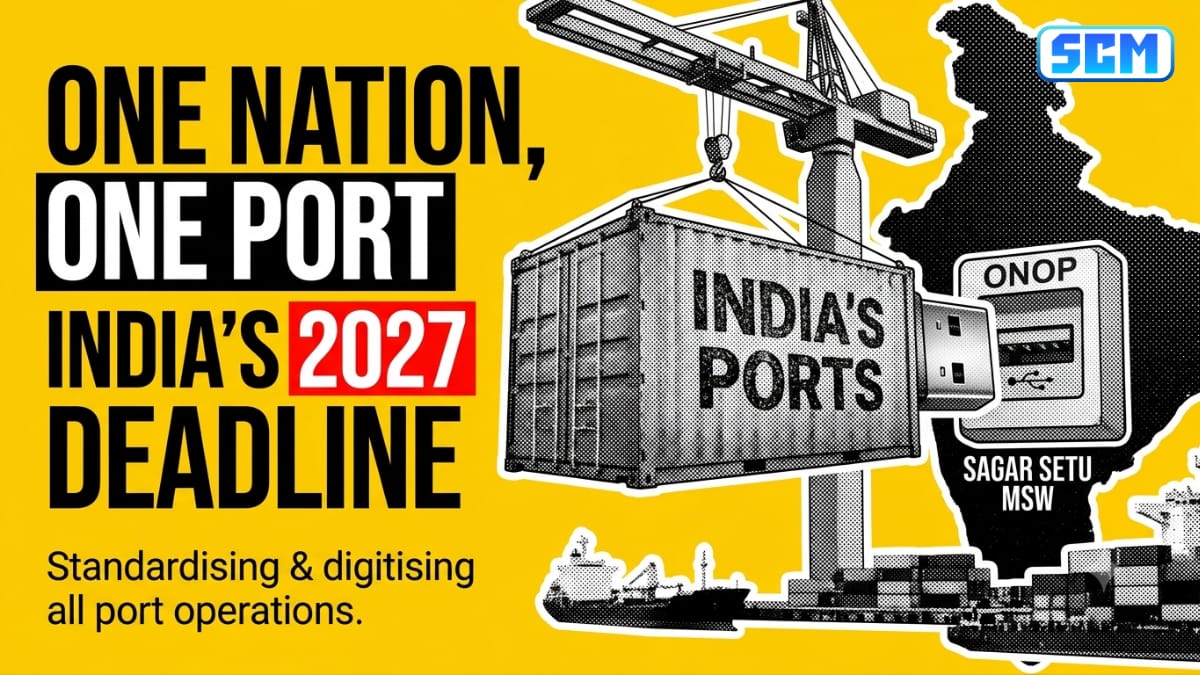
India is accelerating the digital transformation of its maritime logistics sector, with the government setting March 2027 as the deadline for implementing One Nation One Port Process (ONOP) reforms across all ports. The initiative aims to standardise documentation, simplify operational procedures and strengthen coordination between port authorities and government agencies.
The decision was taken at the 21st Maritime State Development Council (MSDC) meeting held in Mumbai on 13 October 2026. The council also directed ports to integrate with the Maritime Single Window platform, Sagar Setu, by the same deadline and mandated the electronic publication of port tariffs.
For shipping lines, freight forwarders, customs brokers and cargo owners, the reforms could mark an important step towards more consistent port procedures and a digitally connected maritime supply chain.
Quick Summary
- Initiative: One Nation One Port Process (ONOP).
- Implementation deadline: March 2027.
- Key reforms: Standardised documentation, port process re-engineering and inter-ministerial coordination.
- Digital integration: All ports are expected to integrate with the Maritime Single Window (MSW–Sagar Setu).
- Tariff transparency: Ports have been directed to publish tariffs electronically.
- Expected outcome: Reduced paperwork, better coordination and improved operational efficiency.
Key Highlights
- The government has set a common implementation deadline for major and non-major ports.
- The ONOP framework aims to reduce duplication in port documentation and procedures.
- Sagar Setu will play a central role in the digital exchange of ship-related information.
- Electronic publication of port tariffs is intended to improve transparency for port users.
- Successful implementation will depend on coordination between central agencies, state governments and individual port authorities.
What Is India’s One Nation One Port Process Initiative?
The One Nation One Port Process initiative is a government-led effort to create greater uniformity in port-related procedures across India.
Traditionally, businesses operating through different ports may encounter variations in documentation, administrative workflows and coordination requirements. These differences can complicate operations for shipping companies and logistics providers managing cargo across multiple locations.
ONOP seeks to address this challenge by establishing common documentation practices, reviewing existing port procedures and improving coordination among the authorities responsible for maritime operations.
The Ministry of Ports, Shipping and Waterways introduced the framework to support more consistent processes and the digital handling of ship-related information. In December 2025, the ministry stated that the initiative was expected to reduce documentation by 33%, with the potential to improve efficiency and lower costs and processing time.
That figure represents an expected reduction rather than a verified result across all Indian ports.
The latest decision strengthens the implementation roadmap by establishing March 2027 as the deadline for rolling out the reforms nationwide.
Three Major ONOP Reforms to Be Implemented by March 2027
The government has identified three core areas for reform.
1. One Nation One Documentation
Documentation is a critical part of port operations. Vessel arrivals, cargo movements and regulatory clearances involve information submitted to different authorities.
Where documentation requirements overlap, businesses may need to prepare or submit similar information through separate processes. This can increase administrative workload and create opportunities for errors or delays.
One Nation One Documentation aims to establish more consistent documentation requirements across ports. Greater standardisation could help shipping lines, agents and logistics providers prepare information in a more predictable manner.
For businesses handling cargo at multiple ports, the potential benefit is straightforward: fewer unnecessary variations in documentation and a more consistent approach to regulatory submissions.
However, standardisation does not mean that all cargo will require identical documents. Commodity-specific rules, customs regulations, security requirements and other applicable laws will continue to determine the documentation required for particular shipments.
2. Port Process Re-engineering
Port process re-engineering focuses on reviewing existing procedures and identifying opportunities to make them more efficient.
A vessel call involves several connected activities, including pre-arrival submissions, regulatory checks, port coordination and vessel-related clearances. If these activities rely on disconnected workflows or repeated administrative steps, they can create avoidable delays.
Under ONOP, process re-engineering is intended to make port procedures more consistent and efficient.
Potential improvements include:
- Reducing unnecessary procedural duplication.
- Improving the sequence of administrative and regulatory activities.
- Encouraging greater use of electronic submissions.
- Making operational requirements clearer for port users.
- Improving coordination between relevant departments.
These measures could make port calls easier to plan and manage. Nevertheless, the impact on vessel turnaround time and cargo dwell time will depend on actual implementation, infrastructure capacity, congestion and the efficiency of individual agencies.
3. Inter-Ministerial Process Reforms
Port operations involve multiple government authorities, each responsible for specific regulatory functions.
These include Customs, immigration, port health authorities, port authorities and other agencies involved in maritime administration. Coordination between them is essential for the smooth movement of vessels and cargo.
The ONOP framework aims to improve coordination between these stakeholders and align their procedures where possible.
The government has also released a Ready Reckoner for Implementing ONOP, a practical guide intended to support implementation at major and non-major ports. According to the Ministry of Ports, Shipping and Waterways, the guide references central circulars issued by the Central Board of Indirect Taxes and Customs (CBIC), the Ministry of Home Affairs (MHA) and the Ministry of Health and Family Welfare (MoHFW).
Better coordination could help reduce administrative friction and make the responsibilities of different agencies clearer. It will also require effective implementation by the relevant authorities at both central and state levels.
Sagar Setu Integration: A Key Part of India’s Port Digitisation Strategy
Alongside the ONOP reforms, the government has directed all ports to integrate with the Maritime Single Window platform, MSW–Sagar Setu, by March 2027.
Sagar Setu, India’s National Logistics Portal (Marine), supports electronic submission and processing of ship-related information. The ONOP framework aims to use this digital infrastructure to strengthen information exchange across the maritime ecosystem.
A more integrated platform could help reduce repeated data entry, improve access to submitted information and streamline interactions between shipping stakeholders and regulatory agencies.
For example, a shipping agent coordinating a vessel call may need to provide information to several authorities. Better digital integration could make it easier to submit relevant information electronically and support coordination between the agencies involved.
The exact benefits will depend on the systems connected, the information that can be shared and the extent to which participating authorities adopt common digital workflows.
The reform should therefore be viewed as both a technology initiative and an operational change. A digital platform alone cannot eliminate delays if underlying procedures remain fragmented or manual.
How ONOP Could Affect India’s Shipping and Logistics Industry
The reforms could have implications across the maritime supply chain, particularly for businesses that regularly use multiple ports.
Shipping Lines and Vessel Operators
More consistent documentation and port procedures could help shipping lines plan vessel calls and coordinate administrative requirements more efficiently.
Improved information exchange may also support better coordination with port authorities. However, the impact on vessel turnaround times will depend on operational conditions, berth availability and other factors beyond documentation.
Freight Forwarders and Shipping Agents
Freight forwarders and shipping agents frequently coordinate with shipping lines, port operators, customs brokers and cargo owners.
Standardised procedures could make it easier to understand documentation requirements across different ports. Better digital workflows may also reduce the effort required to track submissions and follow up with multiple authorities.
For companies managing high shipment volumes, even small reductions in repetitive administrative work could improve productivity.
Customs Brokers and CHAs
Customs House Agents and customs brokers handle documentation and compliance activities for importers and exporters.
ONOP’s emphasis on standardisation and digital coordination could help make certain port-related workflows more predictable. However, customs declarations, classification, valuation, duty assessment and other statutory compliance requirements remain distinct from port process reforms.
Businesses should not assume that ONOP removes existing customs obligations or guarantees faster clearance for every shipment.
Importers and Exporters
For cargo owners, the most relevant potential benefits are improved procedural consistency, clearer information on port tariffs and reduced administrative friction.
These improvements could support better shipment planning and help businesses understand port-related requirements before cargo arrives.
Nevertheless, overall logistics costs will continue to depend on freight rates, terminal charges, inland transport, cargo handling, storage and other commercial factors.
Electronic Port Tariffs to Improve Transparency
Another important decision from the MSDC meeting is the requirement for electronic publication of port tariffs.
Port charges are an important consideration when shipping lines, exporters, importers and logistics service providers compare routing options and estimate shipment costs.
Making tariff information available electronically could help businesses access published charges more easily and improve visibility into applicable port costs.
For logistics teams, this may support more informed budgeting and cost comparisons. It could also make it easier to identify relevant tariff information before making operational decisions.
However, electronic publication alone does not guarantee that all ports will have identical charges. Tariffs may continue to differ according to port, terminal, service and applicable conditions.
The objective is greater transparency, rather than a single nationwide pricing structure.
Implementation Challenges: What Needs to Happen Before March 2027?
Setting a deadline is an important policy step, but achieving consistent implementation across India’s diverse port network will require coordinated action.
Coordination Between Major and Non-Major Ports
India’s port network includes major ports as well as ports governed by state maritime authorities. Their operational structures, technology systems and administrative arrangements can vary.
Effective implementation will require states and port authorities to align their processes with the common framework while addressing local operational requirements.
Integration of Digital Systems
Ports and government agencies may use different systems for documentation, approvals and information management.
Connecting these systems requires technical integration, reliable data exchange, appropriate access controls and clear procedures for resolving errors or incomplete submissions.
Staff Readiness and Process Adoption
Digital reforms are effective only when the people responsible for daily operations understand and consistently use the new processes.
Port authorities, shipping agents and other stakeholders may require updated operating procedures, training and practical implementation guidance.
Measuring Results
The success of ONOP should be assessed through measurable operational outcomes rather than the completion of technology projects alone.
Useful indicators could include documentation volume, submission errors, administrative processing times, system availability and the frequency of repeated data requests.
Tracking these indicators would help authorities identify implementation gaps and determine whether the reforms are delivering the intended benefits.
ONOP and the Future of India’s Maritime Logistics Sector
The ONOP reforms form part of a broader effort to improve India’s maritime infrastructure, port connectivity and logistics competitiveness.
At the October 2026 MSDC meeting, the government also emphasised multimodal connectivity through road, rail, inland waterways, pipelines and conveyors. It called for the development of port-linked industrial clusters and endorsed priorities involving coastal shipping, shipbuilding and cruise infrastructure.
These initiatives are interconnected. Efficient port procedures can support cargo movement, but their full value depends on reliable inland connectivity, adequate terminal capacity and effective coordination across the supply chain.
For manufacturers, exporters and logistics companies, the long-term opportunity lies in a maritime ecosystem where information flows more efficiently between businesses, transport operators, ports and government agencies.
Digital integration, standardised procedures and transparent tariffs could help build that environment, provided the reforms are implemented consistently.
What Businesses Should Do Before the Deadline
Companies that depend on India’s ports can begin preparing for the changes rather than waiting until March 2027.
Recommended actions include:
- Review documentation workflows: Identify repetitive submissions, common errors and port-specific procedural differences.
- Monitor official implementation guidance: Follow announcements and instructions issued by the Ministry of Ports, Shipping and Waterways, port authorities and relevant regulatory agencies.
- Assess digital readiness: Check whether internal systems can support electronic documentation and the exchange of shipment-related information.
- Update operating procedures: Prepare teams for changes to submission workflows, documentation requirements and coordination practices as official guidance becomes available.
- Review port cost visibility: Strengthen internal processes for tracking published tariffs and other port-related charges.
- Measure operational performance: Establish baseline data on documentation effort, processing delays and administrative costs to assess the impact of future reforms.
These steps can help logistics businesses adapt to procedural changes and identify opportunities to improve their own operations.
Conclusion
India’s decision to implement One Nation One Port Process reforms across all ports by March 2027 marks an important step towards a more standardised and digitally connected maritime logistics system.
The combination of common documentation practices, port process re-engineering, inter-ministerial coordination, Sagar Setu integration and electronic tariff publication is intended to improve consistency and transparency across India’s port network.
The real test will be how effectively these measures are adopted by major and non-major ports and the government agencies that support them. If implementation delivers the intended improvements, ONOP could reduce administrative friction and make port-related logistics more predictable for shipping lines, freight forwarders, customs brokers, importers and exporters.
For India’s wider supply chain, the initiative is an important development to watch as the March 2027 deadline approaches.


