

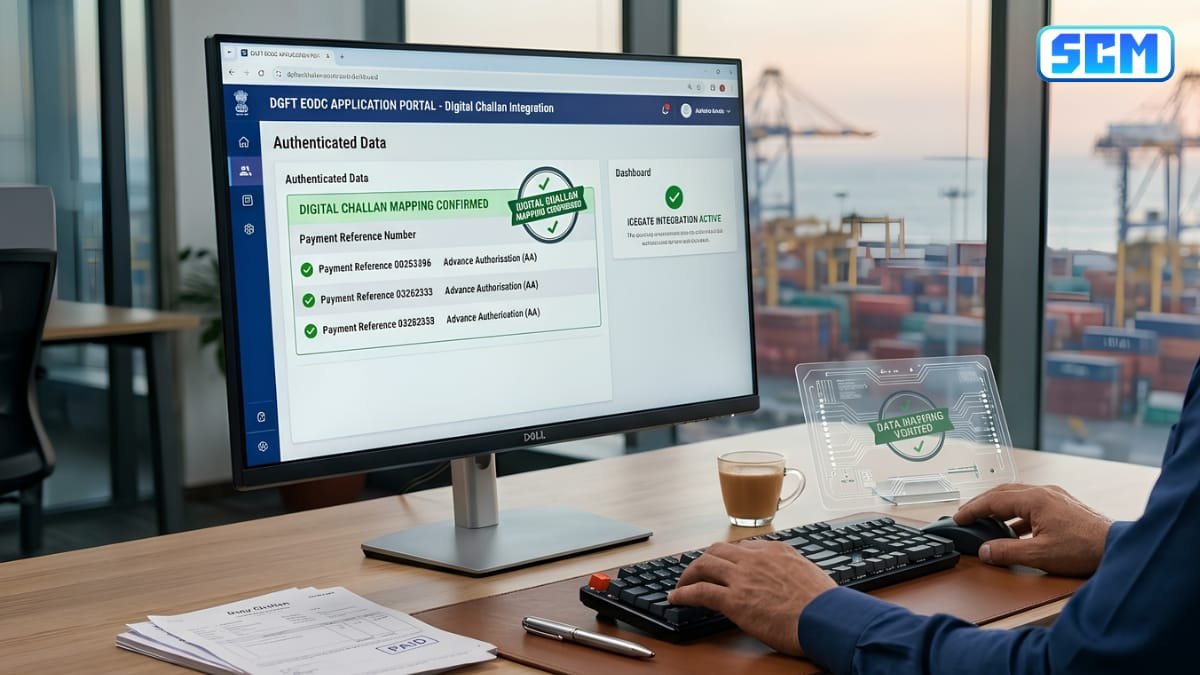
The Directorate General of Foreign Trade (DGFT) has eliminated the requirement for exporters to submit physical duty payment challans when applying for Export Obligation Discharge Certificates (EODC) under the Advance Authorisation (AA) and Export Promotion Capital Goods (EPCG) Schemes — effective for all voluntary duty payments made on or after August 1, 2026. The change is enabled by API-based integration between DGFT and ICEGATE (Indian Customs Electronic Data Interchange Gateway), which now transmits customs duty payment records electronically to DGFT’s EODC processing system. Trade Notice No. 15/2026-27 dated August 5, 2026 has been issued by DGFT formalising this change. For exporters — particularly MSMEs handling EODC closure formalities in-house — this removes a compliance step that has historically required physical documentation, follow-up with customs offices, and in-person or courier submissions. It is a genuinely useful trade facilitation change, and understanding exactly how it works in practice is essential for exporters currently managing open authorisations under AA or EPCG.
The Problem This Solves — Why Physical Challans Were a Burden
To understand why this change matters, it helps to understand what the physical challan submission process actually required of exporters.
Under the Advance Authorisation and EPCG schemes, exporters who have not fulfilled their export obligation in full are required to regularise their case by voluntarily paying the proportionate customs duty saved — along with applicable interest — before applying for an EODC to close the authorisation. This is a standard compliance mechanism: the schemes allow duty-free or concessional import of inputs or capital goods against a commitment to export, and if that commitment is not fully met, the duty benefit must be partially returned.
Until now, once an exporter made this voluntary duty payment at the customs end, they were required to obtain a physical copy of the duty payment challan — the documentary proof of payment — and physically submit it along with their EODC application to DGFT. This meant:
Obtaining the physical challan from the customs office or bank where the payment was processed — which could require follow-up if the challan was delayed or misplaced.
Attaching the physical document to the EODC application — which for exporters filing through DGFT’s online portal still required either physical submission or courier dispatch of the challan to the relevant DGFT Regional Authority.
Manual verification by DGFT Regional Authority officers — who had to cross-check the payment details on the physical challan against customs records, adding processing time and creating potential for errors or delays if details didn’t match.
For large exporters with dedicated compliance teams, this process was manageable but time-consuming. For MSME exporters handling these formalities in-house — often without dedicated customs compliance staff — it was a genuine administrative burden that added cost, time, and friction to what is already a complex closure process.
How the New Process Works — ICEGATE to DGFT Integration
The technical mechanism behind this change is API-based integration between DGFT and ICEGATE — and understanding it helps exporters know what to expect when using the new process.
ICEGATE is India’s customs electronic data interchange gateway — the system through which customs duty payments, import/export declarations, and related data are processed and stored. DGFT’s own systems manage export licensing, authorisation tracking, and EODC processing. Until now, these two systems did not share payment data in real time, which is why physical challans were needed as a paper bridge between the customs payment record and the DGFT application.
The new API integration creates a direct, authenticated data link between the two systems. When an exporter makes a voluntary duty payment at the customs end on or after August 1, 2026, that payment data — licence number, payment amount, date, and other relevant particulars — is transmitted electronically from ICEGATE to DGFT’s EODC processing system and mapped to the relevant authorisation.
Exporters can verify this mapping has occurred correctly by logging into the DGFT Customer Portal before filing their EODC application — the authenticated payment details will be visible against the concerned authorisation. DGFT Regional Authority officers processing the application will similarly see the verified payment data through their Back Office system, eliminating the need for manual verification of physical challans.
What This Means — Step by Step for Exporters
For exporters currently managing open AA or EPCG authorisations where export obligations have not been fully met, here is the practical change in process:
For payments made before August 1, 2026: The old process applies — physical challans are still required for EODC applications involving voluntary duty payments made before this date. Do not assume the new digital process applies to pending payments made prior to August 1.
For payments made on or after August 1, 2026: No physical challan submission is required. After making the voluntary duty payment at the customs end, log into the DGFT Customer Portal and verify that the payment has been correctly mapped to your authorisation before filing the EODC application. Once mapping is confirmed, proceed with the EODC application without attaching physical payment proof.
Processing timeline: While DGFT has not specified a changed processing timeline, the elimination of manual challan verification by Regional Authority officers should reduce processing time for EODC applications — one of the friction points in the closure process.
What remains unchanged: The requirement to pay proportionate customs duty plus interest before applying for EODC remains. The EODC application itself, the export obligation documentation, and other submission requirements are unchanged — only the physical challan attachment requirement has been removed for qualifying payments.
The AA and EPCG Schemes — Context for Exporters New to These Mechanisms
For exporters less familiar with the specific schemes this change affects, a brief explanation helps clarify who is directly impacted.
The Advance Authorisation (AA) Scheme allows exporters to import inputs duty-free when those inputs are physically incorporated into the export product. The scheme operates on a pre-export basis — the exporter gets the duty benefit upfront against a commitment to fulfil a specified export obligation within a defined period. When the obligation is not fully met, the proportionate duty must be repaid before the authorisation can be closed via EODC.
The Export Promotion Capital Goods (EPCG) Scheme allows import of capital goods — machinery, equipment, and related items — at zero or concessional customs duty against a commitment to achieve export earnings of a specified multiple of the duty saved, typically within six years. Again, where the obligation is not fully met by the end of the obligation period, voluntary duty payment is required before EODC closure.
Both schemes are widely used by Indian exporters across manufacturing, engineering, textiles, pharmaceuticals, and other export-oriented sectors. The EODC closure process — the administrative step of formally closing an authorisation after obligations are either fulfilled or regularised — is a compliance requirement that affects thousands of exporters annually.
MSMEs — Why This Change Matters Most for Smaller Exporters
DGFT’s announcement specifically highlighted MSMEs as the primary beneficiaries of this change — and that framing is accurate.
Large exporters with dedicated compliance and customs teams typically have established processes for obtaining and managing physical challans. The burden is real but manageable within their existing operational infrastructure.
For MSME exporters handling EODC closure formalities in-house — often the owner or a small finance/accounts team managing multiple compliance requirements simultaneously — the physical challan requirement added disproportionate complexity. Tracking down physical payment documents, coordinating with customs offices or bank branches, and managing courier submissions to DGFT Regional Authorities requires time and attention that MSME operators can rarely spare.
The shift to digital verification removes these steps entirely for payments from August 1 — reducing the EODC closure process to a portal-based verification and application submission, without physical document management. For MSMEs, this is a meaningful reduction in compliance friction on a process that has historically been one of the more administratively intensive aspects of operating under AA or EPCG schemes.
The Broader Digital Trade Facilitation Context
This change is not isolated — it is part of a systematic effort by DGFT and India’s trade administration to eliminate physical documentation requirements through digital system integration. Earlier measures in this direction include the integration of IEC (Importer Exporter Code) data across customs and DGFT systems, the move to fully digital Advance Authorisation applications, and the electronic transmission of shipping bills from ICEGATE to DGFT for export obligation tracking.
The ICEGATE-DGFT payment data integration announced through Trade Notice 15/2026-27 extends this digital connectivity to the duty payment verification step — closing one of the remaining gaps where physical documentation was still required in an otherwise increasingly digital export compliance workflow.
For trade compliance officers and customs brokers advising exporter clients on AA and EPCG management, Trade Notice No. 15/2026-27 dated August 5, 2026 is the primary reference document — available on the DGFT portal — and should be reviewed in detail for any conditions or exceptions not captured in the Ministry’s press announcement.
Bottom Line
DGFT’s removal of physical duty payment challan requirements for EODC applications is a practical, well-targeted trade facilitation improvement — not a headline reform, but exactly the kind of unglamorous compliance simplification that makes a real difference to exporters managing AA and EPCG authorisations. The API integration between ICEGATE and DGFT that enables this change is the more significant technical achievement: it creates a digital data bridge between India’s two primary trade administration systems that can support further document elimination as the integration matures. For exporters with voluntary duty payments to make from August 1, 2026 onwards, the process is simpler — verify on the DGFT portal that your payment has been mapped, and file your EODC application without the physical challan.
Managing Advance Authorisation or EPCG compliance? Share your experience with DGFT’s digital trade facilitation measures — we are tracking how India’s export compliance landscape is evolving.


