

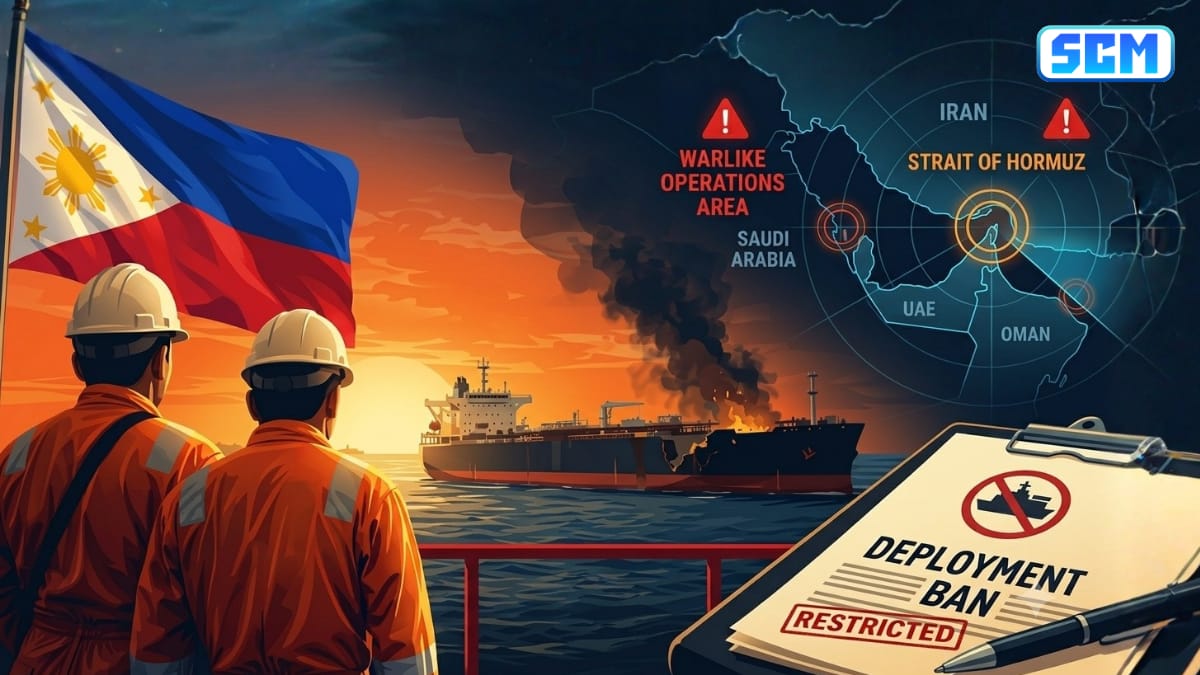
On August 31, the Saudi-flagged crude oil tanker MV Sidr was hit by an unidentified projectile while transiting the Strait of Hormuz. Two Filipino crew members died. Fourteen others survived and returned home on September 8, arriving at Ninoy Aquino International Airport.
Within days, the Philippines’ Department of Migrant Workers was under pressure to act. Senator Raffy Tulfo called for strict enforcement of seafarers’ right to refuse Hormuz voyages without losing their benefits. The Philippine maritime industry was asking hard questions about whether deployment regulations had been followed.
And now, reports indicate the Philippines is moving toward a formal ban on deploying Filipino seafarers in the Strait of Hormuz.
What the Philippines Has Said So Far
The official position has been evolving since the Sidr attack.
DMW Secretary Hans Leo Cacdac initially stopped short of a blanket ban, saying the government would not impose a full deployment prohibition but would enforce the right to refuse. “We are disallowing deployment to the extent there is refusal to sail by seafarers,” he said. “That right must be respected.”
That position was already a significant shift from the status quo. In March 2026, the DMW had issued Advisory No. 11 declaring the Persian Gulf, Strait of Hormuz, and Gulf of Oman as Warlike Operations Areas following US-Israel strikes on Iran. Filipino seafarers already had the right to refuse. What changed after the Sidr deaths is that the pressure to go further, to a formal ban, has intensified.
Senator Tulfo made the political case plainly: shipping companies must ensure Filipino crew members understand the risks before agreeing to sail through dangerous waters, and no seafarer should lose benefits for exercising the right to refuse.
Why This Matters for Global Shipping
The Philippines is not a minor player in maritime labour. It supplies approximately 25% of the world’s seafarers. Around 500,000 Filipino seafarers are working on vessels globally at any given time.
When the Philippines restricts where its crew can be deployed, shipping companies feel it immediately. It’s not a symbolic policy. It directly affects crewing decisions for thousands of vessels transiting the Gulf.
The Strait of Hormuz is one of the most critical maritime chokepoints on earth. Roughly 20% of global oil supply passes through it. With the US-Iran conflict having disrupted normal transit since February 2026, the waterway is already under stress. Adding a formal ban on Filipino seafarers in the zone would reduce the available crew pool for vessels that still need to transit, pushing up crewing costs and potentially slowing already disrupted cargo flows.
For tanker operators in particular, this creates a real operational problem. Many Gulf crude tankers rely heavily on Filipino crew. Finding alternative crewing for Hormuz transits, if the ban extends to the broader Gulf, is not straightforward.
The MV Sidr Attack in Context
The Sidr was a Bahri VLCC, a Very Large Crude Carrier, owned by Saudi Arabia’s National Shipping Company. It caught fire after being struck while crossing the Strait of Hormuz on August 31. The crew contained the fire. Two Filipino crew members died. It was the first confirmed crew fatality from a Hormuz attack since the current conflict escalated.
That changed the calculation. Prior to the Sidr attack, the DMW’s position had been to allow rotations while preserving the right to refuse. Two deaths made that position politically untenable in Manila.
The 14 survivors who arrived home on September 8 were received by DMW officials. President Ferdinand Marcos Jr. expressed condolences and the government committed to providing compensation and insurance proceeds to the families of those who died.
What Shipping Companies Need to Understand
If the Philippines moves to a formal deployment ban in the Strait of Hormuz, the practical implications break down this way.
First, the ban would most likely mirror the existing Black Sea prohibition, where DMW has already issued a directive prohibiting deployment of Filipino seafarers on vessels in the Northern Black Sea due to the conflict there. The Hormuz ban would follow the same framework.
Second, vessels that regularly transit the Strait of Hormuz and rely on Filipino crew would need to restructure their crewing arrangements before entering the designated zone. Crewing agencies would need alternative nationalities for those transits.
Third, war risk bonuses and hazard pay for seafarers who do agree to transit would likely increase further, adding to the already elevated operating costs of Gulf shipping.
For Indian shipping companies, freight forwarders, and importers with cargo moving on vessels through the Strait, this is a crewing risk that feeds directly into schedule reliability and freight cost. Tankers that are struggling to crew for Hormuz transits move cargo more slowly and at higher cost.
The Broader Seafarer Safety Question
What the Philippines is navigating is a genuinely difficult balance.
Filipino seafarers are a critical part of the global maritime workforce and a major source of remittances for the Philippine economy. Restricting their deployment in war zones protects lives but also reduces income for thousands of families who depend on those assignments.
The Sidr deaths made that trade-off impossible to ignore. Two seafarers from Cabuyao, Laguna, and Daanbantayan, Cebu are not coming home. The policy question is no longer theoretical.
The DMW’s approach of enforcing the right to refuse rather than imposing a blanket ban has logic to it from an economic standpoint. A full ban removes income opportunities for seafarers who might willingly take the risk for the additional hazard pay. But the political pressure after two deaths is significant, and a formal ban is increasingly likely.
Bottom Line
The Philippines hasn’t formally announced a full deployment ban in the Strait of Hormuz yet. But the direction is clear. Two deaths, survivor testimony, Senator pressure, and an already-designated warlike operations zone are pushing Manila toward a formal prohibition.
For global shipping, this is another layer of operational pressure on an already severely disrupted waterway. For the families of the two seafarers who died on the Sidr, it is a policy debate that came too late.
We will continue tracking this story as the DMW’s formal position is announced.
Sources: Philippine Department of Migrant Workers (DMW), Gulf News, Seatrade Maritime, Maritime Business Review, Philippine Senator Raffy Tulfo statement.


