


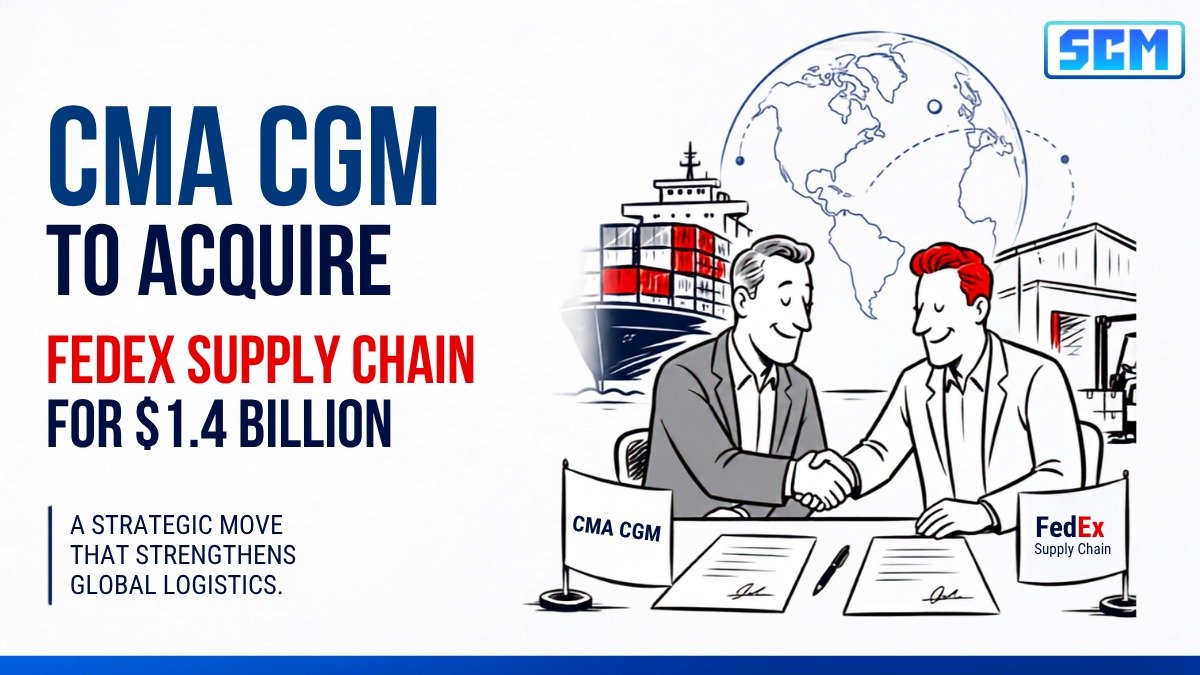
On July 1, 2026, CMA CGM Group announced it would acquire FedEx Supply Chain, the third-party logistics subsidiary of FedEx Corp, for an enterprise value of $1.4 billion. The deal, expected to close later in 2026 subject to customary regulatory approvals, represents one of the most significant moves yet in the ongoing consolidation of the logistics and supply chain industry.
The transaction will nearly triple the size of CMA CGM’s North American contract logistics operations through its subsidiary, CEVA Logistics. It adds nearly 10,000 team members, approximately 34 million square feet of warehouse space, and around 150 warehouses. Post-completion, the combined North American footprint will include more than 240 locations and a workforce of about 20,000 people.
Strategic Rationale for Both Companies
For CMA CGM, the acquisition accelerates its strategy of offering comprehensive, integrated supply chain solutions. Chairman and CEO Rodolphe Saadé stated:
“The acquisition and partnership with FedEx represent a major step in the development of CEVA Logistics and our logistics activities in North America. We are strengthening our ability to provide customers with integrated supply chain solutions… [and] reinforce our long-term commitment to investing in the United States and supporting the resilience and efficiency of its supply chain.”
The deal is not purely acquisitive. CMA CGM and FedEx also plan multi-year commercial agreements covering ocean and air freight. CMA CGM will become a preferred (non-exclusive) ocean carrier for FedEx, with phased collaboration on air cargo capacity solutions expected to begin between now and 2028.
For FedEx, the sale allows greater focus on its core strengths in high-value verticals such as healthcare, automotive, aerospace, and data centers. President and CEO Raj Subramaniam noted:
“Today’s announcement enables FedEx to further increase our focus on providing our unique expertise for high-value verticals… By streamlining our portfolio, FedEx is better positioned to execute our long-term vision.”
Industry Implications
This transaction highlights several important trends shaping logistics in 2026:
- Ocean carriers expanding into contract logistics and fulfillment: Traditional shipping lines are moving deeper into warehousing, distribution, and end-to-end execution to capture more value and offer shippers greater visibility and control.
- Accelerating consolidation: Large players are building scale and integrated capabilities to compete in an environment of rate volatility, regulatory complexity, and demand for resilient supply chains.
- Partnership alongside competition: The accompanying commercial agreements show that even as boundaries blur between carriers, forwarders, and 3PLs, strategic alliances remain valuable for network optimization and capacity utilization.
For freight forwarders and 3PL providers, the move increases competitive pressure from well-capitalized, asset-rich players offering bundled ocean + inland + warehousing solutions. At the same time, it creates new partnership opportunities, particularly for forwarders who can complement these integrated networks on specific lanes or value-added services.
What This Means for Shippers
Shippers stand to benefit from more seamless, end-to-end options with stronger visibility across ocean, air, and domestic logistics. However, they will also need to evaluate how these larger integrated platforms fit into their multi-carrier and multi-forwarder strategies, especially amid ongoing tariff uncertainty, peak season pressures, and the push for greater supply chain resilience.
Looking Ahead
While the deal still requires regulatory clearance and successful integration, it signals continued momentum toward platform-style logistics providers that combine global ocean/air networks with robust North American warehousing and fulfillment capabilities.
As the industry evolves, success will increasingly depend on the ability to deliver not just transportation, but coordinated execution across the full supply chain. CMA CGM’s move with FedEx Supply Chain is a clear example of this direction.
What are your thoughts on this acquisition? Do you see it reshaping how forwarders and shippers approach integrated logistics in North America and beyond? Share your perspective in the comments.
