


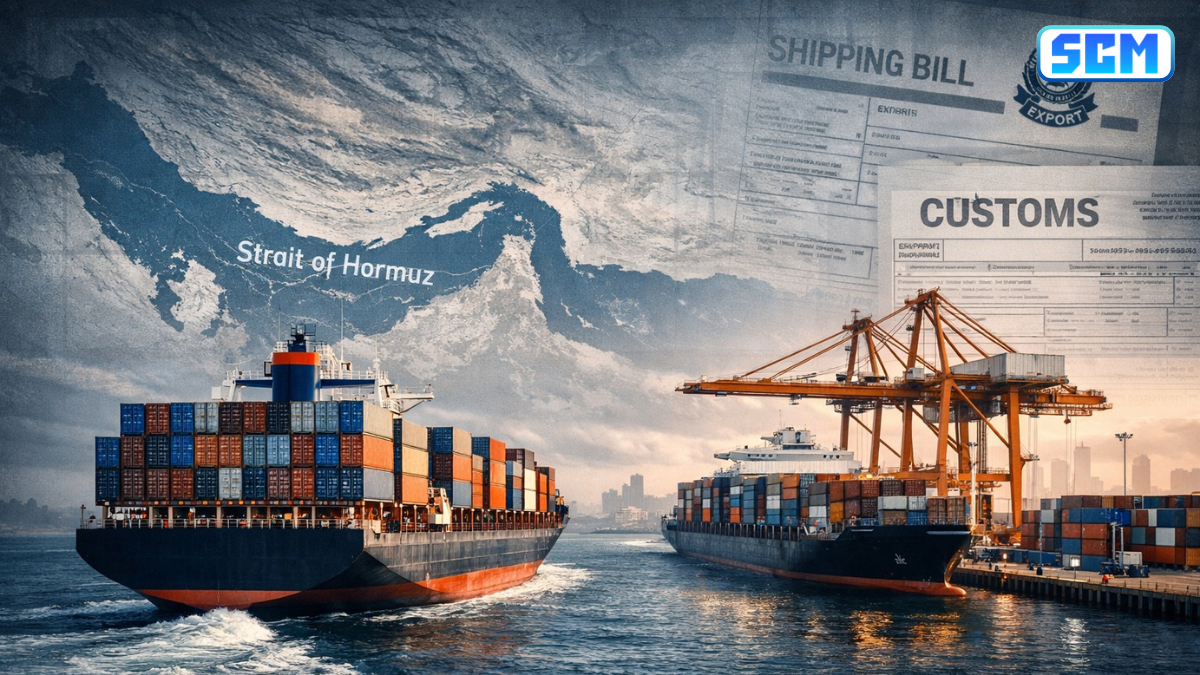
Global trade routes occasionally face unexpected disruptions due to geopolitical tensions, maritime conflicts, or natural disasters. One such critical chokepoint in international shipping is the Strait of Hormuz, through which a significant portion of global oil and cargo trade passes.
Due to the closure of the Strait of Hormuz, several vessels carrying Indian export cargo have been unable to reach their destination ports. As a result, these vessels are returning to Indian ports with the export cargo still onboard.
To address this unusual situation and ensure smooth handling of such shipments, the Central Board of Indirect Taxes and Customs (CBIC) issued Circular No. 09/2026-Customs dated 8 March 2026, providing special procedures under Section 143AA of the Customs Act, 1962 for handling returned export cargo.
This circular aims to facilitate trade, reduce delays, and ensure proper compliance when export cargo returns to India due to maritime disruptions.
Background: Why This Circular Was Issued
Indian customs authorities received representations from field formations reporting that:
- Export vessels departed from Indian ports with cargo.
- Due to closure of the Strait of Hormuz, ships could not continue their voyage.
- Ships had to return to Indian ports without unloading cargo at foreign destinations.
Under normal customs procedures, handling such cargo can involve complex re-import processes, including:
- Filing Bill of Entry
- Customs examination
- Reversal of export incentives
- Documentation corrections
To prevent logistics bottlenecks and compliance confusion, CBIC introduced temporary simplified procedures.
Legal Basis of the Circular
The circular has been issued under:
Customs Act, 1962
Specifically:
Section 143AA – which empowers the government to prescribe procedures for trade facilitation in exceptional circumstances.
This allows CBIC to implement temporary procedural relaxations during extraordinary disruptions affecting international trade routes.
Key Directive: Vessel Must Return to Same Port
A major rule specified in the circular:
- The vessel returning with export cargo must berth at the same Indian port from which it originally departed.
Exception:
- Transshipment cases where cargo is transferred to another vessel.
This requirement helps customs authorities verify shipping documentation and cargo seals more efficiently.
Scenario-Based Procedures for Returned Export Cargo
The circular outlines three operational scenarios and corresponding procedures.
Scenario 1: Vessel Still Within Indian Territorial Waters & EGM Not Filed
Situation
- Cargo already loaded on vessel.
- Ship has not crossed Indian territorial waters.
- EGM (Export General Manifest) or SDM not filed.
Procedure
- Captain’s Undertaking
- The vessel master must submit a declaration confirming the ship has not crossed Indian territorial waters.
- Berthing Permission
- Vessel allowed to berth without filing Sea Arrival Manifest (SAM).
- Cargo Offloading
- Containers can be unloaded without filing Bill of Entry.
- Verification Process
Customs officers will verify:- Shipping Bills
- Container details
- Container seal integrity
- Seal Check
- If container seal is intact → normal processing.
- If seal is tampered → 100% customs examination.
- Shipping Bill Cancellation
- Customs must cancel the Shipping Bill and Let Export Order (LEO).
- Back-to-Town Facility
- Exporter may request Back to Town (BTT) to return cargo back to the domestic market.
Scenario 2: Vessel Within Territorial Waters but EGM Filed OR Ship Returned from International Waters Without Visiting Foreign Port
Situation
This scenario includes:
- Vessel within Indian waters but EGM or SDM already filed, OR
- Vessel crossed territorial waters but returned without visiting any foreign port.
Procedure
- Captain Declaration
- Undertaking confirming:
- Vessel did not call any foreign port.
- Undertaking confirming:
- No SAM Requirement
- Ship allowed to berth without filing Sea Arrival Manifest.
- Cargo Offloading
- Containers unloaded without Bill of Entry.
- Container Verification
- Customs verifies:
- Shipping Bills
- Container seals
- Cargo integrity
- Customs verifies:
- Shipping Bill Cancellation in ICES
- DG Systems will introduce a new feature in the Indian Customs EDI System to cancel Shipping Bills after EGM filing.
- Prevention of Incentive Disbursement
- System ensures export incentives are not wrongly released.
- Data Sharing
Shipping Bill cancellation details will be shared with:- Reserve Bank of India (RBI)
- Directorate General of Foreign Trade (DGFT)
- Other concerned agencies via ICEGATE
- Manual Record Keeping (Temporary)
- Until the system upgrade is implemented:
- Field formations must maintain manual records.
Scenario 3: Vessel Returned After Visiting a Foreign Port Without Discharging Cargo
Situation
- Vessel crossed international waters.
- Ship called at a foreign port.
- No cargo was discharged.
Procedure
- Cargo is treated as exported out of India.
- Sea Arrival Manifest (SAM) must be filed.
- Follow the procedures from Scenario 2, including:
- Container verification
- Shipping Bill cancellation
- Incentive monitoring
Handling Export Incentives
Customs authorities must ensure recovery of any export incentives already granted, including:
- IGST refunds
- Duty Drawback
- Other export promotion benefits
If incentives were already disbursed:
- Recovery must be done manually by field officers.
This ensures no financial benefit is claimed for exports that did not actually take place.
Transshipment Cargo
For cargo meant for transshipment, normal customs provisions will continue to apply under existing rules.
The circular does not alter the current transshipment procedures.
Temporary Validity of the Circular
The relaxation provided under this circular is temporary.
Duration:
15 days from the date of issuance (8 March 2026).
This means the procedures are valid until approximately 23 March 2026, unless extended.
Impact on Exporters, Shipping Lines, and CHAs
For Exporters
Benefits include:
- Faster return of goods.
- Ability to reprocess shipments.
- Avoid complex re-import procedures.
Exporters can:
- Request Back-to-Town facility
- Re-export goods later.
For Customs Brokers (CHAs)
Customs brokers must:
- Coordinate with shipping lines
- Ensure correct Shipping Bill cancellation
- Track export incentive reversal
- Maintain compliance records.
For Shipping Lines
Shipping lines must:
- Provide Captain undertakings
- File required manifests where applicable
- Ensure cargo integrity documentation.
Impact on Supply Chain and Logistics
This circular highlights the vulnerability of global shipping chokepoints.
The Strait of Hormuz disruption has affected:
- Middle East trade routes
- India-Gulf shipping lanes
- Energy and cargo flows
India’s quick procedural response demonstrates the importance of trade facilitation during geopolitical disruptions.
Conclusion
CBIC Circular 09/2026 provides critical procedural relief for exporters and logistics operators affected by the Strait of Hormuz disruption.
Key takeaways:
- Simplified procedures for returned export cargo.
- No Bill of Entry required in most cases.
- Shipping Bill cancellation process introduced.
- Export incentives strictly monitored.
- Temporary relief valid for 15 days.
This move ensures minimal disruption to Indian export logistics while maintaining regulatory compliance.
