


The Strait of Hormuz situation just got more complicated.
On Sunday, Mohsen Rezaei, Secretary of Iran’s Supreme National Security Council, announced that Iran will declare a new restricted zone in the Gulf in the coming days. The zone will begin from where the US naval blockade of Iran starts and extend into parts of the Persian Gulf.
Any vessel entering this zone without Iranian coordination will be placed on Tehran’s sanctions list. That affects insurance coverage and future passage through the strait.
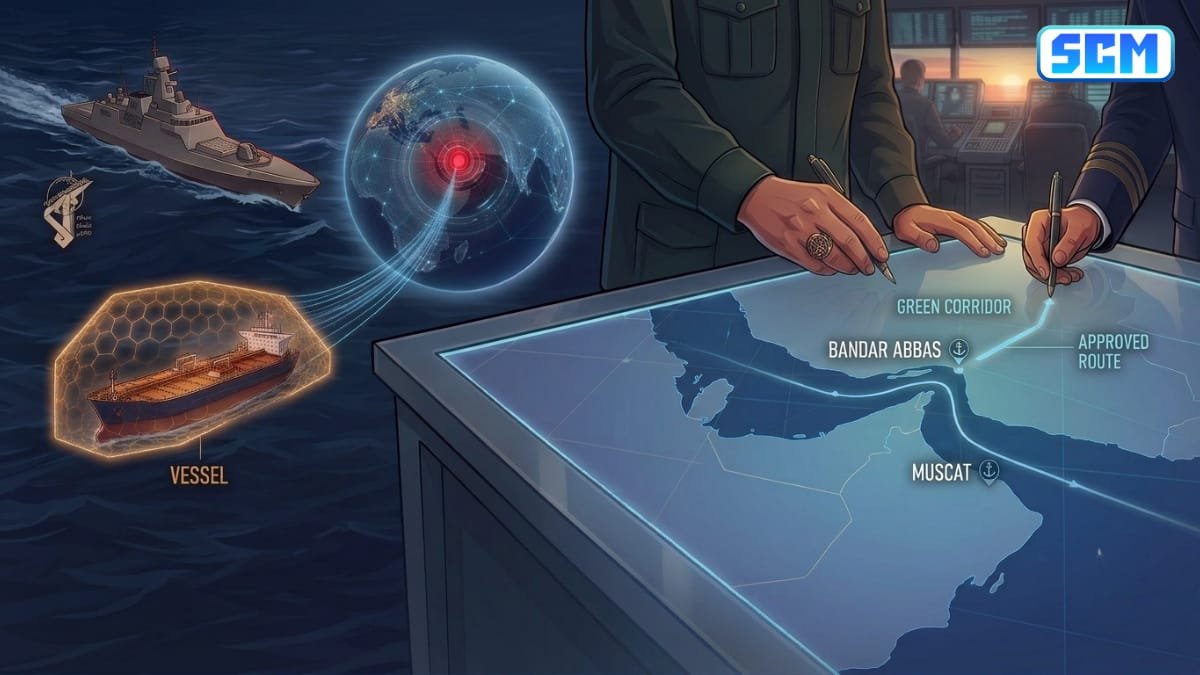
At the same time, Iran and Oman have reportedly agreed on a new shipping corridor through the Strait of Hormuz. The maps have been agreed. Signatures are expected soon.
Two announcements in one weekend. Both significant. Neither fully resolved yet.
What’s Actually Happening in the Strait Right Now
The Strait of Hormuz has been largely closed to normal tanker traffic since the US-Iran conflict escalated earlier this year. This past weekend made things worse.
The US struck three Iranian oil tankers. Iran responded with a missile and drone barrage targeting US military facilities in Jordan and the UAE. Iranian Parliament Speaker Mohammad Bagher Ghalibaf warned the era of proportional responses is over.
Shipping traffic through the waterway has fallen sharply. Over the past ten days, roughly 10 commodity ships per day have been transiting the strait. In normal times, the Strait of Hormuz handles around 20% of global oil supply. Brent crude rose above $97 a barrel on Monday following the weekend escalation.
The US takes a different view of how open the strait is. Energy Secretary Chris Wright told CNN that US naval transits are averaging over 9 million barrels per day through the waterway. With bypass pipelines, he said the US is moving roughly two-thirds or more of pre-conflict flows. “The Iranians are still causing trouble, but the United States Navy is winning that battle,” he said.
Iran’s position is simpler: no vessel passes through the Strait of Hormuz without Iranian permission. Rezaei called Trump’s claim that the strait remains open “a big lie.”
The New Restricted Zone — What We Know and What We Don’t
Details on the new restricted zone are limited. Rezaei didn’t publish maps or precise coordinates on Sunday. What he said:
The zone starts from the US Navy’s blockade line and extends into parts of the Persian Gulf, stretching toward several key ports. Any vessel entering will be placed on Iran’s sanctions list. Insurance consequences follow from that designation.
That last part is significant for shipping operators. Getting placed on an Iranian sanctions list doesn’t just create political complications. It affects whether P&I clubs and hull insurers are willing to continue covering a vessel. Lose insurance, and you effectively lose the ability to operate commercially in most markets.
Iranian Parliament speaker Ghalibaf went further on Sunday, warning that US actions would be met with “faster, heavier and more painful” retaliation. “The Americans have surely understood that the era of proportionate responses has come to an end,” he said.
The Oman Corridor — A Potential Opening
The more interesting development from a shipping perspective is the Iran-Oman corridor agreement.
Deputy Foreign Minister Kazem Gharibabadi said late last month that Iran and Oman had agreed on a temporary maritime route through the Strait of Hormuz, with vessels transiting through Iranian territorial waters. Rezaei confirmed Sunday that maps have been agreed and should be signed soon.
The corridor would run through Iranian and Omani waters, with Iran holding management authority over the passage.
What this means in practice: ships using this corridor would effectively be operating under Iranian oversight. That creates its own set of complications for operators based in the US, UK, or EU. Sanctions compliance and insurance coverage for vessels transiting an Iran-managed corridor is genuinely complex legal territory.
But for some operators — particularly those moving cargo that doesn’t trigger US or EU sanctions concerns — it could represent a partial reopening of the strait under defined conditions.
The details will matter enormously. Until the maps are signed and published, the corridor is a framework, not an operational reality.
What This Means for India’s Supply Chains
India’s exposure to the Hormuz situation is significant and direct.
Around 60% of India’s crude oil imports come from the Gulf. Substantial volumes of LPG, LNG, and petrochemical products flow through the strait. And India-Gulf trade — worth over $180 billion annually across both directions — runs heavily through the shipping lanes now being reorganised by Iran’s announcements.
We’ve covered this situation across multiple angles over the past months. The CBIC emergency customs procedures, DP World’s Fujairah terminal investment, the Russia-India overland corridor proposals — all of them are responses to the same underlying problem: the Strait of Hormuz is no longer a reliable shipping route.
Iran’s new restricted zone makes that problem more formal. It gives the disruption a defined geographic boundary and a legal mechanism — the sanctions list — that makes non-compliance with Iranian requirements commercially consequential.
For Indian importers and freight forwarders managing Gulf-origin cargo, the practical reality hasn’t changed dramatically this week. The bypass routes — Fujairah, UAE overland networks, Saudi pipelines — remain the operational workarounds. But the formalisation of Iran’s restricted zone and the potential Iran-Oman corridor adds two new variables to navigation and routing decisions that shipping operators will need to assess carefully.
The Oil Price Effect
One immediate consequence is already visible in energy markets.
Brent crude above $97 a barrel on Monday reflects the weekend’s escalation. If the restricted zone announcement triggers further vessel diversions or insurance withdrawals from Gulf routes, prices move higher. If the Iran-Oman corridor is signed and creates a genuine operational passage for some cargo, prices moderate.
The range of outcomes is wide. That’s what makes this weekend’s announcements so significant — not just what they mean now, but what they indicate about where the Gulf shipping situation is heading over the next weeks.
What to Watch This Week
A few specific developments to track:
The maps for the Iran-Oman corridor are expected to be signed in the coming days. Publication of those maps — including exact coordinates, vessel eligibility criteria, and management arrangements — will determine whether the corridor is commercially usable or legally complicated for most operators.
Iran’s formal declaration of the restricted zone, including its precise boundaries, will define which vessel positions in the Gulf become compliance questions.
Tanker insurance market responses. P&I clubs typically react quickly to new risk zone designations. Watch for Joint War Committee updates and changes to war risk premium zones.
US Navy posture. Wright’s statement that the US is managing oil flows at two-thirds of pre-conflict levels suggests the US sees the situation as manageable. Further escalation could test that assessment.
Bottom Line
Iran is formally restructuring Gulf shipping geography. The new restricted zone creates a compliance mechanism around Iranian territorial claims. The Oman corridor, if signed, creates a defined passage for some vessels under Iranian management.
Neither development resolves the underlying conflict. Both change the operational environment for shipping in ways that will take days and weeks to fully understand.
For anyone moving cargo through or around the Gulf, this week’s announcements are the ones to watch closely.
Tracking the Strait of Hormuz situation and its supply chain impact? Follow SupplyChain MetaVerse for ongoing coverage.
