


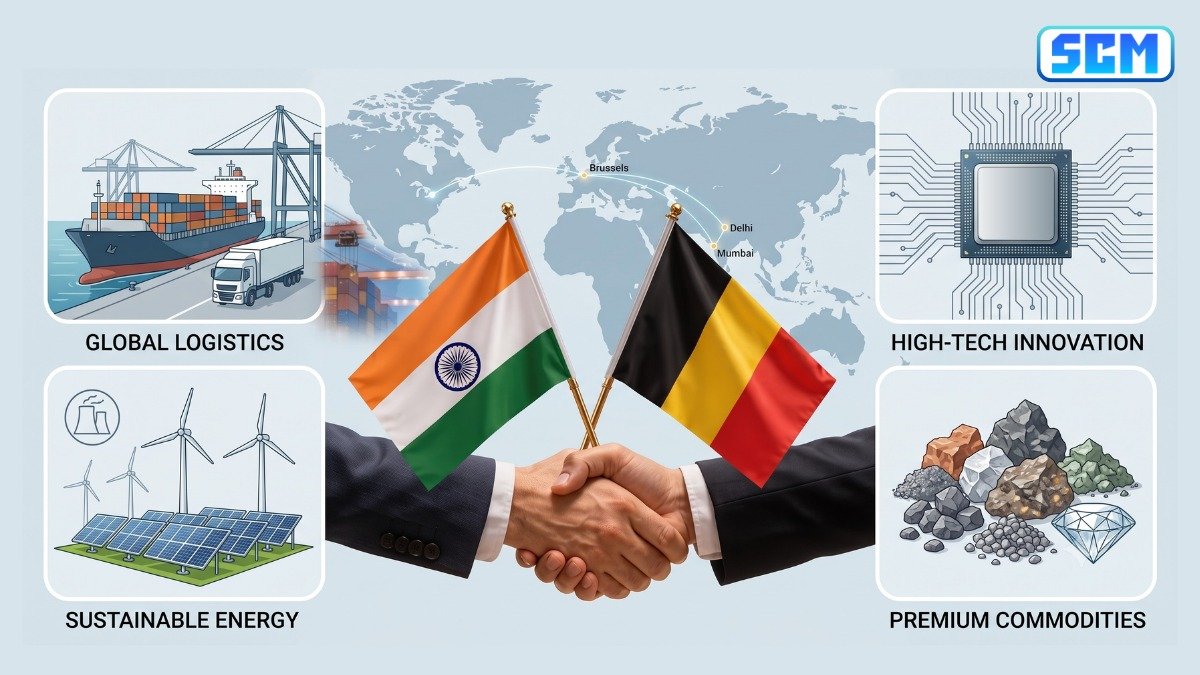
Belgian Prime Minister Bart De Wever landed in India for a three-day official visit this week — the first Belgian PM to visit India in two decades. That alone tells you something about how seriously both sides are taking this relationship right now.
After talks with PM Narendra Modi at Hyderabad House in New Delhi on September 3, the two countries announced 10 outcomes. The headline: double bilateral trade from $13.01 billion (FY26) to over $26 billion within five years.
That’s an ambitious target. Whether it happens depends on a lot of moving parts — but the groundwork being laid right now is more substantial than a typical diplomatic announcement.
Beyond Diamonds — Diversifying What India and Belgium Actually Trade
India and Belgium have traded for decades. But for most of that history, the relationship has been dominated by one thing: diamonds.
Antwerp is the world’s diamond capital. A huge share of India’s rough diamond imports flow through Belgium, get cut and polished by Indian craftsmen, and flow back out. It’s a well-established supply chain — but it’s also a concentrated one.
Both sides acknowledged this explicitly. The goal isn’t just to grow trade volume — it’s to diversify it into sectors that weren’t even part of the conversation five years ago.
The sectors identified: semiconductors, chemicals, pharmaceuticals, defence, critical mineral refining and recycling, sustainable industries, nuclear energy, logistics, and ports.
Logistics and ports making that list is worth noting. It’s not a coincidence — Belgium is home to the Port of Antwerp-Bruges, one of Europe’s largest cargo hubs and a port that already signed an MoU with India’s VOC Port earlier this year. Supply chain connectivity between the two countries is increasingly a real agenda item, not just a footnote.
The India-EU FTA Connection
A lot of what India and Belgium agreed this week is riding on something bigger — the India-EU Free Trade Agreement, concluded on January 27, 2026.
Modi described it as “the mother of all deals.” That’s diplomatic language, but the substance is real. The FTA — when implemented — will reduce tariffs on a wide range of goods traded between India and EU member states, including Belgium.
For Belgian companies, this means Indian market access gets easier. For Indian exporters, European markets open up. Both sides called for early completion of related agreements — the EU-India Investment Protection Agreement and the Geographical Indications agreement — to lock in the full benefit of the FTA framework.
Belgium and India also launched an Investment Fast-Track Mechanism specifically for Belgian companies looking to enter India. It’s a dedicated pathway to cut through bureaucratic delays — and a signal that India is serious about making Belgium’s business community feel welcome.
Defence — The New Pillar
Defence cooperation got significant attention in the outcomes from this visit.
The two countries signed a Letter of Intent covering joint weapons co-production, military exchanges, and intelligence sharing. Half a dozen agreements were signed between Indian and Belgian defence companies.
India will also appoint a resident defence attaché at its embassy in Brussels — Belgium already posted its attaché in New Delhi earlier this year. That’s a small detail with real significance. A resident attaché means ongoing, embedded defence dialogue — not just high-level visits.
The Zorawar tank — India’s domestically developed lightweight tank designed for high-altitude operations — came up specifically as an area of potential collaboration. Belgium has specialised expertise in defence manufacturing and advanced industrial technologies that fits well with India’s Make in India defence push.
Critical Minerals — The Less Discussed But Important Part
Belgium refines and recycles critical minerals at scale. That capability is increasingly valuable as global supply chains for EV batteries, semiconductors, and clean energy technology compete for the same limited mineral inputs.
India identified critical mineral refining and recycling as a priority cooperation area. Given India’s push into EV manufacturing, semiconductor fabrication, and renewable energy infrastructure — all of which are mineral-intensive — accessing Belgium’s refining expertise is strategically useful.
This is the kind of industrial supply chain cooperation that rarely makes front-page news but has real long-term implications for how India sources and processes the materials its future industries will run on.
What the Supply Chain and Logistics Community Should Watch
For freight forwarders, logistics operators, and trade professionals, a few specific threads from this visit are worth tracking.
The Port of Antwerp-Bruges connection is the most direct. Belgium’s flagship port already has an MoU with VOC Port Tuticorin signed earlier this year — covering digital port management and green shipping. If India-Belgium trade volumes grow as targeted, that MoU becomes more than symbolic. Increased cargo flows between India and Antwerp will need real logistics infrastructure on both ends.
The India-EU FTA implementation timeline is the other thing to watch. The FTA creates the tariff framework — but the logistics infrastructure to move increased volumes efficiently needs to develop alongside it. Freight forwarders handling India-Europe lanes should be watching implementation progress closely, because new trade flows create new routing and capacity decisions.
And the Investment Fast-Track Mechanism — if it actually works as designed — could accelerate Belgian manufacturing investments in India, creating new supply chain connections between Belgian industrial clusters and Indian production facilities.
Bottom Line
India and Belgium doubling trade in five years is ambitious. But the building blocks are more solid than a typical bilateral announcement. The India-EU FTA provides the tariff framework. The Port of Antwerp-Bruges MoU with VOC Port provides the logistics connection. The Investment Fast-Track Mechanism provides the business pathway.
What’s new about this visit is the defence and critical minerals dimension — both of which point to a relationship moving beyond traditional commerce into strategic industrial partnership.
Whether the $26 billion target gets hit by 2031 will depend on FTA implementation, investment follow-through, and global trade conditions. But the direction is clear.
Tracking India-Europe trade developments and their supply chain implications? Follow SupplyChain MetaVerse for ongoing coverage.
