


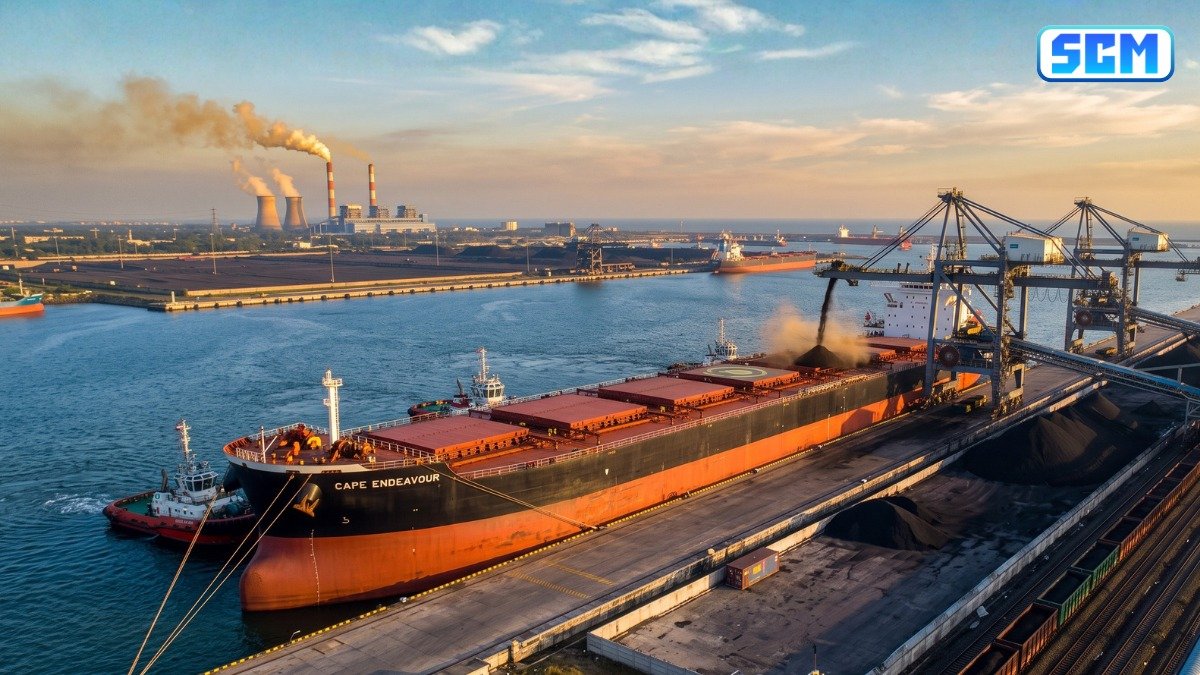
India’s port infrastructure is moving into a deeper-water era.
Kamarajar Port Limited at Ennore, near Chennai, has become India’s second major port to achieve an operational draft of 18 metres. The milestone, achieved after the completion of Capital Dredging Phase VI, allows the port to handle fully laden Capesize bulk carriers carrying cargo parcels of up to 170,000 deadweight tonnes (DWT).
The upgrade matters because it changes how bulk cargo can move through India’s east coast. Larger vessels can now call at Kamarajar Port with higher cargo loads, helping shipping lines, importers and industrial users benefit from economies of scale.
With an investment of around ₹440 crore, the project positions Kamarajar Port as a deeper, more competitive gateway for India’s growing EXIM trade.
Quick Summary
Kamarajar Port has achieved an 18-metre operational draft after completing its Capital Dredging Phase VI project. The upgraded depth enables the port to handle fully laden Capesize vessels of up to 170,000 DWT.
The development makes Kamarajar Port India’s second major port, after Visakhapatnam Port, with an 18-metre draft capability. It is expected to reduce logistics costs, improve bulk cargo handling efficiency and strengthen the Chennai–Ennore maritime cluster’s role in India’s trade network.
Key Highlights
- Kamarajar Port has achieved an operational draft of 18 metres.
- It is now India’s second major port with this capability, after Visakhapatnam Port.
- The ₹440 crore Capital Dredging Phase VI project made the port “Cape Compliant.”
- The port can now accommodate fully laden Capesize vessels carrying up to 170,000 DWT.
- The outer approach channel was deepened from 20 metres to 23 metres.
- The inner entrance channel was deepened from 19 metres to 22 metres.
- The upgrade can lower per-tonne freight costs and improve cargo-handling productivity.
- The project supports India’s Maritime India Vision 2030 and Maritime Amrit Kaal Vision 2047.
What Does an 18-Metre Draft Mean for a Port?
A vessel’s draft is the vertical distance between the waterline and the lowest point of the ship’s hull. In simple terms, it indicates how much water depth a vessel needs to sail safely.
A deeper port draft allows larger vessels to enter and berth with more cargo on board.
For bulk cargo ports, this is especially important because commodities such as thermal coal, coking coal, iron ore, limestone and other industrial raw materials are usually transported in large volumes. If a port cannot provide adequate depth, vessels may have to arrive partially loaded, reduce cargo at another location or use a different port altogether.
An 18-metre operational draft gives Kamarajar Port the ability to receive much larger bulk carriers at a higher load factor.
From Dredging Project to Cape-Compliant Port
The achievement follows the completion of Capital Dredging Phase VI, a major marine infrastructure project undertaken by Kamarajar Port Limited.
The project involved deepening critical navigation and berthing areas, including:
- Outer approach channel: from 20 metres to 23 metres
- Inner entrance channel: from 19 metres to 22 metres
- Berths: upgraded to support vessels with an 18-metre draft
- Harbour basin and navigation areas: deepened to support safe vessel movement
The purpose was to make Kamarajar Port “Cape Compliant.”
A Cape Compliant port can accommodate Capesize vessels, which are among the largest dry-bulk carriers operating in global trade. These vessels are commonly used for long-haul movement of coal, iron ore and other bulk commodities.
Why Capesize Vessel Capability Is a Major Advantage
Capesize vessels are generally too large to pass through the Panama Canal and historically travelled around the Cape of Good Hope or Cape Horn, which is where the category gets its name.
For Indian trade, the ability to handle fully laden Capesize vessels can create a major cost advantage.
A larger vessel can carry more cargo in one voyage. This allows fixed voyage costs, including crew, fuel, chartering and port-related costs, to be spread across a larger cargo volume.
For cargo owners, that can translate into lower freight cost per tonne.
For shipping lines, it can improve vessel deployment efficiency. For the port, it can increase cargo throughput potential and strengthen its appeal for large bulk cargo calls.
How the Upgrade Can Lower Logistics Costs
The biggest benefit of the 18-metre draft capability is likely to be improved economies of scale.
Earlier, a large bulk vessel may have needed to reduce its cargo load before calling at a port with lower draft availability. This can create additional handling, transshipment or routing costs.
With Kamarajar Port now able to receive fully laden Capesize vessels up to 170,000 DWT, cargo can potentially move closer to its final destination in fewer steps.
The upgrade can support:
- Lower ocean freight cost per tonne
- Reduced need for part-loading or lightering
- Improved vessel turnaround potential
- Higher cargo volumes per vessel call
- Better supply chain predictability for bulk importers
- More competitive logistics for industrial users in southern India
The actual savings will depend on vessel size, freight markets, cargo type, terminal capacity, inland connectivity and commercial agreements. However, the infrastructure removes a key physical limitation that previously restricted larger vessel calls.
A Strategic Boost for Tamil Nadu’s Industrial Supply Chain
Kamarajar Port is located at Ennore, north of Chennai, in one of India’s most important industrial and manufacturing regions.
The wider Chennai–Ennore maritime cluster supports automotive manufacturing, engineering, power generation, petrochemicals, metals, logistics and other industrial sectors. The region also has strong road, rail and coastal shipping connectivity.
The deeper draft capability can be particularly valuable for industries dependent on high-volume raw material imports.
Potential beneficiaries may include:
- Thermal power and energy companies
- Steel and metal producers
- Cement and construction-material businesses
- Manufacturing units requiring imported bulk raw materials
- Commodity traders and bulk cargo logistics providers
- Shipping lines serving India’s east coast
The port already handles diverse cargo categories, including coal, automobiles, containers, liquid cargo and project cargo. The Capesize capability strengthens its position in the bulk cargo segment while adding strategic depth to the region’s maritime infrastructure.
Kamarajar Port and India’s EXIM Trade Ambition
India’s trade growth depends not only on manufacturing capacity and export demand but also on the efficiency of ports, terminals, shipping corridors and inland logistics.
Port depth is a critical but often overlooked part of that system.
A port can have modern terminals and good cargo equipment, but without sufficient draft, it cannot attract the largest vessels or support maximum cargo loads. Deepening a port therefore has a direct impact on shipping economics and competitiveness.
Kamarajar Port’s new capability supports India’s wider goal of reducing logistics costs and building globally competitive maritime infrastructure.
It also strengthens India’s ability to handle larger bulk cargo volumes on the east coast, which is important as industrial demand and trade volumes continue to expand.
The Role of Maritime India Vision 2030 and Maritime Amrit Kaal Vision 2047
The project aligns with the Government of India’s long-term maritime development agenda.
Maritime India Vision 2030 focuses on modernising ports, improving cargo handling, increasing private investment, enhancing coastal shipping and reducing logistics bottlenecks.
Maritime Amrit Kaal Vision 2047 takes a longer-term view, aiming to position India as a leading maritime nation with world-class ports, stronger shipbuilding capabilities, better logistics integration and improved global trade competitiveness.
Kamarajar Port’s 18-metre draft milestone reflects this shift from capacity expansion alone to capability expansion.
The focus is no longer only on handling more cargo. It is also about handling the right cargo, on larger vessels, with better efficiency and at lower cost.
What This Means for Shipping Lines and Cargo Owners
For shipping lines, the new draft availability creates an opportunity to deploy larger bulk vessels to Kamarajar Port, subject to commercial demand, berth availability, cargo terminal capability and navigational planning.
For cargo owners, the upgrade may create more options for sourcing and routing bulk imports.
For freight forwarders, customs brokers and logistics service providers, the development may influence cargo routing decisions across the Chennai–Ennore region.
However, deep draft alone does not guarantee an immediate increase in Capesize calls. The port’s success will depend on how effectively it converts infrastructure capability into regular vessel traffic and cargo volumes.
Key factors will include:
- Terminal productivity
- Berth availability
- Rail and road evacuation capacity
- Cargo aggregation
- Shipping line service planning
- Competitive port tariffs
- Digital port systems and vessel turnaround performance
Kamarajar Port vs Other Deep-Draft Ports in India
Kamarajar Port is now the second major port in India to offer an 18-metre draft, after Visakhapatnam Port.
It is important to distinguish between major ports and all ports in India. Several private ports and transshipment-focused facilities may have different natural depth conditions, channel depths or vessel-handling capabilities.
The significance of this announcement is that Kamarajar Port has joined a small group of Indian major ports capable of supporting fully laden Capesize bulk carriers.
This gives the port a stronger competitive position in the bulk cargo market and adds resilience to India’s port network.
The Bigger Picture: Deep Draft Is Only the First Step
The 18-metre draft milestone is a major infrastructure achievement, but the next phase is commercial execution.
To maximise the value of the project, Kamarajar Port will need to attract regular deep-draft vessel calls, strengthen cargo partnerships and ensure fast cargo evacuation from the port.
The strongest deep-water ports are not defined only by channel depth. They are defined by how efficiently they connect ships, terminals, rail networks, roads, warehouses, industrial clusters and digital trade systems.
For Kamarajar Port, the opportunity is to convert its Cape Compliant status into a long-term role as a preferred bulk cargo gateway for southern India.
FAQs
Why is Kamarajar Port’s 18-metre draft important?
The 18-metre operational draft allows Kamarajar Port to handle fully laden Capesize bulk carriers carrying cargo parcels of up to 170,000 DWT. This can improve shipping economies of scale and lower freight costs per tonne.
Which was India’s first major port with an 18-metre draft?
Visakhapatnam Port was the first major port in India to offer an 18-metre draft. Kamarajar Port is now the second.
What is a Capesize vessel?
A Capesize vessel is a large dry-bulk carrier commonly used to transport commodities such as coal and iron ore. These vessels typically require deep-water ports because of their large size and loaded draft.
How much was invested in the Kamarajar Port dredging project?
Capital Dredging Phase VI was completed with an investment of approximately ₹440 crore.
Where is Kamarajar Port located?
Kamarajar Port is located at Ennore, north of Chennai, in Tamil Nadu. It is part of the wider Chennai–Ennore maritime and industrial cluster.
Will this reduce freight costs immediately?
The deeper draft creates the infrastructure needed for lower per-tonne freight costs through larger vessel calls. Actual savings will depend on vessel deployment, cargo volumes, shipping market conditions, terminal productivity and inland logistics.
Conclusion
Kamarajar Port’s achievement of an 18-metre operational draft is a significant milestone for India’s maritime sector.
The ₹440 crore dredging project enables the port to handle fully laden Capesize vessels of up to 170,000 DWT, creating the potential for lower freight costs, better cargo efficiency and stronger bulk trade capacity.
More importantly, it strengthens the Chennai–Ennore maritime cluster at a time when India is investing heavily in port-led development, manufacturing growth and supply chain competitiveness.
The port now has the depth to compete for larger bulk cargo calls. The next challenge will be turning that capability into consistent trade volumes, faster cargo movement and a stronger position in India’s evolving maritime economy.
