

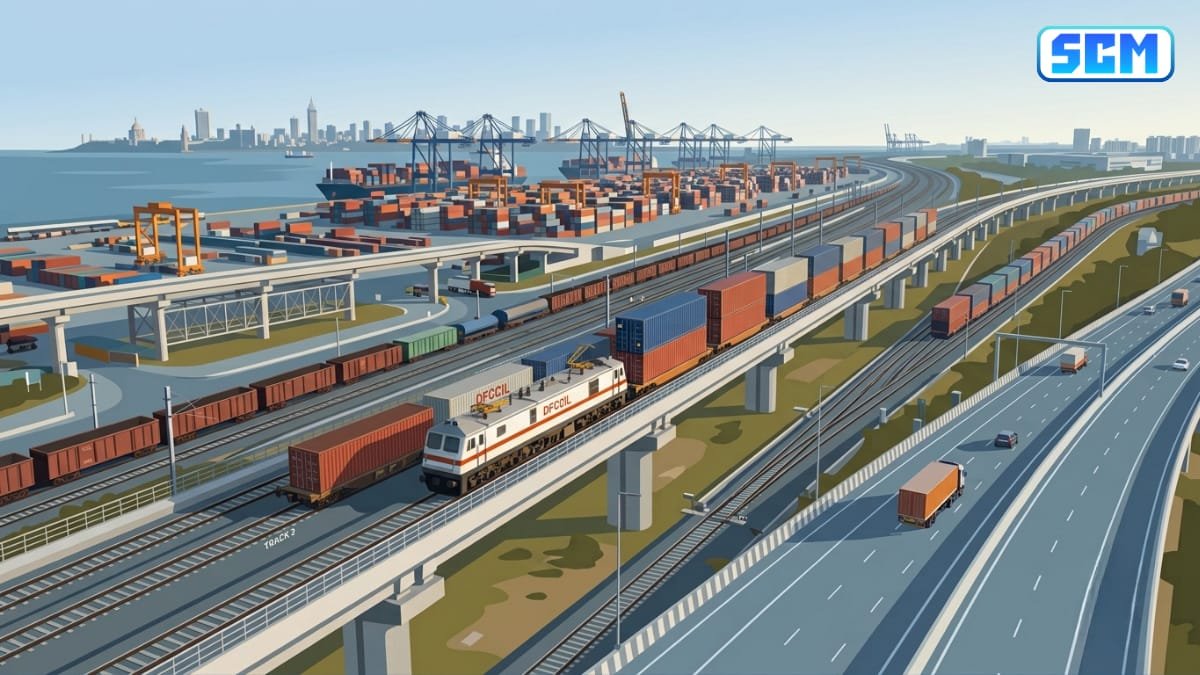
Twenty years. That’s how long it took to build India’s Dedicated Freight Corridor network from approval to full completion.
On September 8, 2026, Prime Minister Narendra Modi dedicated the final three sections of the Western Dedicated Freight Corridor in Vadodara — completing the full 1,506 km route from JNPT in Mumbai to Dadri in Uttar Pradesh. Combined with the already completed Eastern DFC from Ludhiana to Sonnagar, India now has a dedicated freight rail backbone of approximately 2,843 km.
For anyone who has followed this project — through delays, funding battles, land acquisition struggles, and missed deadlines — today is a significant moment.
What Got Completed Today
Three sections were dedicated today, covering 326 route kilometres built at a cost of over Rs 20,700 crore.
Sanand (North) to Makarpura. New Umbergaon to New Saphale. And the critical final link — New Saphale to JNPT.
That last section is the one that really matters. It’s the port-end connection that freight operators have been waiting for. Double-stack trains can now run directly from JNPA to manufacturing and consumption centres in western and northern India — without touching Mumbai’s congested conventional rail network at all.
PM Modi also flagged off freight train services from four new stations: New Sanand (North), New Makarpura, New Umbergaon, and New JNPT.
The full infrastructure package being inaugurated today in Vadodara is worth over Rs 35,000 crore.
Why the JNPT Link Was the Missing Piece
Here’s something worth understanding. The WDFC has been partially operational for a while. Sections in Rajasthan, Gujarat, and UP were running freight trains long before today.
But without the final JNPT connection, the whole point was undermined.
India’s largest container port — handling more than a third of the country’s containerised trade — couldn’t be directly accessed by the high-speed freight corridor sitting just kilometres away. Export cargo from JNPT still had to navigate Mumbai’s conventional rail network. Import cargo faced the same congestion on the outbound journey.
Today’s commissioning closes that gap. JNPT now has direct freight corridor connectivity. That changes the logistics equation for every exporter and importer moving cargo through Mumbai’s port.
What This Means in Practice
Double-stack container trains are the headline capability here. The WDFC is built for them — higher bridges, stronger tracks, electrification designed for heavier loads. A double-stack train carries roughly twice the cargo of a conventional freight train in the same length.
On the JNPT-Dadri corridor, that means freight trains connecting Mumbai’s port directly to Delhi’s industrial hinterland can now carry more, run faster, and stick to schedules in a way that was impossible on the shared passenger-freight conventional network.
Railways Minister Ashwini Vaishnaw said the Eastern and Western DFCs together form a key backbone of India’s transportation and logistics network. That’s accurate — and it’s taken two decades to get there.
For Indian exporters and importers, the practical benefits will show up over the next year as train services ramp up on the newly completed sections. Expect faster transit times on the JNPT-Dadri corridor, lower logistics costs at scale, and reduced pressure on Mumbai’s congested road and conventional rail network.
The 20-Year Story — Why It Took This Long
The DFC project was approved in 2006. The original target was 2017. Then 2019. Then 2022. Then various revised dates after that.
What caused the delays? Land acquisition was the biggest single factor — acquiring hundreds of kilometres of right-of-way through densely populated states is genuinely difficult. Funding arrangements took time to finalise, with Japanese JICA financing the Western DFC and World Bank financing parts of the Eastern DFC. And coordination across six states — Delhi, UP, Haryana, Rajasthan, Gujarat, Maharashtra — was as complex as it sounds.
The irony is that the sections that got built early proved their value quickly. Freight operators using the operational WDFC sections reported significant improvements in transit times and reliability. The argument for completing the remaining sections was never really in doubt — it was always a question of execution.
Today’s completion is the end of that story.
Where This Fits in India’s Freight Future
This completion doesn’t mean the work is done.
India’s freight rail share — around 27% of total freight tonne-kilometres — needs to grow significantly if the country is going to hit its logistics cost reduction targets. The DFC is the infrastructure foundation. But getting more cargo onto the DFC requires industrial parks, logistics hubs, and CFS facilities being built along the corridor — and that work is ongoing.
Amazon’s first e-commerce operation on the WDFC, which we covered last month when they launched the JPP-RCS parcel service from New Dadri, is one early signal of what commercial DFC usage looks like. As more services launch on the now-complete corridor — including from the JNPT end — that picture will fill in quickly.
Bottom Line
Twenty years is a long time. But India now has 2,843 km of dedicated freight rail corridor — operational, electrified, built for double-stack trains — connecting its major ports and industrial centres across the north and west of the country.
The final JNPT connection is the piece that makes it a complete system rather than a collection of useful but disconnected sections. That matters more than the headline inauguration.
The real measure of today’s milestone won’t be the ceremony in Vadodara. It’ll be in freight train schedules, logistics cost data, and port throughput figures over the next 12 to 24 months.
Tracking India’s freight corridor development and its logistics impact? Follow SupplyChain MetaVerse for ongoing coverage.


