


Quick Summary
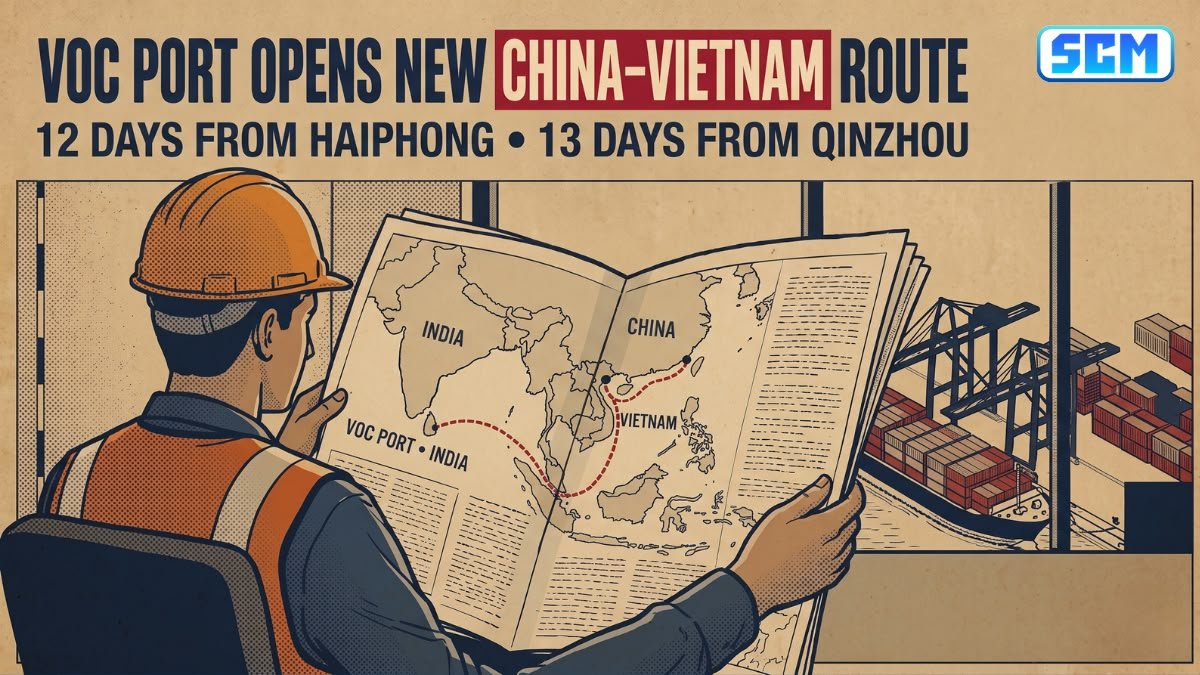
V.O. Chidambaranar (VOC) Port in Thoothukudi, Tamil Nadu, has strengthened its international shipping connectivity with the launch of a new container service linking southern China, Vietnam and India. Operated by Regional Container Line (RCL), the service began with the arrival of M.V. Nawata Bhum at Dakshin Bharat Gateway Terminal on October 18, 2026. The route offers announced transit times of 13 days from Qinzhou, China, and 12 days from Haiphong, Vietnam, to Thoothukudi.
Key Highlights
- New international connection: VOC Port gains another shipping link with China and Vietnam.
- Vessel capacity: M.V. Nawata Bhum can carry approximately 1,100 TEUs.
- Transit time: 13 days from Qinzhou and 12 days from Haiphong to Thoothukudi.
- Initial frequency: The service is planned to operate every two weeks, with weekly sailings possible if demand supports expansion.
- Potential beneficiaries: Exporters, importers, solar-panel manufacturers, electric-vehicle supply chains and other industries in southern India.
VOC Port Launches a New China–Vietnam Container Shipping Service
Tamil Nadu’s international trade network has gained another shipping connection with the introduction of a container service linking V.O. Chidambaranar Port with China and Vietnam.
The service commenced on October 18, 2026, when the Singapore-flagged vessel M.V. Nawata Bhum arrived at Dakshin Bharat Gateway Terminal (DBGT) in Thoothukudi. Regional Container Line operates the service, while Chakiat Shipping Services Pvt. Ltd. serves as the vessel’s local agent.
The development gives businesses in southern Tamil Nadu another option for moving containerised cargo through regional Asian shipping networks. It also strengthens the role of VOC Port as an international gateway for manufacturers, exporters and importers.
For businesses trading with China and Vietnam, the new connection adds another route to consider when planning shipment schedules, selecting ports and comparing freight options.
What Is the New VOC Port Shipping Route?
The service connects ports in China, Vietnam and India through a defined vessel rotation.
The announced port rotation is:
Qinzhou, China → Haiphong, Vietnam → Thoothukudi, India → Kattupalli, India → Chu Lai, Vietnam → Qinzhou, China.
The route includes two Indian ports, providing an additional connection for cargo moving through Tamil Nadu and the wider regional shipping network.
Key service details
| Particular | Details |
| Indian port | V.O. Chidambaranar Port, Thoothukudi |
| Container terminal | Dakshin Bharat Gateway Terminal (DBGT) |
| Shipping line | Regional Container Line (RCL) |
| Vessel | M.V. Nawata Bhum |
| Vessel flag | Singapore |
| Approximate capacity | 1,100 TEUs |
| Qinzhou–Thoothukudi transit | 13 days |
| Haiphong–Thoothukudi transit | 12 days |
| Initial service frequency | Every two weeks |
| Local vessel agent | Chakiat Shipping Services Pvt. Ltd. |
The transit times refer to the announced inbound journeys to Thoothukudi. Actual shipment schedules may vary depending on sailing dates, port operations and other operational factors.
How the New Route Could Benefit Tamil Nadu Exporters and Importers
A new shipping service can give businesses more flexibility in choosing how their goods move between manufacturing centres and overseas markets.
However, the commercial benefit will depend on cargo volumes, sailing reliability, freight rates and the availability of suitable equipment.
1. More shipping options for international trade
Importers and exporters can compare the new service with their existing shipping arrangements. An additional connection may provide greater flexibility when planning shipments between southern India, China and Vietnam.
Businesses should compare the full journey, including inland transportation, terminal charges, sailing schedules and any connecting services, before selecting a route.
2. Support for solar-panel and renewable-energy supply chains
The port authority has identified solar-panel manufacturing among the industries that could benefit from improved connectivity.
Solar manufacturing supply chains often involve the international movement of components, production equipment and finished products. A wider choice of container services can help businesses assess alternative shipping arrangements for these movements.
The new service does not automatically guarantee lower freight costs, but it creates another option for eligible cargo.
3. Opportunities for electric-vehicle manufacturing
Electric-vehicle manufacturing depends on the movement of components and materials across multiple suppliers and markets. Better maritime connectivity with Asian manufacturing centres could help businesses evaluate additional routing options.
For EV-related cargo, importers should consider shipment urgency, cargo handling requirements, container availability and the reliability of onward transport before choosing a service.
4. An additional route through Kattupalli
The service also calls at Kattupalli in Tamil Nadu. According to the reported service details, it provides shipping lines and non-vessel-operating common carriers (NVOCCs) with an additional option to route outbound export cargo through Kattupalli for onward transshipment.
For freight forwarders and NVOCCs, the practical value will depend on vessel connections, booking availability and the timing of onward sailings.
Could the New Service Reduce Shipping Costs?
The new route creates an opportunity for businesses to compare shipping options, but a reduction in logistics costs has not been established.
A route with a shorter announced transit time may be attractive, but transit time alone does not determine the overall cost of moving cargo.
Importers, exporters and freight forwarders should evaluate:
- Ocean freight: Compare the quoted rate with alternative services.
- Transit time: Check the full journey, not only the sea leg to Thoothukudi.
- Port and terminal charges: Include applicable handling and documentation fees.
- Inland transport: Calculate the cost of moving containers between factories, warehouses and ports.
- Sailing frequency: Assess whether the service matches the shipment’s required dispatch date.
- Transshipment risk: Confirm the availability and timing of onward connections where applicable.
- Equipment availability: Verify the availability of suitable containers for the planned shipment.
The most suitable route is the one that balances total landed logistics cost, delivery requirements and schedule reliability.
Bi-Weekly Sailings Planned, With Scope for Weekly Operations
The service is initially planned to operate every two weeks. The operator may increase the frequency to weekly sailings if market demand supports the expansion.
This distinction matters for supply chain planning. A fortnightly service can provide an additional option, but businesses with regular high-volume cargo may need to align production schedules and inventory planning with the available sailing dates.
If the service eventually moves to weekly operations, it could offer greater scheduling flexibility. However, weekly frequency remains conditional rather than a confirmed launch arrangement.
Exporters should confirm the latest sailing schedule and booking availability with their shipping line or freight forwarder before committing cargo to a particular departure.
VOC Port’s Growing Role in India’s Maritime Network
VOC Port, located in Thoothukudi on Tamil Nadu’s southeastern coast, serves industries and trading businesses across southern India. Its road and rail links, container-handling infrastructure and access to international sea routes support its role in export-import logistics.
The port handled approximately 442,000 TEUs during April–September 2026, representing growth of 3.18% compared with approximately 428,000 TEUs during the corresponding period a year earlier.
The new China–Vietnam service adds to this existing container activity by expanding the available shipping connections.
VOC Port is also pursuing infrastructure development, including plans for additional container-handling capacity. Such investments and new shipping services address complementary requirements: terminals need the capacity to handle cargo efficiently, while exporters and importers need dependable connections to overseas markets.
The long-term impact will depend on sustained cargo demand, service reliability, terminal performance and the availability of onward transport.
What This Means for India’s Supply Chain Industry
The new connection highlights the importance of regional shipping networks in supporting manufacturing and international trade.
For businesses operating in southern India, access to more shipping options can improve flexibility when planning import and export movements. For logistics providers, the service creates another connection to evaluate when designing transport routes for customers.
The development is particularly relevant to businesses that trade with Asian manufacturing centres or manage regional supply chains involving multiple ports.
Nevertheless, companies should base routing decisions on actual schedules, commercial quotations and end-to-end transport requirements rather than assuming that a new service will automatically be faster or cheaper.
Conclusion
The new China–Vietnam container service at VOC Port is a significant addition to Thoothukudi’s regional shipping connectivity. With announced transit times of 13 days from Qinzhou and 12 days from Haiphong, the service gives Tamil Nadu businesses another option for moving containerised cargo through Asian trade networks.
Its initial fortnightly schedule provides an additional connection, while any move to weekly sailings will depend on market demand.
For exporters, importers and freight forwarders, the next step is to assess the service against existing routes, freight rates, sailing schedules and inland logistics requirements. Its lasting value will depend on how effectively the new connection meets the needs of regional businesses.
Frequently Asked Questions
1. What is the new shipping service at VOC Port?
It is a container shipping service operated by Regional Container Line that connects Qinzhou in China, Haiphong and Chu Lai in Vietnam, and the Indian ports of Thoothukudi and Kattupalli.
2. When did the new service begin?
The service commenced with the arrival of M.V. Nawata Bhum at Dakshin Bharat Gateway Terminal on October 18, 2026.
3. How long does the vessel take to reach Thoothukudi from China and Vietnam?
The announced transit times are 13 days from Qinzhou, China, and 12 days from Haiphong, Vietnam.
4. How frequently will the service operate?
The service is initially planned to operate every two weeks. Weekly sailings may be introduced if market demand supports an increase.
5. Which industries could benefit from the new route?
Potential beneficiaries include solar-panel manufacturers, electric-vehicle supply chains, other manufacturers, importers, exporters, freight forwarders and NVOCCs handling suitable containerised cargo.
6. Will the new shipping route reduce freight costs?
Not necessarily. The additional service creates another option for comparing routes, but actual savings depend on freight rates, terminal charges, inland transport, sailing frequency and other shipment-specific costs.
7. What is the container capacity of M.V. Nawata Bhum?
The vessel has an approximate container capacity of 1,100 TEUs, where TEU means twenty-foot equivalent unit.
8. Which terminal handled the vessel at VOC Port?
The vessel called at Dakshin Bharat Gateway Terminal (DBGT) at V.O. Chidambaranar Port in Thoothukudi.
