

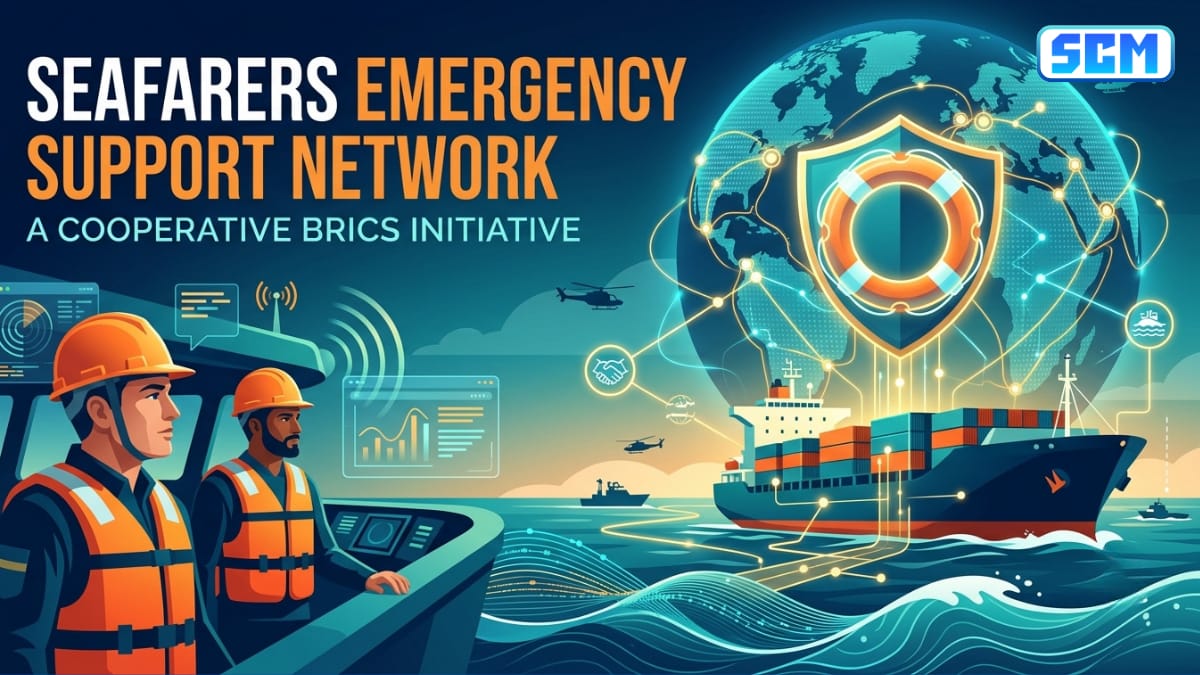
Two Filipino seafarers died in the Strait of Hormuz on August 31. Fifteen Filipinos were aboard two container vessels seized by Iranian forces earlier this year. And right now, hundreds of thousands of seafarers from India, the Philippines, China, and other BRICS nations are transiting some of the most dangerous shipping routes in recent memory.
Against that backdrop, Prime Minister Narendra Modi stood at the 18th BRICS Summit in New Delhi on September 12 and asked a question the maritime world has been quietly asking for years.
“Seafarers make a significant contribution to global trade, but they often find themselves without adequate support during difficult times. My proposal is: can we create a Seafarers Emergency Support Network?”
It’s a proposal worth taking seriously.
What PM Modi Actually Proposed
The idea is a coordinated emergency support mechanism among BRICS countries specifically for seafarers caught in crises.
Under the proposed network, maritime authorities and diplomatic missions of participating BRICS countries would be connected to each other. When a seafarer from any member country faces an emergency, the network activates across jurisdictions.
The services it would cover: distress alerts, medical assistance, communication with family members, and evacuation support.
That last one is critical. When a vessel is seized, attacked, or encounters a crisis in international waters, the speed at which a seafarer can get help often depends on which country’s flag the ship flies, which country the seafarer is from, and whether those two countries have any coordination arrangement in place. Right now, that coordination is largely ad hoc. It depends on individual consulates, shipping companies, and the ITF making calls to the right people.
A formal network among BRICS members changes that from improvised to systematic.
Why This Matters Right Now
The timing of this proposal isn’t accidental.
The Strait of Hormuz has been one of the most dangerous maritime zones on earth since the US-Iran conflict escalated in February 2026. Vessels have been attacked. Crews have been seized. Two Filipino seafarers lost their lives on the MV Sidr just two weeks before this BRICS Summit.
The Philippines, which supplies roughly 25% of the world’s seafarers and ranks first among the world’s five largest seafarer-supplying nations, has been pushing hard for better protections. Philippine President Ferdinand Marcos Jr., who attended the BRICS Summit, specifically noted that the safety of seafarers was tackled at the gathering and welcomed India’s initiative.
India has its own stake in this. It is one of the world’s largest suppliers of maritime labour, with Indian seafarers serving on vessels across every major shipping lane globally. Any mechanism that provides faster, more coordinated support to seafarers in emergencies directly protects Indian maritime workers.
The risks are not hypothetical. In July, the Government of India confirmed that Indian nationals had suffered casualties amid the West Asian conflict. More recently, an attack on the Panama-flagged tanker MT El Gaia off Oman left one Indian seafarer missing while 13 of the 14 Indian crew members were rescued. These are not distant statistics. They are real people working on vessels that keep India’s trade moving.
What BRICS Brings to This
The BRICS grouping has something genuinely useful to offer here that other multilateral bodies don’t.
BRICS collectively accounts for a substantial share of global trade. The member countries also collectively supply a large proportion of the world’s seafarers. India, China, and Russia are all major seafarer-supplying nations. The Philippines, while not a BRICS member, has expressed direct interest in the initiative.
That means a BRICS emergency support network would cover a significant portion of both the vessels involved in global shipping and the crews manning them. The diplomatic missions and maritime authorities of BRICS members are already present in most major ports and trade hubs globally. Connecting them into a coordinated network for seafarer emergency response is operationally realistic in a way that building something entirely new from scratch would not be.
PM Modi framed it within the broader context of global institutional reform. “Global institutions will earn the trust of humanity only when they are able to provide effective solutions to global challenges,” he said, positioning the seafarer network as part of making global governance more responsive rather than just aspirational.
What Actually Needs to Happen Next
A proposal at a summit is a starting point, not a solution.
For the Seafarers Emergency Support Network to become operational, several things need to follow. BRICS members need to formally adopt the proposal and assign it to a working group with a timeline. The specific protocols for how maritime authorities communicate and coordinate across jurisdictions need to be defined. Funding and staffing for any coordination mechanism need to be agreed. And the network needs to interface with existing bodies like the International Maritime Organization, the ITF, and the International Chamber of Shipping, which already have frameworks for seafarer welfare.
None of this is simple. But the foundational logic is sound. When a vessel is in distress in a conflict zone, having pre-agreed protocols between the maritime authorities of major seafarer-supplying and vessel-operating nations saves time. And in maritime emergencies, time is lives.
What This Means for the Maritime Industry
For shipping companies, manning agencies, and freight operators, this proposal matters in a few specific ways.
First, it reflects a clear signal that BRICS governments are paying serious attention to crew welfare as a supply chain issue, not just a humanitarian one. When vessels can’t be crewed because seafarers are refusing high-risk routes, cargo doesn’t move. The Hormuz situation has made that connection impossible to ignore.
Second, if the network materialises, it could reduce the reputational and operational risk for shipping companies operating in conflict zones. A company that knows its Filipino or Indian crew members have a formal, coordinated government support mechanism behind them is in a different position than one managing seafarer welfare entirely through its own channels.
Third, for the ITF and seafarer unions who have been pushing for better protections for years, a BRICS-level political commitment gives them a higher-level framework to hold governments accountable to.
Bottom Line
PM Modi’s Seafarers Emergency Support Network proposal is the right idea at the right moment. Two seafarers died in the Hormuz last month. Hundreds of thousands more are transiting dangerous waters every day. A coordinated emergency response mechanism among the countries that supply most of the world’s seafarers is not a luxury. It’s an operational necessity.
Whether it moves from proposal to reality depends on what BRICS members do in the months following this summit. The precedent from the BRICS Joint Transport Declaration in Nagpur earlier this year, which we covered in detail, suggests that when India tables a specific initiative under its BRICS Chairship, it tends to follow through on the working-group framework. That’s a reason for cautious optimism.
The seafarers keeping global trade moving deserve better than ad hoc crisis management. This proposal, if it becomes operational, gives them something more.
Tracking maritime worker safety and BRICS cooperation developments? Follow SupplyChain MetaVerse for ongoing coverage.


