

Quick Summary
Maersk and Hapag-Lloyd both reported Q2 2026 earnings on August 13 — and both beat expectations. Maersk raised its full-year 2026 earnings guidance for the second time this year, now targeting underlying EBITDA of $10.5 billion to $12.5 billion (up from $8-10 billion previously), with Q2 revenue jumping 20% year-on-year to $15.8 billion and net income reaching $1.3 billion. Freight rates rose 22% to $2,746 per 40-foot container. Hapag-Lloyd’s recovery was less dramatic but followed the same direction — revenue rose 11% to $5.8 billion, with net income of $83 million. Maersk shares popped 7% in European morning trade after the guidance raise. The financial headline is strong. But both CEOs — Maersk’s Vincent Clerc and Hapag-Lloyd’s Rolf Habben Jansen — spent significant time in their earnings calls warning about something that has little to do with ocean freight: the landside infrastructure bottleneck. And for Indian importers, exporters, and freight forwarders, this warning is directly relevant.
What Both CEOs Actually Said — The Landside Warning
The most important content from both earnings calls was not the financial figures — it was the structural warning about landside infrastructure.
Maersk CEO Vincent Clerc was explicit: “Infrastructure is stretched to the maximum.” He described landside logistics — port terminals, cargo facilities, road and rail links — as the result of “underinvestment in landside infrastructure for the last 15 years” combined with “continued growth in traded volumes.” The consequence, he said, is that the system is “starting to hit or stretch the limit.”
Clerc went further: “We will see rate events much more frequently as more bottlenecks within the supply chain arise. It’s really hard to forecast when we start to have this.” The implication is clear — landside bottlenecks are becoming a structural feature of the shipping market, not a cyclical blip, and they will drive freight rate volatility with limited advance warning.
Hapag-Lloyd CEO Rolf Habben Jansen echoed the same concern from a slightly different angle, specifically citing Asian hub ports: “The balance of supply and demand is much more reasonable than people anticipated” — but Asian hubs such as Shanghai were “struggling to cope with demand, causing delays.” This is the same congestion that Typhoon Dolphin made dramatically visible in August — but Jansen’s point is that the underlying capacity constraint existed before the storm, and will persist after it.
Clerc also flagged that strong, broad-based demand from the Far East since 2024 has created “significantly more unbalanced trade flows, with volume levels that are challenging landside infrastructure capacity” — generating congestion and disruptions across ports and inland transportation networks globally.
The Financial Picture — Two Carriers, Two Very Different H1 Experiences
Despite being Gemini Cooperation partners sharing a joint hub-and-spoke network, Maersk and Hapag-Lloyd had starkly different Q2 experiences — primarily because of how the Middle East conflict affected each carrier’s specific route portfolio.
Maersk Q2 2026:
- Revenue: $15.8 billion (+20% year-on-year)
- Net income: $1.3 billion
- Pre-tax profit: $1.6 billion
- Freight rates: $2,746 per 40-foot container (+22%)
- Volume growth: 4%+
- Ocean freight segment revenue: $10.5 billion (+23%)
- Full-year EBITDA guidance raised to $10.5-12.5 billion (second upgrade this year)
Hapag-Lloyd Q2 2026:
- Revenue: $5.8 billion (+11%)
- Net income: $83 million
- EBIT: $176 million
- Middle East conflict headwind: approximately $600 million during the quarter
- Full-year outlook raised in July, though with “considerable uncertainty” caveat
The $600 million Middle East headwind Hapag-Lloyd absorbed is significant context. Hapag-Lloyd had greater exposure to Gulf trade routes — now disrupted by the Strait of Hormuz closure since February 2026 — which Maersk’s more globally diversified route structure helped it partially offset. The Gemini Cooperation’s shared network design helped both carriers manage rerouting, but the specific cargo mix and contract structure each carrier holds determined how much the Middle East disruption cost them commercially.
Maersk noted it is currently routing approximately one-third of its normal traffic through the Suez Canal or Red Sea, covering four of its 13 services — a gradual, cautious return that avoids overwhelming already-congested terminals. Clerc said conditions for a full return to Suez in 2026 are in place, but that Maersk is moving deliberately to avoid chaos.
The Landside Bottleneck — What It Means in Practice
The landside infrastructure warning from both CEOs is not abstract. It describes a specific dynamic that supply chain operators are already experiencing in multiple markets — and that will affect cargo movement in India as well.
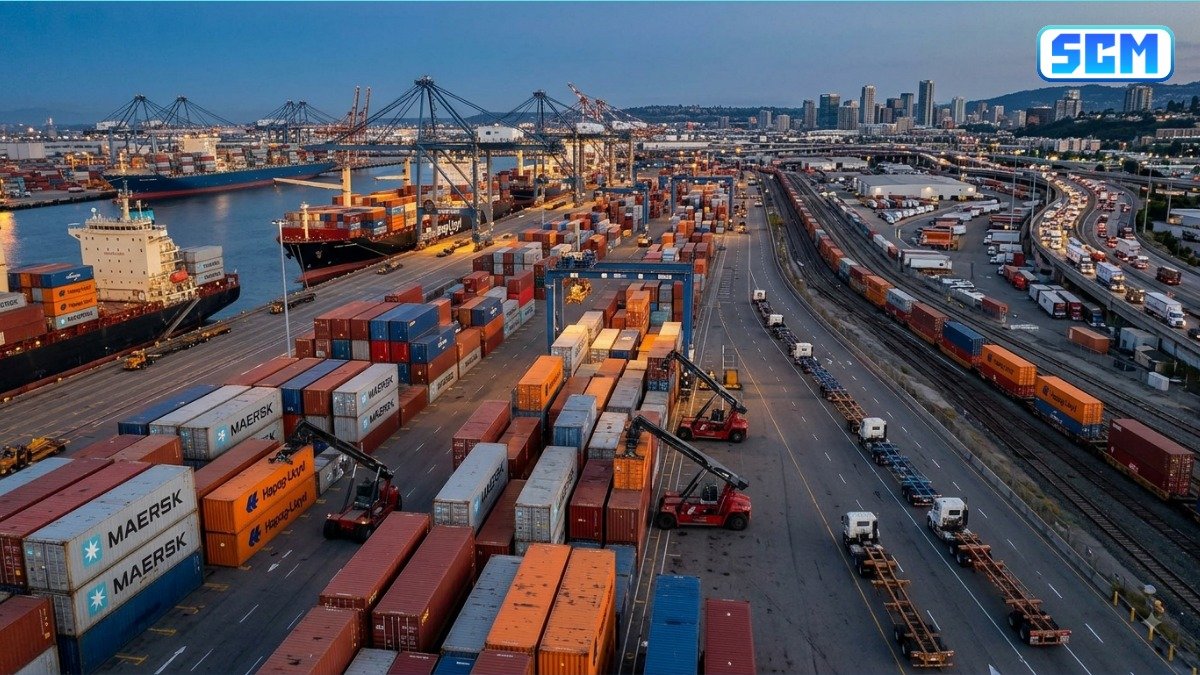
The core problem is that ocean freight capacity — the number of vessels and TEUs available — has been growing through new vessel deliveries. But the landside infrastructure that cargo must pass through after it leaves a ship — port terminals, container yards, trucking fleets, rail connections, inland depots — has not grown at the same pace. When demand grows faster than landside capacity, the result is congestion that manifests as:
Extended port dwell times: Containers sitting at terminals longer because there are not enough trucks or rail slots to move them out. This occupies terminal space that could otherwise receive new vessel calls, slowing turnaround times for vessels and cascading delays across schedules.
Trucking capacity shortages: At peak demand periods, trucking capacity at major port gateways is exhausted — rates for port drayage increase sharply, and transit times from port gate to inland warehouse become unpredictable.
Rail network saturation: In markets where port-to-inland rail is a primary freight mode — particularly in the US and parts of Europe — rail network capacity constraints create additional delays beyond the port terminal itself.
Rate spikes at short notice: As Clerc specifically warned, landside bottlenecks create “rate events” — sudden freight rate increases driven by capacity constraints — that are harder to predict than ocean rate movements because they arise from local infrastructure conditions rather than global vessel supply-demand dynamics.
Why India’s Shippers Need to Pay Attention
For Indian importers, exporters, and freight forwarders, the Maersk-Hapag-Lloyd landside warning connects to specific, already-visible dynamics in India’s own port and logistics infrastructure.
India has been experiencing its own version of the landside bottleneck problem. Major container ports — Nhava Sheva, Mundra, Chennai — have seen periodic congestion episodes driven by the mismatch between vessel arrival volumes and terminal handling capacity. The Dedicated Freight Corridor network, while significantly improving rail freight capacity in northern India, is still being extended and has not yet eliminated the road freight dependency that creates trucking bottlenecks at peak periods.
As we covered recently in the Typhoon Dolphin China port congestion analysis, Indian importers sourcing from China are already dealing with delayed ETAs as Chinese port backlogs work through the system. Clerc’s warning about more frequent rate events means these disruptions — and associated cost spikes — are likely to become a recurring feature of the shipping market rather than isolated incidents.
The specific implications for Indian supply chain operators:
For importers: Build more buffer stock than your just-in-time model suggests. Landside bottlenecks create delivery unpredictability that lean inventory strategies cannot absorb. The cost of a stockout driven by port delays is typically higher than the inventory carrying cost of a few extra weeks of safety stock.
For exporters: Book freight earlier and build landside time into your delivery commitments to international buyers. A vessel sailing on schedule does not guarantee your cargo reaches the inland destination on the original timeline if landside congestion adds days to port dwell or trucking transit.
For freight forwarders: The landside bottleneck environment creates an opportunity to differentiate through multi-modal expertise. Shippers who cannot predict which road or rail connection will be congested need forwarders who can switch between options — inland depots, alternative rail routes, feeder vessel connections — as conditions change.
The Red Sea Return — What Maersk’s Gradual Approach Means for Rates
One specific forward-looking signal from the Maersk earnings call deserves attention: the carrier’s deliberate, gradual approach to returning services to the Suez Canal and Red Sea.
Clerc said conditions for a full Suez return in 2026 are in place — implying the security situation has improved enough to make the route commercially viable — but that Maersk is routing only one-third of its normal Suez traffic through the canal currently, covering four of 13 services. The reason for the gradual pace is explicitly to avoid chaos at already-congested terminals.
This is a significant signal for the freight rate outlook. The Cape of Good Hope rerouting that has been in place since early 2024 absorbs vessel capacity — longer routes mean the same fleet carries less volume per year. As more cargo returns to the Suez route, that absorbed capacity is released back into the market, which typically puts downward pressure on freight rates. But Maersk is managing this release gradually specifically to avoid the terminal congestion that would arise from a sudden large-scale return — which means the rate-depressing effect of the Suez return will also be gradual rather than sudden.
For Indian importers and exporters on Asia-Europe lanes — which are the primary routes affected by the Red Sea situation — the practical takeaway is that freight rates on those lanes will remain elevated for longer than they would if carriers returned to Suez simultaneously and completely.
Bottom Line
Maersk and Hapag-Lloyd’s Q2 results confirm that container shipping demand is robust and freight rates are high — good news for carrier profitability but a cost challenge for shippers. The more important signal from both earnings calls is the structural landside infrastructure warning: after 15 years of underinvestment, port terminals, trucking networks, and rail links are being stretched by demand volumes that infrastructure was not built to handle. For Indian supply chain operators, the practical response is clear — more buffer inventory, earlier freight bookings, and multi-modal flexibility. The era of predictable, low-friction logistics is being replaced by one where landside bottlenecks create frequent, hard-to-forecast disruptions. Planning supply chains that can absorb that variability is now a competitive advantage, not just a logistics consideration.
Managing supply chain costs amid rising freight rates and landside bottlenecks? Share your experience — we are tracking how the container shipping market is evolving for Indian importers and exporters.


