

Quick Summary
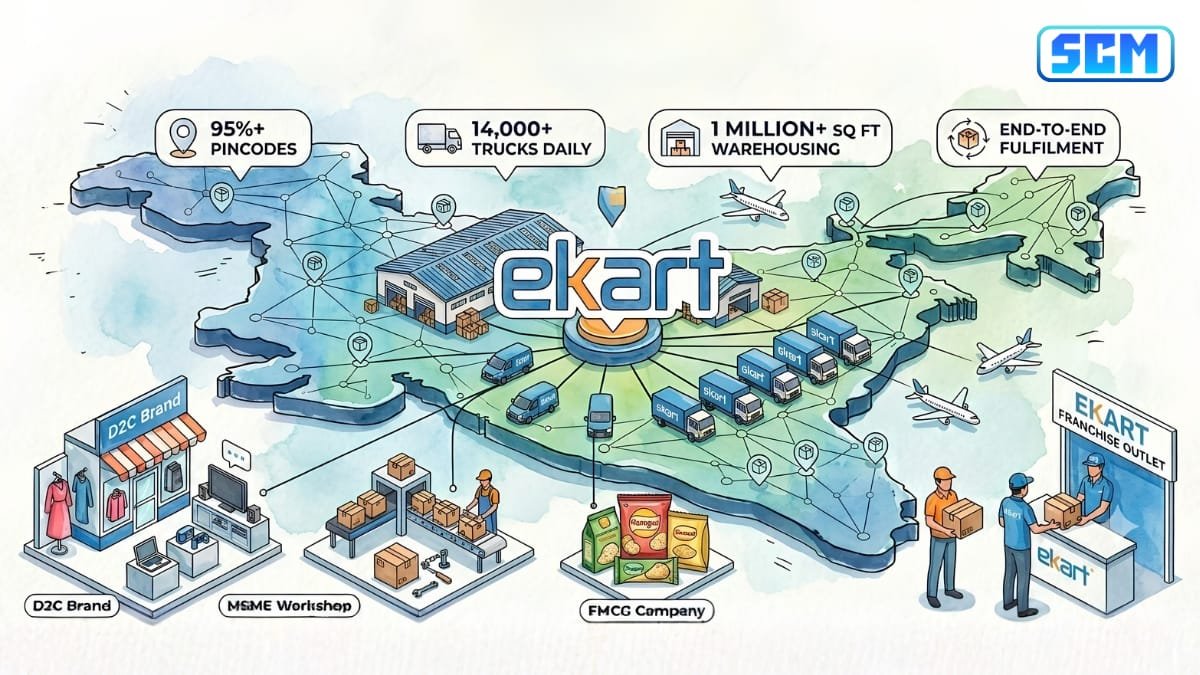
Ekart, the supply chain arm of Flipkart Group, has opened its pan-India logistics network to external businesses — MSMEs, D2C brands, FMCG companies, and enterprises — through a new franchise model and dedicated warehousing infrastructure. The move gives businesses outside the Flipkart ecosystem access to a network that covers more than 95% of Indian pincodes, operates over 14,000 trucks daily, and handles shipments across 80+ product categories. Ekart has already operationalised over 300 franchise outlets across Surat, Mumbai, Delhi, and Bengaluru, with plans to scale to more than 1,000 outlets by end-2026. Over 1 million square feet of dedicated warehousing space is now available to external customers for end-to-end fulfilment. For India’s rapidly growing D2C and MSME commerce ecosystem — where logistics has historically been the most expensive and operationally complex problem to solve — this is a meaningful shift in what’s available.
What Ekart Is Actually Offering — And What’s New About It
Ekart is not new to third-party logistics. The company has worked with brands and merchants outside the Flipkart Group for years. What has changed with this announcement is the structure and scale of that external access.
The franchise model is the key new element. Previously, external brands accessing Ekart’s network did so primarily through direct commercial arrangements. The franchise model changes the distribution of how that network is accessed — by creating 300+ physical outlets (scaling to 1,000+) that function as local entry points into Ekart’s national logistics infrastructure. A small D2C brand operating out of Surat, for instance, can now hand shipments to a local Ekart franchise outlet and access the same national distribution network that handles Flipkart’s own orders, without needing a direct enterprise-level contract with Ekart.
The warehousing component adds another layer. More than 1 million square feet of Ekart’s dedicated Grade-A warehouse space across 20+ locations — with capacity expansion underway in Delhi-NCR, Hyderabad, Kolkata, and Mumbai — is now available to external customers for end-to-end fulfilment. This means brands can store inventory inside Ekart’s network and have orders fulfilled and shipped from Ekart facilities, rather than managing their own warehouse operations and simply using Ekart for last-mile delivery.
The combination — franchise access plus dedicated warehousing — effectively makes Ekart a full 3PL provider competing openly for the same business that Delhivery, Shiprocket, Xpressbees, and other logistics providers have been building for years.
The Numbers That Make This Network Worth Accessing
The commercial appeal of Ekart’s offer for MSMEs and D2C brands comes down to the scale of the underlying infrastructure, which most third-party logistics providers cannot match.
Ekart reaches more than 95% of Indian pincodes and delivers across 15,000+ pincodes nationally. It deploys over 14,000 trucks daily and handles shipments across more than 80 product categories. The network was built to handle the volume and complexity of Flipkart’s own e-commerce operations — which means it has been stress-tested at a scale that most standalone 3PL networks have not.
Mani Bhushan, Chief Business Officer at Ekart, has noted that brands integrated into Ekart’s full logistics stack typically see an 8-10% reduction in supply chain costs — largely because inefficiencies between multiple logistics partners disappear when a single provider manages the entire journey from warehouse to doorstep. For D2C brands currently stitching together multiple logistics partners for different geographies or shipment types, that cost reduction is meaningful.
Ekart also offers value-added services — Open-Box Delivery, Hand-in-Hand Exchange, and air-network express deliveries for time-sensitive shipments — that go beyond basic courier services. For categories like electronics or premium fashion where delivery experience directly affects customer trust and return rates, these capabilities matter commercially.
Why This Matters for India’s D2C and MSME Commerce Landscape
India currently has roughly 11,000 D2C brands, with a growing proportion emerging from non-metro cities. The structural challenge for these brands has consistently been logistics — not because logistics providers don’t exist, but because the economics of building reliable, nationwide last-mile capability are difficult to justify at low volumes. A brand doing 500 orders a month cannot negotiate the same rates, service levels, or geographic coverage as one doing 50,000.
Ekart’s franchise model changes this by making enterprise-scale logistics infrastructure accessible at smaller volumes. A D2C brand in Ludhiana or Coimbatore can now access a network capable of delivering to Nashik or Guwahati without building regional logistics partnerships independently.
The timing of this expansion also reflects a broader shift in how India’s e-commerce infrastructure is being monetised. Flipkart, like Amazon (through Amazon Logistics/Shiping with Amazon), has recognised that its logistics infrastructure — built at enormous capital cost — is itself a commercial asset that can generate revenue beyond its original purpose of supporting the platform’s own marketplace. Opening Ekart to external brands is both a growth strategy and a utilisation strategy: it fills network capacity that exists regardless of whether external brands use it.
What This Means for the Existing 3PL Market
Ekart’s entry as an openly competitive 3PL provider intensifies an already crowded market. Delhivery, Xpressbees, Shiprocket, Shadowfax, and Ecom Express have all been competing for exactly the MSME and D2C logistics segment that Ekart is now targeting.
Ekart’s competitive advantages in this market are specific: pincode coverage depth (95%+ is at the top of the market), category breadth (80+ categories), warehouse infrastructure quality (Grade-A facilities across 20+ locations), and the brand credibility that comes from being Flipkart’s logistics backbone.
Its potential disadvantages are also real: Ekart’s pricing for external brands will need to be competitive with providers that have been optimising for third-party business longer, and the franchise model introduces a layer of operational variability that direct logistics networks don’t have. How consistently the 300+ franchise outlets (scaling to 1,000) deliver on service standards will be the key operational test of this model.
For freight forwarders and logistics consultants advising MSME and D2C clients on logistics partner selection, Ekart is now a credible option worth evaluating alongside established 3PLs — particularly for brands that already sell on Flipkart and can benefit from integrated fulfilment.
Bottom Line
Ekart opening Flipkart’s logistics network to MSMEs and D2C brands through a franchise model is one of the more significant structural changes in India’s last-mile logistics market in recent years. It brings enterprise-scale infrastructure — 95%+ pincode coverage, 14,000+ daily trucks, Grade-A warehousing — within reach of brands that previously couldn’t access it commercially. Whether Ekart executes the franchise model at the service quality levels its Flipkart operations are known for will determine whether this becomes a genuine market-shaping move or a capacity-filling exercise. The 1,000-outlet target by end-2026 will be the first real test.
Running an MSME or D2C brand and evaluating logistics partners? Share your experience with third-party logistics providers in India — we are tracking how the last-mile logistics market is evolving for small and mid-size brands.


