


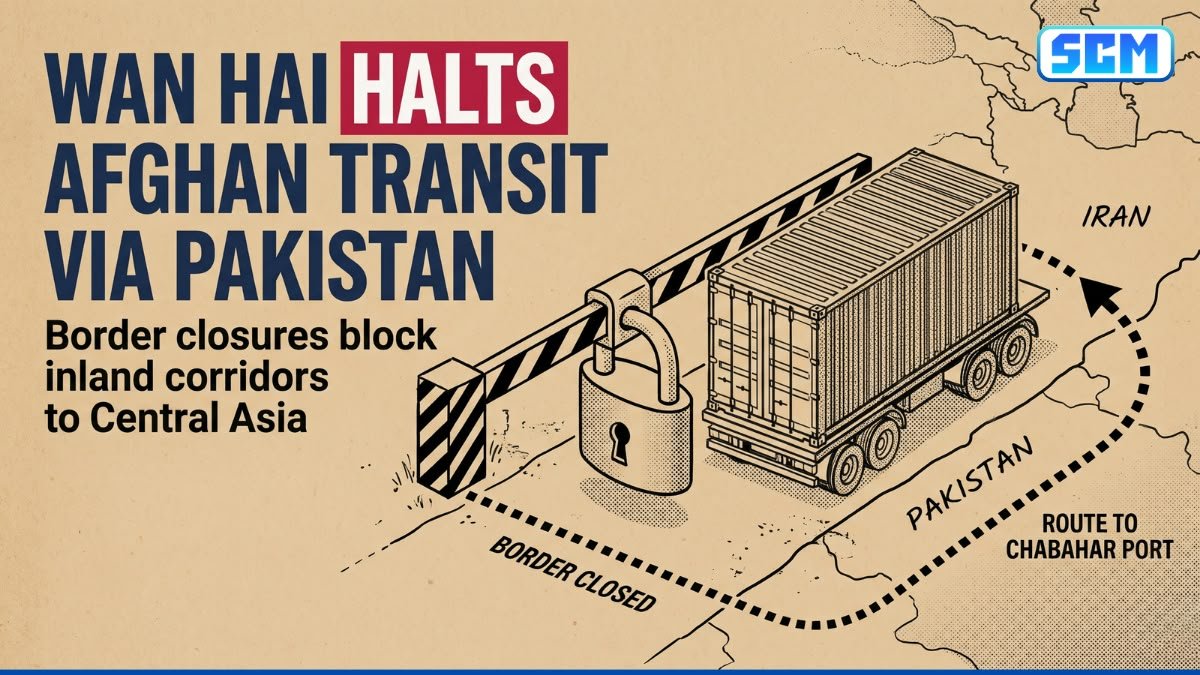
The regional shipping industry is facing another setback as Wan Hai Lines suspends bookings for cargo destined for Afghanistan and Central Asian markets through Pakistani ports. The decision follows prolonged disruptions along the Pakistan–Afghanistan border, creating fresh challenges for importers, exporters and freight forwarders that rely on these routes.
The reported restriction affects containers discharged at Pakistani ports for onward transit to Afghanistan and selected Central Asian destinations, including Uzbekistan and Kazakhstan. It also covers shipments for which customers or third parties independently arrange inland transportation.
The suspension adds pressure to an already disrupted logistics network, where border closures, cargo delays and rising transportation costs have made regional trade increasingly difficult. Businesses must now reassess shipping routes and verify service availability before confirming new bookings.
Key Highlights
- Wan Hai Lines has suspended bookings for specified Afghanistan and Central Asia transit cargo routed through Pakistani ports.
- The restriction includes shipments with independently arranged inland transportation.
- Pakistan–Afghanistan border closures have disrupted commercial cargo movements and transit operations.
- Alternative routes through Iran and Central Asia are becoming increasingly important.
- Exporters and freight forwarders should confirm booking acceptance, transit permissions and total logistics costs before dispatching cargo.
Why Has Wan Hai Lines Suspended Cargo Bookings?
The main reason behind the suspension is the continued disruption of commercial transportation between Pakistan and Afghanistan.
Major border crossings, including Torkham and Chaman, faced closures following deadly clashes in October 2025. These disruptions affected bilateral trade and the movement of transit cargo destined for Afghanistan and neighbouring Central Asian markets.
Under normal conditions, international shipments can arrive at Pakistani ports before moving inland by road to their final destinations. However, when border access becomes uncertain, shipping lines face difficulties guaranteeing the onward movement of containers.
Wan Hai’s reported restriction is particularly significant because it also covers cargo for which customers or third-party logistics providers arrange inland transportation independently. Arranging a separate trucking service does not automatically make a shipment eligible under the carrier’s booking conditions.
The decision highlights a critical challenge for regional logistics: ocean transportation cannot provide a reliable end-to-end service when the inland corridor needed to complete the shipment remains disrupted.
Pakistan–Afghanistan Border Closure Disrupts Regional Trade
Pakistan has historically served as an important maritime gateway for Afghanistan, a landlocked country that depends on neighbouring countries for access to international shipping networks.
Cargo arriving at Pakistani ports can be transferred to trucks for onward movement into Afghanistan. The same transit infrastructure has also supported trade serving parts of Central Asia.
This operating model depends on predictable border access, customs procedures, transportation capacity and coordination between shipping lines and inland logistics providers.
When border crossings close, containers may remain at terminals or designated inland locations while importers face uncertainty over delivery schedules and additional charges.
Other shipping companies have also issued advisories concerning the disruption. CMA CGM Pakistan warned customers in December 2025 against planning new Afghan and CIS transit bookings amid border closures and stranded containers. Hapag-Lloyd also reported in January 2026 that commercial transit containers were being held at port and border locations pending further instructions.
Wan Hai’s latest decision adds another restriction for businesses attempting to use Pakistan as a gateway to Afghanistan and Central Asia.
Afghan Transit Trade Faces Growing Pressure
The disruption has affected the volume and reliability of Afghanistan’s transit trade.
Industry reports cited approximately 11,592 Afghan transit containers, valued at around US$367 million, during FY2025–26. The same reporting compared this with nearly 89,000 containers in an earlier period.
These figures illustrate the potential consequences of prolonged disruption for a trade corridor that connects international shipping services with landlocked markets.
The impact extends beyond shipping companies and port operators. Trucking companies, customs agents, freight forwarders, warehouses and trading businesses also depend on predictable cargo movements.
Prolonged delays can create several operational and financial problems:
- Higher logistics costs: Additional handling, storage and inland transportation expenses can increase the overall cost of moving goods.
- Delivery delays: Businesses may struggle to meet customer commitments when cargo cannot cross the border as scheduled.
- Working capital pressure: Payments and inventory investments remain tied up while shipments wait for onward movement.
- Inventory shortages: Importers may experience stockouts when essential goods arrive later than expected.
- Contractual disputes: Delays can create disagreements over delivery obligations, demurrage, detention and other charges.
The actual impact depends on the cargo, route, carrier conditions and contractual arrangements. Businesses should obtain shipment-specific cost estimates rather than assume that every consignment will face the same charges.
Alternative Shipping Routes Gain Importance
With the Pakistani transit corridor under pressure, Afghanistan has increasingly explored alternative routes to maintain international trade.
Reuters reported in January 2026 that Afghan traders were using Iran’s Chabahar Port and expanding overland movements through Uzbekistan, Turkmenistan and Tajikistan to reduce the impact of Pakistan’s border closures.
These alternatives can provide additional routing options, but they do not necessarily offer the same cost, capacity or transit time as the established Pakistani corridor.
1. Iran and Chabahar Port
Chabahar Port provides Afghanistan with maritime access through Iran and is an important alternative gateway for regional trade.
Businesses considering this route should evaluate vessel availability, port handling arrangements, inland transportation, customs requirements and applicable regulatory restrictions.
The suitability of Chabahar depends on the final destination, available services and the total cost of moving cargo from the port to the consignee.
2. Overland Routes Through Central Asia
Transport connections through Uzbekistan, Turkmenistan and Tajikistan can support cargo movements into Afghanistan and wider Central Asian markets.
These routes may help businesses diversify their transportation options and reduce dependence on a single transit corridor.
However, route selection requires careful assessment of border conditions, road and rail availability, transit permissions and documentation requirements.
3. Air Freight for Urgent Shipments
Air freight may be suitable for high-value, urgent or perishable goods when appropriate services are available.
Its higher transportation costs generally make it unsuitable as a direct replacement for large volumes of containerised cargo. Businesses should therefore consider air freight selectively, based on shipment value, urgency and delivery requirements.
What the Suspension Means for Indian Exporters and Freight Forwarders
The latest development is relevant to Indian exporters serving Afghanistan and Central Asian markets through regional shipping and transit networks.
A route that was commercially viable before the disruption may become more expensive or unreliable when border closures introduce additional handling, longer inland journeys or uncertain delivery schedules.
Indian exporters, importers and freight forwarders should take several precautions before confirming shipments.
1. Confirm carrier booking acceptance
Contact the shipping line or its authorised representative to verify whether the cargo, destination and proposed transit route are permitted under current booking conditions.
2. Review the complete transportation route
Evaluate the entire movement, including ocean freight, port discharge, inland transportation, customs transit and final delivery. Do not assess a shipment solely on the basis of the ocean freight rate.
3. Calculate total logistics costs
Compare freight, terminal handling, storage, inland transportation, transit charges and potential delay-related expenses across available routes.
4. Verify customs and transit documentation
Confirm the applicable customs declarations, transit permissions and destination-specific documentation requirements with the relevant authorities and logistics partners.
5. Communicate realistic delivery timelines
Inform customers about revised transit estimates and unresolved routing risks. Avoid promising delivery dates until the transportation plan has been confirmed.
6. Maintain alternative routing plans
Evaluate alternative ports and transport modes where they are operationally feasible and commercially competitive.
These measures can help businesses avoid dispatching cargo against a route that cannot be completed as planned.
A Wider Lesson for Regional Supply Chains
Wan Hai’s booking suspension highlights a major vulnerability in transit-dependent logistics networks: access to a seaport does not guarantee access to the final market.
For landlocked countries, international trade depends on coordination between shipping lines, ports, customs authorities, road and rail networks, and neighbouring countries.
When one part of this network becomes unavailable, businesses may need to reroute cargo across several jurisdictions. This can increase costs, extend transit times and create additional administrative requirements.
The disruption also reinforces the importance of supply chain diversification and shipment visibility. Businesses that maintain alternative routing options, monitor border conditions and communicate early with logistics partners are better positioned to respond to sudden changes.
Digital shipment tracking, automated exception alerts and proactive carrier communication can help logistics teams identify delays earlier and make informed routing decisions.
Over time, some businesses may continue using alternative corridors even after the Pakistani route becomes operational again. However, this will depend on comparative freight rates, transit reliability, available capacity and border conditions.
What Happens Next?
The next important developments will include any changes to Pakistan–Afghanistan border operations, further shipping-line advisories and improvements in the reliability of alternative trade corridors.
Until the affected routes become dependable again, businesses should not assume that new bookings through Pakistani ports will be accepted for destinations covered by Wan Hai’s restriction.
For importers, exporters and freight forwarders, the immediate priority is to verify route availability, review shipment costs and maintain realistic delivery commitments.
The bottom line: Wan Hai’s suspension highlights the risks of relying on a single transit corridor to reach Afghanistan and Central Asia. Route diversification, accurate cost planning and early coordination with shipping lines will be essential while regional trade remains disrupted.
Frequently Asked Questions
Why has Wan Hai Lines suspended bookings for Afghan cargo via Pakistan?
Wan Hai Lines has suspended the affected bookings amid continuing Pakistan–Afghanistan border disruptions that have made onward cargo transportation uncertain.
Which destinations are affected by the suspension?
The reported restriction covers Afghanistan and selected Central Asian destinations, including Uzbekistan and Kazakhstan, when containers are routed through Pakistani ports for onward transit.
Does the suspension mean Karachi Port is completely closed?
No. The reported restriction concerns specified transit cargo and destinations. It does not mean that all shipping operations at Karachi Port or Port Qasim have stopped.
What alternative routes can businesses consider?
Depending on the final destination and available services, businesses can evaluate Chabahar Port in Iran, overland connections through Central Asia or air freight for selected urgent shipments.
How can freight forwarders minimise disruption risks?
Freight forwarders should confirm carrier acceptance, validate transit arrangements, compare total logistics costs, verify customs requirements and communicate revised delivery schedules before dispatching cargo.
