


Quick Summary
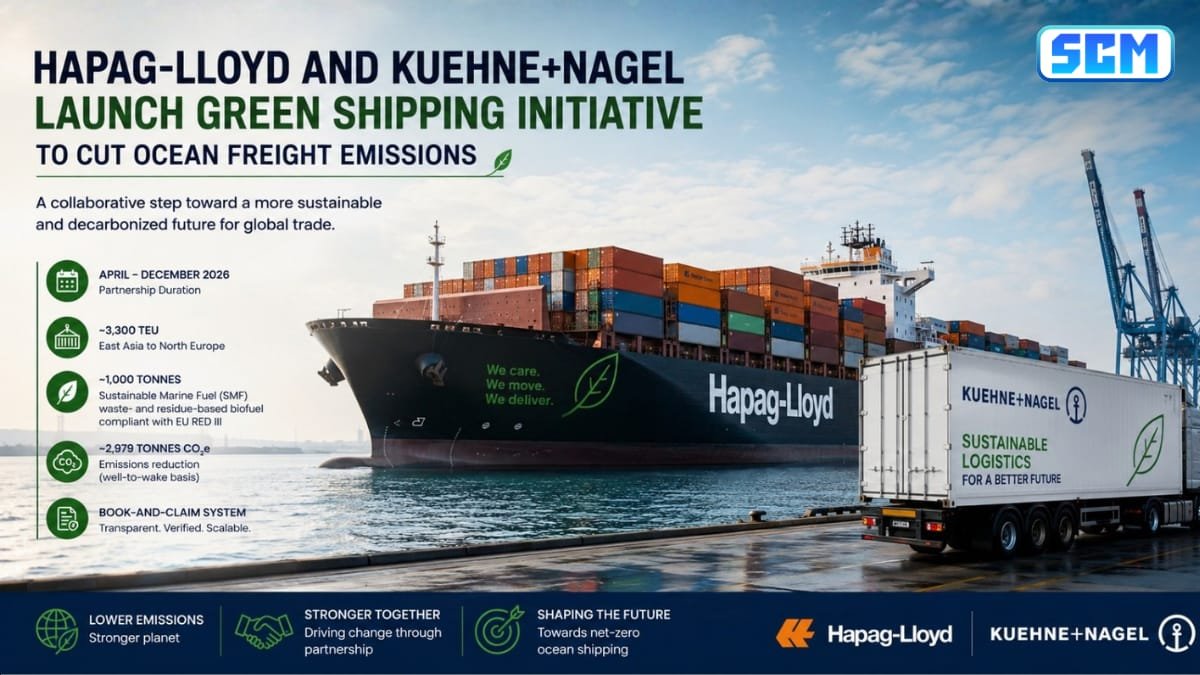
Hapag-Lloyd and Kuehne+Nagel have announced a collaborative sustainable ocean freight initiative covering East Asia–North Europe shipments from April through December 2026. The partnership will use approximately 1,000 tonnes of waste-based sustainable marine biofuel to move around 3,300 TEU of cargo under Hapag-Lloyd’s “Ship Green” program — cutting an estimated 2,979 tonnes of CO₂ equivalent emissions on a well-to-wake basis. The numbers are modest relative to global shipping volumes. But the structure of the deal — a major ocean carrier and one of the world’s largest freight forwarders jointly committing to measurable emission reduction through a certified fuel accounting system — is the part worth paying attention to.
What the Deal Actually Involves
The mechanics matter here because they reveal something important about how the shipping industry is approaching decarbonisation in practice.
Kuehne+Nagel will use Hapag-Lloyd’s “Ship Green” service for selected shipments on the East Asia–North Europe corridor. The fuel being used is derived from waste and residue-based biofuel sources — not virgin crop-based fuels — and complies with the European Union’s RED III sustainability framework, which sets standards for what qualifies as a genuinely renewable transport fuel.
The emission reduction calculation uses a well-to-wake methodology, which tracks emissions through the entire fuel lifecycle — from how the fuel is produced and transported, to how it is burned onboard. This is a more rigorous measurement standard than a simple tailpipe or exhaust comparison, and it matters because it closes the accounting loophole of using fuels that appear clean at the point of combustion but carry significant upstream emissions.
The 2,979 tonnes of CO₂ equivalent reduction projected from this initiative is not a large number in the context of global shipping — a single large container vessel can emit that amount in a matter of weeks. But it is a verified, accounted, real reduction — and that distinction is increasingly what separates credible sustainability initiatives from greenwashing.
Why Sustainable Marine Fuel Matters
The shipping industry contributes nearly 3% of global carbon emissions, making decarbonization one of the sector’s biggest priorities over the next two decades. While long-term solutions such as green methanol, ammonia-powered ships, and hydrogen propulsion are still developing, sustainable marine biofuels are currently among the most practical and scalable alternatives available.
Unlike conventional bunker fuel, sustainable marine fuel significantly lowers lifecycle emissions because it is produced from renewable waste materials rather than fossil fuels.
For shipping companies, biofuel adoption offers an immediate pathway toward meeting emission reduction targets without requiring complete fleet replacement or new vessel technologies.
This makes initiatives like the Hapag-Lloyd and Kuehne+Nagel partnership especially important, as they demonstrate how sustainability measures can already be integrated into existing global shipping operations.
The “Book-and-Claim” System — What It Means for Freight Buyers
One of the more technically significant aspects of this partnership is its use of the book-and-claim accounting model — and it is worth explaining clearly because it is becoming the dominant framework for sustainable fuel adoption in shipping, and it works differently from what most cargo owners might assume.
Under a book-and-claim system, the sustainable fuel used in this initiative does not necessarily power the specific vessel carrying Kuehne+Nagel’s cargo. Instead, Hapag-Lloyd introduces the sustainable fuel into its fleet operations at whatever point is logistically optimal, and the verified environmental benefit — the actual CO₂ reduction — is digitally allocated to Kuehne+Nagel’s shipments through a certified carbon accounting process.
This approach exists because shipping fuel logistics make direct fuel-to-cargo matching impractical at scale. A vessel bunkering in Singapore may carry cargo bound for twenty different customers across multiple forwarders. Requiring each customer’s cargo to physically travel on a vessel powered exclusively by sustainable fuel would make scaling impossible.
Book-and-claim solves this by separating the physical fuel purchase from the carbon accounting — the environmental attribute is real and verified, even if the fuel and the specific cargo don’t travel together. For freight buyers and their sustainability teams trying to report Scope 3 emissions reductions, this matters: the claim is auditable, not just a carrier’s word.
Why This Partnership Structure Is Different From Solo Carrier Programs
Most sustainable fuel programs in shipping have historically been carrier-driven — a shipping line offers a green surcharge option, individual customers opt in or out, and volumes remain low because uptake is fragmented.
What the Hapag-Lloyd–Kuehne+Nagel structure does differently is bring a major freight forwarder’s volume aggregation capability into the equation. Kuehne+Nagel manages freight for thousands of importers and exporters globally. By committing a block of volume — 3,300 TEU — to the Ship Green program as part of its own offering, Kuehne+Nagel can potentially package sustainable shipping as a service option for its own customers without requiring each individual shipper to separately negotiate with Hapag-Lloyd.
This aggregation model is arguably more scalable than direct shipper opt-in programs, because it inserts sustainability into the forwarder’s existing commercial relationship with cargo owners rather than creating a separate purchasing decision.
What This Means for Indian Freight Forwarders and Exporters
The East Asia–North Europe corridor at the centre of this initiative is one of the world’s highest-volume container trade lanes — and Indian exporters moving goods through transshipment hubs like Colombo, Singapore, or Port Klang to reach European markets are part of this trade ecosystem, even if their cargo originates in India rather than directly from East Asia.
More directly relevant: the sustainability reporting pressure driving this initiative is already reaching Indian exporters. European buyers are increasingly asking Indian suppliers for Scope 3 emission data from their supply chains, including ocean freight. The EU’s Corporate Sustainability Reporting Directive (CSRD) and Carbon Border Adjustment Mechanism (CBAM) are creating compliance requirements that flow upstream to suppliers in India and other export markets.
For Indian freight forwarders, this partnership signals the direction the market is moving: customers will increasingly expect sustainable freight options as a standard offering, not a premium add-on. Forwarders that can credibly offer verified emission reduction options — through partnerships with carriers running programs like Ship Green — will be better positioned as these requirements intensify.
The Bigger Picture: Biofuels as a Bridge, Not a Destination
It is worth being clear-eyed about what sustainable marine biofuels are and are not in the context of shipping decarbonisation. They are a bridge technology — practically available now, scalable within existing vessel technology, and capable of delivering verified emission reductions. They are not the long-term answer.
The shipping industry’s decarbonisation roadmap ultimately points toward green methanol, green ammonia, and potentially hydrogen propulsion — fuels that can achieve zero or near-zero lifecycle emissions. Hapag-Lloyd itself has been investing in methanol-capable vessels, with a series of dual-fuel container ships on order.
Biofuel initiatives like this one matter in that transition because they build the commercial frameworks, carbon accounting infrastructure, and customer familiarity with paying for sustainability that the next generation of zero-emission shipping will require. A cargo owner who starts tracking and reporting Scope 3 shipping emissions today through a biofuel program is building the internal capability to participate in a green methanol or ammonia-based program in five years.
Bottom Line
The Hapag-Lloyd–Kuehne+Nagel initiative is not a transformative leap in shipping decarbonisation — 3,300 TEU and 2,979 tonnes of CO₂ reduction are modest numbers against the industry’s total footprint. What it represents is something more incremental but arguably more durable: a carrier and a major forwarder building and testing the commercial, logistical, and accounting infrastructure that scalable sustainable shipping will need. For the freight and logistics industry, the significance is less in the numbers and more in the model.
Moving cargo on the East Asia–Europe corridor? Share your experience with sustainable freight options — we are tracking how green shipping demand is developing across major trade lanes.
