


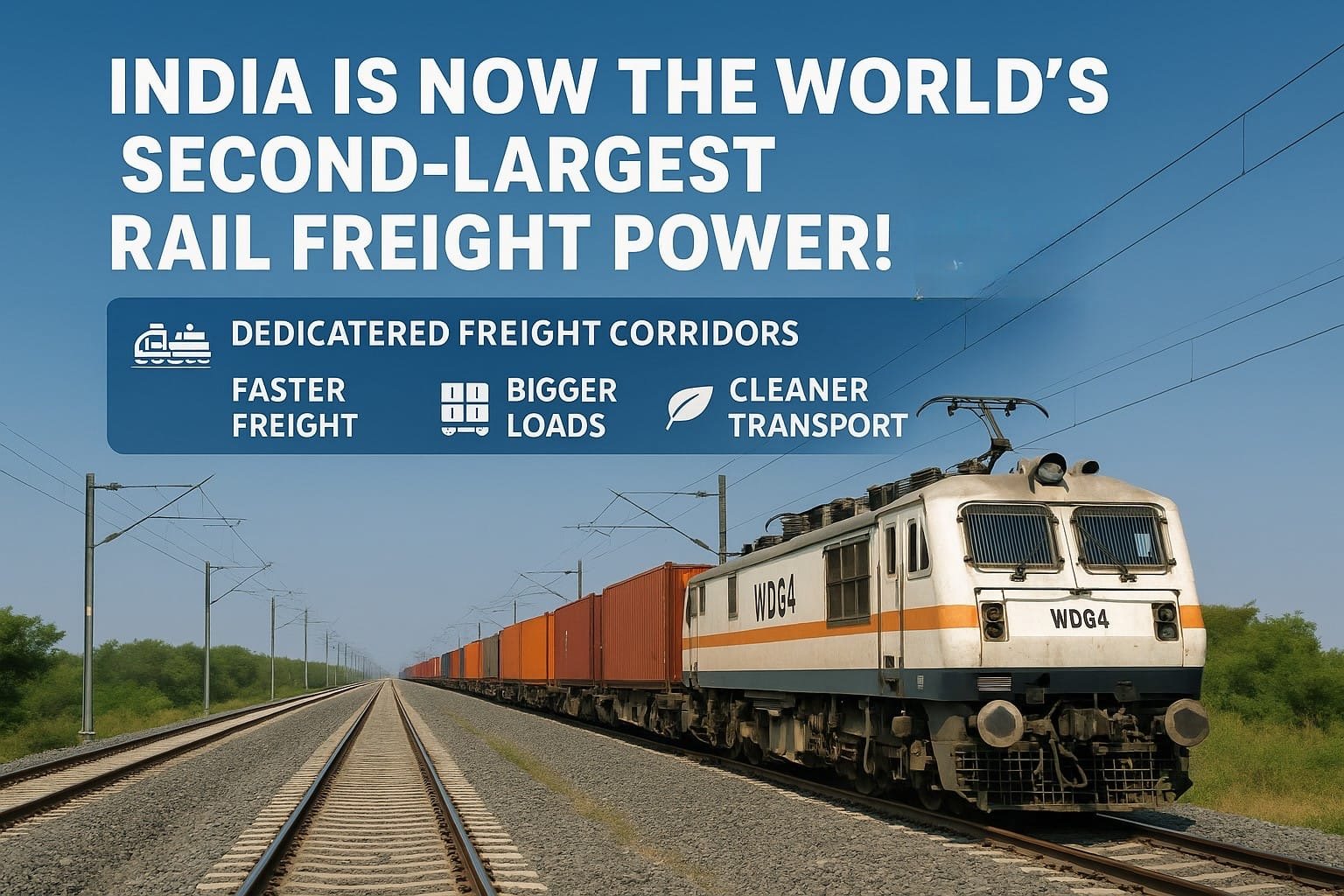
A Big Leap for India’s Railways
India has achieved a major milestone in its transport history — it is now the world’s second-largest rail freight carrier.
In 2024–25, Indian Railways carried around 1.6 billion tonnes of goods, surpassing both the United States and Russia.
Only China moves more cargo by rail than India today.
This growth didn’t happen overnight. It’s the result of major investments, modern infrastructure, and one of India’s most ambitious rail projects — the Dedicated Freight Corridors (DFCs).
What Are Dedicated Freight Corridors?
The Dedicated Freight Corridors are special railway lines built only for goods trains.
Unlike normal railway routes where passenger and freight trains share the same track, DFCs are designed to carry freight faster, safer, and more efficiently.
There are two main corridors:
- Western DFC: Connects Mumbai (JNPT Port) to Dadri (Uttar Pradesh) – about 1,500 km.
- Eastern DFC: Runs from Ludhiana (Punjab) to Sonnagar (Bihar) – around 1,300 km.
Together, these corridors cover nearly 2,800 km across India, linking key industrial and trade hubs.
Most of the network is already operational, with the final sections expected to be ready by the end of 2025.
Why DFCs Are a Game Changer
Before DFCs, freight trains in India moved slowly — often averaging just 20–25 km/h because of traffic from passenger trains.
Now, on the DFCs, freight trains run at 50–60 km/h, cutting travel time by half.
Some key improvements include:
- Faster transit: Goods reach destinations much sooner.
- Heavier loads: Trains can carry more cargo in a single trip.
- Double-stack containers: Two layers of containers per train improve efficiency.
- All-electric routes: Environment-friendly and cost-efficient.
In 2024–25 alone, over 130,000 freight train trips ran on the DFC network — a 47% increase from the previous year.
Boosting India’s Logistics Network
The rise in rail freight has transformed India’s logistics and supply chain landscape.
1. Cheaper and Greener Transport
Transporting goods by rail costs less than by road, especially for long distances.
It also helps reduce fuel use and carbon emissions, making it a greener option for companies.
2. Stronger Connection Between Ports and Factories
The DFCs link major ports, industrial zones, and consumption centers — helping goods move seamlessly from factories to markets and ports for export.
3. Growth Along the Corridors
New freight terminals, logistics parks, and warehouses are being developed along the DFC routes.
This is creating new business opportunities and jobs in nearby regions.
India’s Progress in Numbers
| Year | Freight Volume (Billion Tonnes) | Average Speed (km/h) | Global Rank |
| 2019 | 1.22 | 25 | 4th |
| 2025 | 1.6 | 60 | 2nd |
India now handles nearly 10% of the world’s total rail freight — a massive achievement for the nation’s infrastructure and economy.
Challenges Still Ahead
While the progress is impressive, a few challenges remain:
- Empty return trips: Many trains still travel back without cargo.
- Last-mile connectivity: Efficient links between rail terminals, roads, and ports need further improvement.
- Full completion: Some sections of the Western Corridor are still under construction.
Once these gaps are closed, India’s rail freight system will become even stronger and more reliable.
The Road to the Future
India’s success in rail freight marks the beginning of a new logistics era.
Faster trains, better infrastructure, and sustainable transport are helping the country move goods more efficiently than ever before.
As the Dedicated Freight Corridors reach full capacity, India’s rail network will not only ease road congestion but also reduce logistics costs and emissions — creating a smarter and cleaner transport ecosystem for the future.
Conclusion
India’s journey to becoming the world’s second-largest rail freight carrier shows how powerful infrastructure investment can be.
With Dedicated Freight Corridors changing the way goods move across the country, rail is quickly becoming the backbone of India’s logistics growth.
The success of the DFCs is more than just a transport achievement — it’s a step toward making India a global leader in sustainable and efficient freight movement.
