


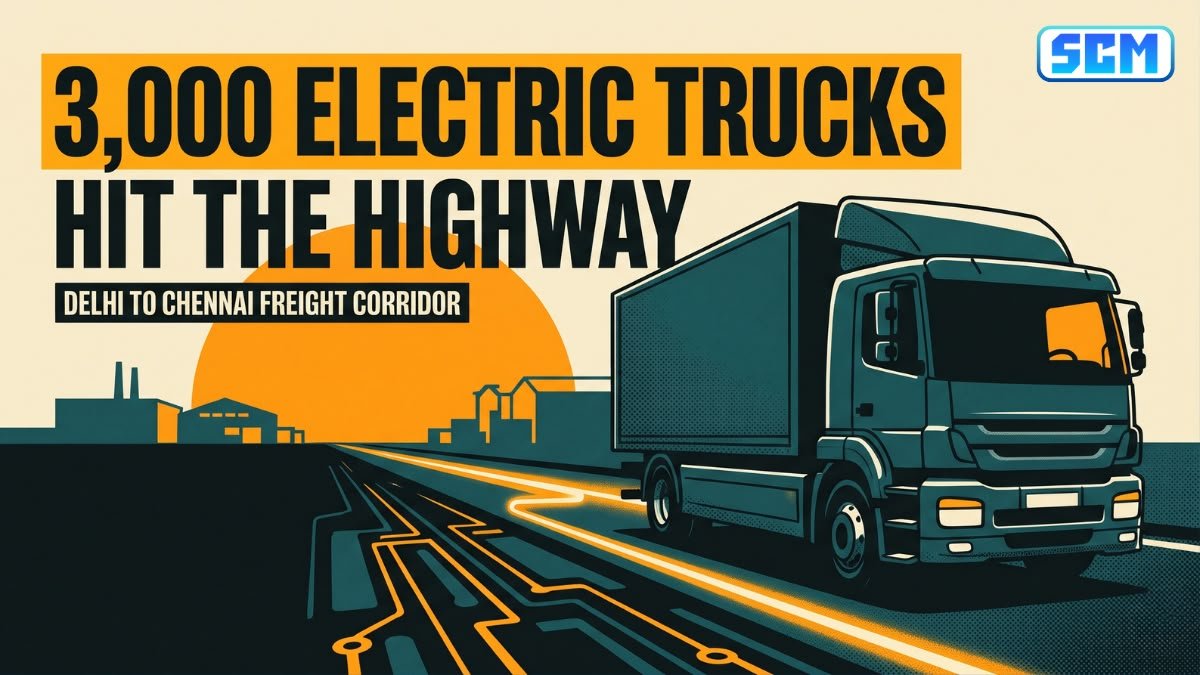
Amazon is taking a major step towards cleaner freight transportation in India. The e-commerce giant has partnered with Tata Motors to introduce 3,000 electric trucks into its logistics operations over the next three years. The initiative, announced on October 27, 2026, will extend electric mobility beyond last-mile deliveries to the movement of goods between warehouses, fulfilment centres and distribution hubs.
The first vehicles were flagged off in Delhi, marking the beginning of a wider rollout across the country. The companies also plan to expand operations along major freight routes, including the Delhi–Bengaluru–Chennai corridor.
The development signals a growing shift in India’s commercial vehicle market, where electric trucks are increasingly being considered for regular freight operations rather than limited pilot projects.
Key Highlights
- 3,000 electric trucks: Planned deployment across Amazon’s Indian logistics network over three years.
- Initial rollout: The first vehicles were introduced in Delhi on October 27, 2026.
- Vehicle model: The initial deployment includes Tata Ultra E.7 electric trucks.
- Freight corridor: Expansion plans include the approximately 2,800-km Delhi–Bengaluru–Chennai route.
- Charging facilities: Supporting infrastructure will be developed to facilitate fleet operations.
- Operational focus: The vehicles will primarily support middle-mile transportation.
Amazon–Tata Motors Partnership: What Is the Plan?
Under the partnership, Tata Motors will supply electric commercial vehicles for Amazon’s transportation requirements. Amazon’s carrier partners will own and operate the trucks as part of its wider delivery network.
This arrangement allows Amazon to expand its use of electric vehicles while working with existing transportation partners. Tata Motors will contribute its commercial vehicle manufacturing and servicing capabilities, while charging infrastructure and operational support will help integrate the fleet into daily logistics activities.
The initial rollout focuses on light- and medium-duty electric trucks. Further expansion is expected to cover additional cities and major highway routes.
The three-year deployment timeline also provides an opportunity to assess how battery-powered commercial vehicles perform under real operating conditions, including varying cargo loads, road conditions and delivery schedules.
Why Amazon Is Moving Beyond Electric Delivery Vans
Electric vehicles have already started gaining ground in urban delivery operations. However, moving larger volumes of goods between warehouses and distribution centres presents a different challenge.
This stage of the supply chain is commonly known as middle-mile logistics. It connects fulfilment facilities with regional hubs and helps maintain the flow of products before they reach customers.
Amazon’s latest initiative targets this important part of its transportation operations.
1. Reducing Transportation Emissions
Diesel-powered trucks contribute to air pollution and greenhouse gas emissions. Battery-electric vehicles produce no tailpipe emissions while operating.
Replacing suitable diesel-powered journeys with electric alternatives could reduce the environmental impact of freight movement. However, the overall emissions benefit also depends on the electricity source, battery production and vehicle lifecycle.
The initiative supports Amazon’s wider Climate Pledge commitment to achieve net-zero carbon emissions across its operations by 2040.
2. Managing Growing E-commerce Volumes
India’s e-commerce market generates substantial demand for transportation between fulfilment centres, sorting facilities and delivery stations.
During festive sales and promotional periods, shipment volumes can rise sharply, placing additional pressure on transport capacity.
A larger electric fleet could help Amazon handle these movements while reducing dependence on conventional fuel-powered vehicles. Maintaining delivery schedules will depend on efficient route planning and access to charging facilities.
3. Evaluating Long-Term Operating Costs
Fuel and maintenance expenses are important considerations for logistics companies.
Electric trucks may offer savings through lower energy costs and fewer conventional powertrain components. However, their overall financial performance depends on several factors:
- Initial vehicle purchase or financing costs.
- Electricity tariffs and charging expenses.
- Daily distance travelled.
- Battery performance and replacement costs.
- Vehicle utilisation and maintenance.
- Availability of charging facilities.
For fleet operators, total cost of ownership (TCO) is more useful than comparing vehicle purchase prices alone.
Delhi–Bengaluru–Chennai Corridor: A Major Expansion Route
One of the important elements of the initiative is the proposed expansion along the approximately 2,800-km Delhi–Bengaluru–Chennai corridor.
The route connects several major commercial and industrial markets across India. It is relevant to e-commerce distribution, manufacturing supply chains and the movement of consumer goods.
However, operating electric trucks across long distances requires careful coordination between vehicle range, charging locations and transport schedules.
The companies are planning supporting charging facilities, including infrastructure development with charging provider Yahhvi. Reports have also referred to plans for 10 charging yards across India.
For commercial operators, the effectiveness of this infrastructure will depend on:
- Strategic placement near freight routes and logistics hubs.
- Sufficient charging capacity for commercial vehicles.
- Reliable electricity connections.
- Minimal waiting time during charging.
- Maintenance and technical support.
These facilities will play an important role in determining how efficiently the fleet can operate beyond city limits.
Tata Ultra E.7: The Electric Truck Behind the Initial Rollout
The initial deployment includes Tata Ultra E.7 electric trucks, designed for commercial goods transportation.
The model features several technologies intended to support day-to-day freight operations.
Key reported features include:
- Integrated e-axle: Combines electric drive components to deliver propulsion.
- CCS2 fast charging: Supports charging through the Combined Charging System 2 standard.
- Regenerative braking: Recovers some energy during braking and deceleration.
- High-voltage safety systems: Supports the safe operation of electrical components.
- Crash-tested cabin: Provides a safety-focused cabin structure.
For logistics businesses, selecting an electric commercial vehicle requires more than checking its advertised range. Payload capacity, daily route distance, charging time and operating conditions must all be considered.
The availability of servicing facilities and trained technicians will also influence vehicle uptime as the fleet expands.
What This Means for India’s Logistics Industry
The announcement has implications beyond Amazon’s own transportation operations. Large-scale commercial deployments can encourage other logistics companies to evaluate electric vehicles for suitable freight routes.
Greater focus on middle-mile electrification
Electric mobility in logistics has largely attracted attention through smaller delivery vehicles. The latest initiative brings greater attention to the trucks connecting warehouses, fulfilment centres and regional distribution hubs.
This is an important development because middle-mile transportation handles significant cargo movement within large distribution networks.
Changing requirements for fleet operators
Amazon’s carrier partners will need to adapt their operating models to accommodate battery-powered vehicles.
This may involve:
- Introducing charging schedules into dispatch planning.
- Monitoring battery levels and vehicle performance.
- Training drivers in electric vehicle operations.
- Identifying routes suitable for electrification.
- Coordinating maintenance and charging support.
Fleet management software can help transport operators monitor vehicle location, energy consumption, charging status and trip performance.
Opportunities for charging infrastructure providers
The expansion of commercial EV fleets could create additional demand for depot charging, highway charging stations and dedicated facilities for heavy-duty vehicle operations.
Infrastructure providers will need to consider freight traffic patterns rather than simply installing chargers wherever land is available.
More attention to emissions reporting
Businesses are increasingly examining emissions across their supply chains, including transportation and distribution.
Electric fleet data can help companies track energy consumption and estimate reductions in tailpipe emissions. Accurate reporting will require reliable information about vehicle usage, electricity sources and conventional fuel consumption.
Challenges That Could Affect the Expansion
Despite the potential benefits, large-scale adoption of electric trucks involves several operational challenges.
Charging availability: Insufficient charging points can disrupt delivery schedules, particularly on longer routes.
Initial investment: Electric commercial vehicles and charging facilities may require significant upfront capital.
Vehicle range and payload: Operators must ensure that battery performance meets the requirements of their cargo and route conditions.
Charging time: Longer charging periods can affect daily vehicle utilisation if they are not incorporated into transport schedules.
Power supply: Charging yards require suitable electricity connections, especially when several vehicles need to charge simultaneously.
Maintenance support: A reliable service network and access to spare parts will be necessary to maintain fleet availability.
The commercial success of the initiative will ultimately depend on whether electric trucks can meet the operational and financial requirements of regular freight transportation.
India’s Green Freight Transition Gains Momentum
India’s electric mobility transition is gradually extending into commercial transportation.
Government programmes such as PM E-DRIVE and state-level electric vehicle policies are part of the wider policy environment supporting electric mobility and charging infrastructure.
Delhi’s EV policy is another relevant development, with specific provisions for eligible electric commercial vehicles.
However, the Amazon–Tata Motors initiative is a commercial fleet expansion rather than a government-funded vehicle deployment. Its significance lies in the demand it could generate for electric trucks, charging facilities and related services.
Large logistics networks can provide vehicle manufacturers with valuable operating data and help identify which vehicle categories and routes are commercially suitable for electrification.
What Happens Next?
The coming three years will be important in determining how quickly the planned 3,000-vehicle fleet enters regular operations.
Industry observers will be watching several indicators:
- The pace of vehicle deployment across Indian cities.
- Expansion of charging facilities along major highways.
- Performance under different cargo and road conditions.
- Vehicle utilisation and operating expenses.
- The extent to which electric trucks replace conventional vehicles.
The results could influence investment decisions by other e-commerce businesses, third-party logistics providers and fleet operators considering similar transitions.
Conclusion
Amazon and Tata Motors’ plan to introduce 3,000 electric trucks marks an important development for India’s commercial transportation sector.
The initiative moves the conversation beyond electric delivery vans and towards the larger challenge of electrifying freight movement between cities and logistics facilities.
While vehicle availability is an important first step, charging infrastructure, operating costs and fleet reliability will determine the programme’s long-term success.
For India’s logistics industry, the partnership offers an opportunity to evaluate how electric commercial vehicles can become part of everyday freight operations while supporting the transition towards cleaner transportation.
